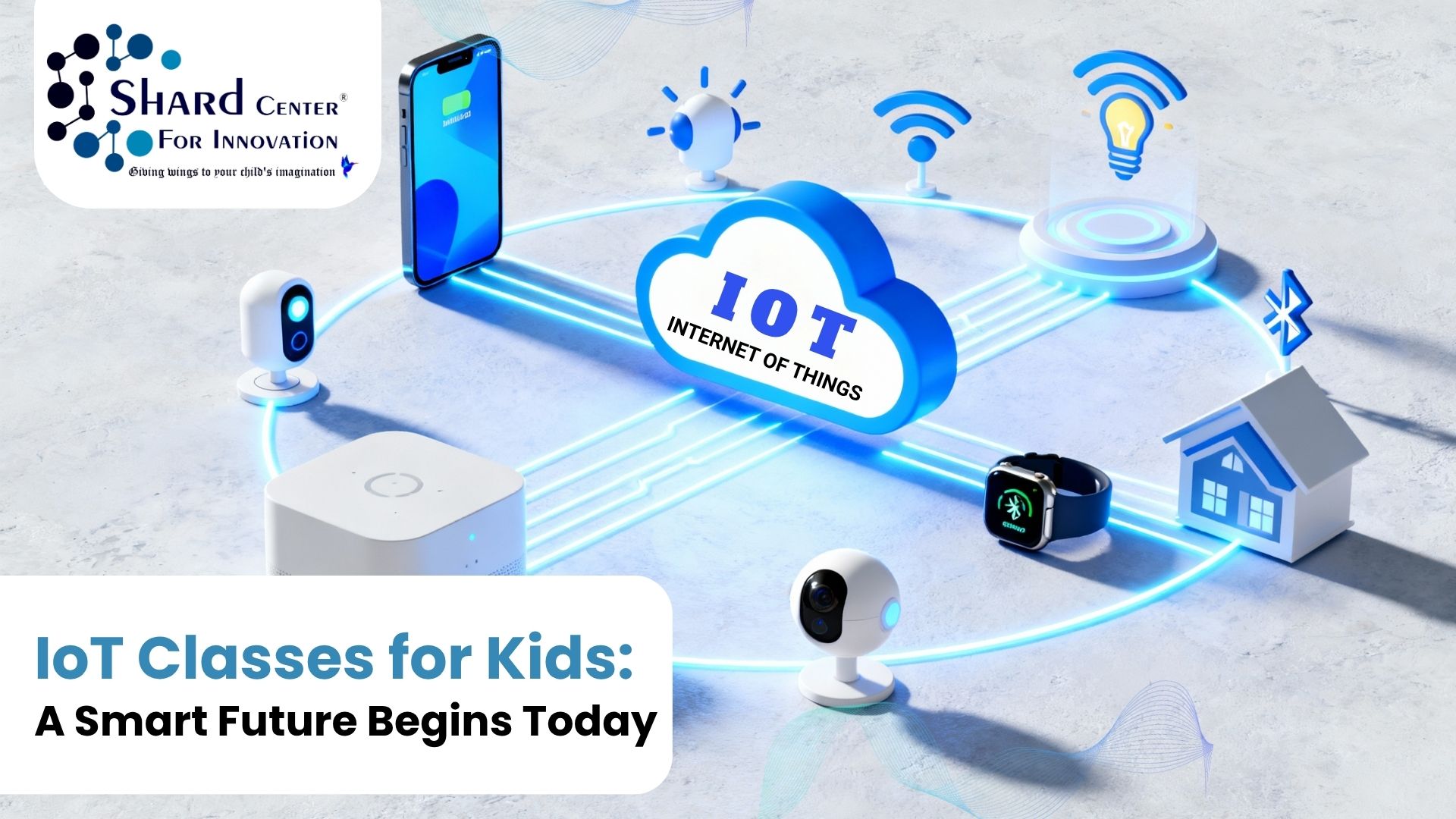
Today’s children are growing up surrounded by technology, not just traditional toys. With smart speakers, smart watches, and more, technology shapes their world. This is where IoT Classes for Kids step in, helping children understand how the everyday devices around them communicate, interact, and collaborate.
Here on this blog, you will learn about IoT, why children need to learn at an early age, how they can easily begin learning, and how SCIL can help your child confidently join the world of future technology. Hold on until the end, and you will have a simple roadmap for helping your child start their journey into the IoT today.
What is IoT, and why should kids learn it?
IoT, short for Internet of Things, is a system in which devices are connected to the internet. Smart fans that automatically switch on, lights that can be switched on by voice, and security cameras that you can view on your phone are all examples of IoT.
Essentially, IoT enables devices to sense, transmit, and receive information, which simplifies and makes life smarter. Such technology will greatly shape our future, and children taught about the IoT early will be able to adapt to the world of smart technology and automation tomorrow.
Statista has indicated that the number of IoT devices utilized in the world by 2030 is more than 30 billion and is set to operate homes, cities, and industries.
Therefore, educating children in IoT today is training them to be problem solvers and creative thinkers of new smart solutions tomorrow.
What kids learn in IoT Classes for Kids:
In the classes, kids learn everything they need to know to build the technology for a better tomorrow. Some of the major ones include:
Basic electronics
Sensor functions
Coding for devices
Smart systems and automation.
Real-world problem-solving
Children are not taught how to use the devices, but they are taught how to make them. And that is a great virtue of the future.

Benefits of Teaching IoT to Kids Early
IoT develops innovation and rationality. It educates children not to view technology as a game but as a way to make the world different.
Enhances innovation—kids design and create smart objects.
Promotes problem-solving—they reason, test, and solve real-life problems.
Increases confidence—kids realize that their ideas can be applied in reality.
Become tech literate—at a young age, they are knowledgeable of modern technology.
Enables the future—readiness for future tech careers.
The World Economic Forum has shown that one of the highest talents of the future workforce will be technology fluency. Young children who are taught IoT develop a culture of creativity and exploration, which is required in any discipline.
IoT is not merely a subject, but it will be a way in which children can innovatively perceive the world.
How Kids Can Start Learning IoT (Step-by-Step)
You may think that learning IoT may be complicated, but it can be easy and fun with the proper guidance and starting with basic and entertaining methods.
Step-by-Step Path:
Step 1: Master the basics of electronics.
Step 2: Learn about sensors (motion, light, sound, temperature)
Step 3: Begin block-based coding (scratch-style)
Step 4: Develop small automation projects.
Step 5: Transfer to actual device coding (Arduino, Micro: bit, Raspberry Pi)
Fun IoT Projects Kids Can Build:
Smart plant watering system
Motion-activated night light.
Temperature alert device
Smart doorbell
Home automation mini system
Children are learners and not memorizers. That is what makes IoT interesting and successful. With the help of regular study and training, a child will be able to become a beginner and then a young innovator.
How SCIL Helps Kids Learn IoT Easily
The SCIL (Shaard Centre of Innovation) has been assisting children in attaining technology skills by organizing learning programs. We provide interactive IoT classes to kids to make them easy, practical, and engaging as well. Children are taught using real-life projects, graphic learning, and programmable devices.
Why parents choose SCIL:
Beginner-friendly learning
Live and practical sessions
Step-by-step projects
Center on innovation and interest.
Training educator mentorship.
We also provide AI, robotics, and coding classes to enable children to have a solid background in future technologies. Children who study at SCIL do not just know about IoT; they create working objects and also become technologically confident.
We not only make kids ready to work with smart devices but also to invent them—to form future innovators and leaders.
Conclusion
The future is of intelligent creators, not only intelligent device users. IoT empowers children to create technology that has real solutions. The sooner the better, be regular, and have your child become a tech-thinker who is even confident. Want to get your child to be a tech creator?
Join SCIL's IoT Classes Today!
Frequently Asked Questions
Q1. Can young kids learn IoT?
Ans. Yes. The IoT is explained in a straightforward, creative manner that even a novice can comprehend and develop projects.
Q2. Do children require any experience with coding and then learn IoT?
Ans. No. SCIL IoT classes begin with a basic and contain beginner-friendly code.
Q3. What are the learning devices used by kids?
Ans. Children work with safe and simple instruments in the form of sensors, micro-controllers, and student-friendly IoT kits.
Q4. Will the Internet of Things be useful in the career of my child?
Ans. Yes. IoT has an application in all areas, such as healthcare, transport, space, smart home, agriculture, and robotics. Early education will prepare a good future.
Q5. What sets SCIL apart as compared to other institutes?
Ans. SCIL also educates children using real-life projects and interactive methods that develop creativity, reasoning, and confidence among the students.
Related Blogs:
- Data Science for Beginners
- Artificial Intelligence Program in Delhi
- 3D Printing Course for Kids and Beginners: An Ultimate Guide
- Machine Learning and Deep Learning: A Complete Guide to Key Concepts, Differences, and Applications
- How AI Education is Transforming the Way Students Learn?
- Best AI Learning in India: How Kids Can Start Their AI Journey Early
- How EdTech Institutes Empower Young Innovators with STEM Education?