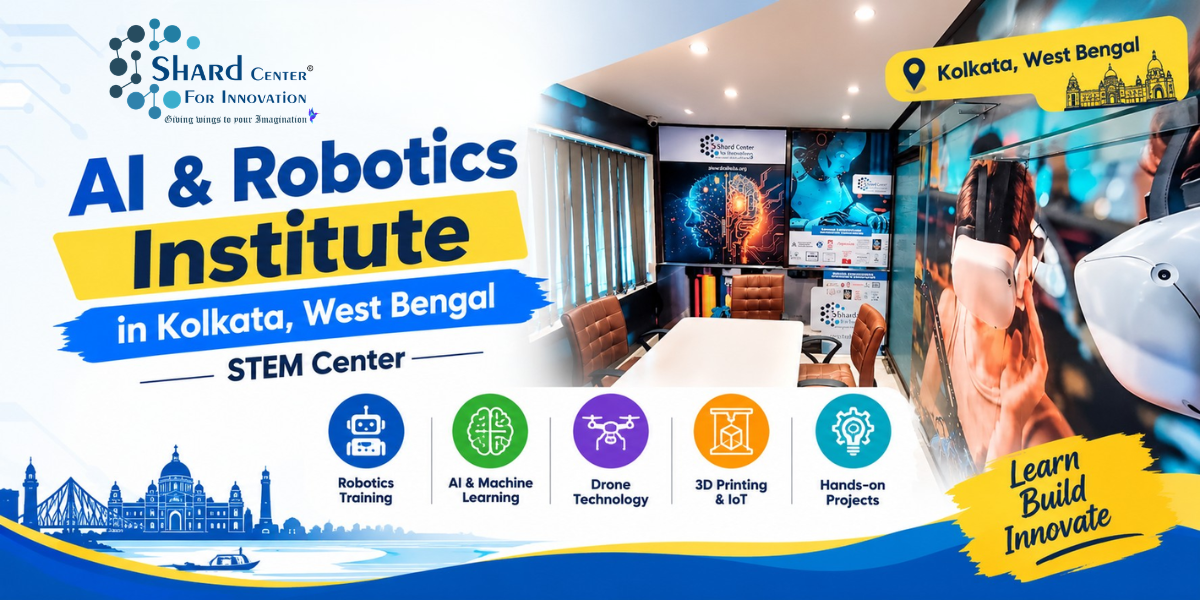
Technology is changing the way students learn, create, and solve problems. AI & Robotics Institute in Kolkata, West Bengal For school students, learning about artificial intelligence, robotics, machine learning, drones, and the Internet of Things becomes more meaningful when they can experiment, build, test, and improve their own projects.
Kolkata provides a practical STEM learning environment where students can explore emerging technologies through hands-on activities, guided projects, and structured learning. As an AI class in Kolkata, SCIL focuses on helping students develop practical technology skills alongside creativity, logical thinking, and problem-solving abilities.
At this STEM Training Institute in Kolkata, students can explore a range of future-focused technology areas, including robotics, artificial intelligence, machine learning, drone technology, IoT, 3D printing, and data science. Project-based activities allow learners to understand how technology works and apply their knowledge to real-world challenges.
Why Project-Based STEM Learning Matters
One of the biggest advantages of project-based learning is that students do not simply receive information—they use it.
For example, a student learning robotics may first understand sensors, then program a robot, test its movement, discover a problem, and modify the code. That process teaches more than the final result. It develops patience, logical reasoning, troubleshooting, and confidence.
Similarly, an AI project can encourage students to understand a problem, collect information, experiment with a solution, and explain their results.
Why practical STEM education can complement traditional classroom learning
AI & ML
Artificial intelligence and machine learning are becoming important areas of modern technology. Introducing these concepts at an appropriate level can help students understand how intelligent systems work.
AI & ML training centers for kids should not focus only on complex theory. A good beginner-friendly program should introduce concepts through simple examples, activities, coding exercises, and projects.
Students can gradually learn about topics such as
Basics of Artificial Intelligence
Machine learning concepts
Automation
Data and patterns
Problem-solving
AI-based applications
The goal should be to develop curiosity and understanding rather than simply memorizing technical terms.
Robotics
Robotics combines several areas of STEM, including programming, electronics, mechanics, sensors, and problem-solving. This makes it an effective way for students to learn by creating something tangible.
Students can start with basic robotic systems and gradually move toward more challenging projects. They can learn how sensors work, control motors, write basic programs, and test how their robots respond to different conditions.
For students comparing the robotics training in India, it is important to look beyond certificates. Practical projects, experienced mentors, appropriate equipment, and opportunities to test ideas are equally important.
Drone Flying
Drones are another interesting way to introduce students to technology and engineering. Learning about drones can combine concepts from electronics, flight, sensors, programming, navigation, and engineering.
Drone flying training for professionals should be age-appropriate and emphasize responsible and safe learning alongside technical concepts.
At SCIL Kolkata, the Drone Technology program includes hands-on assembly and pilot training, giving students an opportunity to understand drone systems through practical learning.
3D Design
3D design enables students to take their creative ideas and put them in a digital format. The best 3D printing courses provide students with hands-on experience of working with 3D modeling software, creating shapes, sizes, visualizations, and designs to aid in developing creativity and imagination amongst them. Students get to learn how 3D digital designs can be transformed into hard copies using 3D printing technology through projects.
Internet of Things
The Internet of Things, or IoT, connects physical devices through sensors, software, and communication technologies. It is a practical area for students because they can see how a physical device responds to information.
Internet of Things courses for students can introduce concepts such as:
Sensors
Microcontrollers
Smart devices
Automation
Data monitoring
Device communication
For example, students could create a basic smart system where a sensor detects a condition and triggers an action. Projects like these help connect coding and electronics with real-world applications.
SCIL's IoT program covers sensors, microcontrollers, data monitoring, automation, and connected systems.
Architecture & Visualization
The course of Architecture & Visualization teaches the students how to form a digital design of an idea. The students will learn to create 3D models, renderings, and spatial designs using their creativity and imagination.
The students will gain from this course by learning the fundamentals of architecture. The students will also acquire skills such as creating visualizations, graphic design, and the utilization of software to conceptualize their designs.
Compositing & VFX
The Compositing & VFX course teaches the students the necessary skills for the composition of imagery, video, animation, and other media. The students will get an opportunity to learn the fundamental components of visual effects, animation, and motion graphics. They will also obtain editing and compositional skills to conceptualize their creative ideas and designs.
AI Certification Courses for Kids
AI classes for school students in India: Certification can be useful when it represents actual learning and project work. However, parents should not select a course only because it offers a certificate.
When considering the AI Certification Courses for beginners, parents can look at:
Course curriculum
Practical activities
Project-based learning
Trainer experience
Learning equipment
Student support
Assessment methods
A meaningful certification should complement practical skills rather than replace them.
Why Choose a Shard Center for Innovation in Kolkata?
Choosing the right best STEM center in Kolkata can give students an opportunity to learn technology beyond traditional classroom concepts. Practical activities can help learners understand programming, electronics, sensors, automation, robotics, and emerging digital technologies through direct experience.
SCIL encourages students to learn by doing. Depending on the program, learners can work on technology projects, experiment with different tools, understand basic programming concepts, and develop solutions to practical problems.
For parents looking for an AI & Robotics Institute in Kolkata, West Bengal, a project-based learning environment can be a useful way to introduce children to emerging technologies while building skills that support their academic and future learning.
Future-Focused STEM Learning in Kolkata
AI & Robotics courses in Kolkata can play an important role in introducing students to technologies that are increasingly relevant across education, research, engineering, and industry. Early exposure to AI, robotics, drones, IoT, and related technologies can encourage curiosity and help students become more confident with technology.
SCIL combines STEM education with practical experimentation so students can move from understanding concepts to applying them through projects. This approach makes learning more interactive and gives students opportunities to explore their ideas in a structured environment.
For parents looking for STEM classes for kids in Kolkata, a project-based learning environment can be a useful way to introduce children to emerging technologies while building skills that support their academic and future learning.
What Students Can Learn at a STEM Center in Kolkata
A well-rounded STEM center can expose students to multiple technology areas rather than limiting them to one subject.
At SCIL Kolkata, students can explore:
Artificial Intelligence & Machine Learning
Robotics
Drone Technology
Internet of Things
3D Printing
Data Science
Design Thinking
3D Animation
Architecture & Visualization
Compositing & VFX
Exposure to different fields can help students discover which areas they enjoy most.
Hands-On Learning at SCIL Kolkata
The learning environment matters as much as the curriculum. SCIL's Kolkata center highlights hands-on access to robotics kits, AI/ML workstations, 3D printing, and a dedicated area for drone-related learning.
Students can learn through practical activities rather than depending entirely on theoretical explanations. This gives them opportunities to experiment, make mistakes, troubleshoot problems, and improve their work.
Building Future-Ready Skills Through STEM
AI, robotics, IoT, drones, and other emerging technologies are influencing many industries. Students do not necessarily need to choose a technology career today, but early exposure can help them understand these fields and develop transferable skills.
Practical STEM education can encourage students to ask questions, experiment with ideas, work in teams, solve problems, and become more confident with technology.
For parents in Kolkata looking for a STEM training institute, Admissions choosing a learning environment that combines structured education with hands-on experience can provide a stronger foundation for future learning.
Conclusion
AI and robotics education is most effective when students get opportunities to learn by doing. From building robots and exploring AI to understanding drones and creating IoT projects, practical experiences can make technology more understandable and engaging.
Shard Center for Innovation's Kolkata center focuses on hands-on STEM education across AI, ML, robotics, drones, IoT, 3D printing, and other emerging technologies. For school students, this kind of exposure can help develop both technical knowledge and important skills such as creativity, logical reasoning, teamwork, and problem-solving.
For parents and students exploring technology education in Kolkata, the right program should ultimately be one that encourages curiosity, practical experimentation, and continuous learning.
Frequently Asked Questions
Q1. What will a student learn at an AI & Robotics Institute in Kolkata?
Ans. Students can learn about AI, machine learning, robotics, coding, drone technology, IoT, 3D printing, and other STEM-related technologies through interactive programs at an AI and Robotics Institute.
Q2. Are students who are new to AI and robotics able to join these programs?
Ans.Yes, students can be introduced to the world of robotics and AI through basic activities and can develop their skills further through advanced activities.
Q3. How can project-based learning benefit students?
Ans.By using a project-based learning approach, students are able to understand concepts better by using trial and error as well as developing and testing their own ideas and projects.
Q4. What factors should a parent consider while enrolling their child in robotics classes?
Ans.A parent can consider factors like curriculum, project-based learning, mentorship, equipment, and support for the students and choose the best robotics classes for their children.
Q5. Can school students learn artificial intelligence?
Ans.Yes, school students can be taught the basics and fundamentals of AI through interactive activities and can develop their skills further with more advanced topics.
Q6. What are the things drones are used for?
Ans.Students can learn about drones and their uses through drone programs and can also learn about various other aspects like sensors and assemblies.
Q7. What are the various benefits of an IoT course for kids?
Ans.An IoT course for kids can teach them about IoT and get them acquainted with various activities related to sensors and microcontrollers and help them develop various skills.
Q8. Why is it important for kids to learn 3D design?
Ans.Learning about 3D design can help kids get accustomed to the designing process, use their creative skills, and develop their design thinking abilities.
Q9. Can kids learn VFX and compositing?
Ans.Kids can learn the basics and fundamentals of VFX and compositing through interactive programs and can learn about various other visual effects and animation.
Q10. Can students benefit from practical STEM education?
Ans.Practically based STEM education can help students develop creativity, critical thinking, coding and programming skills, logical and abstract thinking, collaboration and confidence, and get accustomed to various new technologies and innovations.