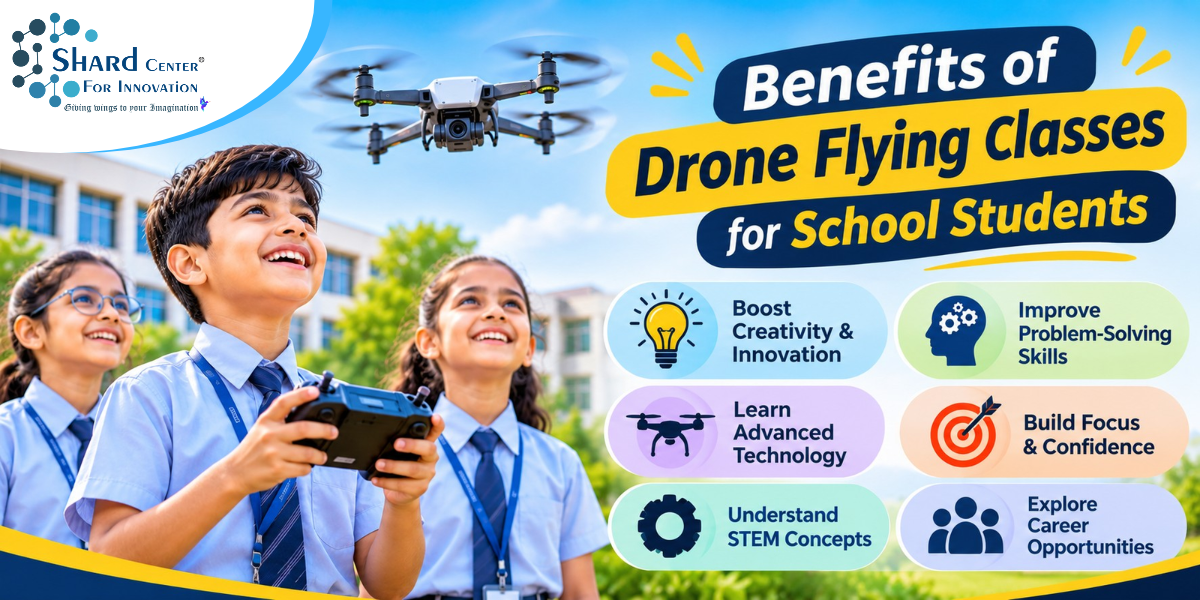
Drone flying is a fun activity that also provides many benefits to students. As students learn to work with drone technology themselves, they become familiar with various aspects of STEM (Science, Technology, Engineering and Mathematics), which improves their interest and skills in this domain. They also enhance their creativity, problem solving and critical thinking skills as they work with drones, making education more future-oriented and fun. Benefits of Drone Flying Classes for School Students discusses in detail the many benefits of flying drones for students.
1. Enhances Understanding of STEM concepts
Making a drone from a DIY kit and learning how to fly it introduces students to many STEM concepts through application from physics, engineering, mathematics, and electronics. Through practical applications, students learn about many concepts from physics, such as motion, aerodynamics and gravity. Drone flying makes STEM learning more fun and interactive for students by encouraging their curiosity, experimentation and ensuring active participation.
2. Develops Problem-Solving Skills and Critical Thinking
Drone flying involves understanding the challenges and limitations to flight. A drone flight is not necessarily successful in the first instance. Students learn to identify problems and develop solutions to them based on their knowledge and experience with drones. They learn to quickly adapt their models to situations and use quick and critical thinking in their drone operations.
3. Promotes Creativity and Innovation
Children develop creativity as they develop different flight patterns, aerial photography, obstacle courses and drone-based projects. Their imagination is honed as they innovate to develop better drone systems and solve problems.
4. Introduces Children to Robotics and Automation
Building drones provides an excellent introduction to robotics, sensors and programming. Students can build more complex drones and other devices by utilising the robotics and coding skills learnt through drone operations, and progress towards autonomous flight and coding. 
5. Builds Confidence, Focus and Concentration
Successfully building a drone gives children immense confidence, along with a sense of achievement as they complete flight challenges. It also develops their focus and concentration as students learn to navigate their drones over unfamiliar terrain with different altitude and speed. Successfully flying the drone requires more attention and grit from students.
6. Encourages Teamwork and Collaboration
As students work together on drone flying projects and competitions, they develop teamwork skills and learn to collaborate with each other. They learn to communicate with each other effectively, share responsibilities, and divide tasks as they work together. They also learn concepts practically beyond the scope of textbooks.
7. Introduces Children to Future Career Opportunities
Children who develop and operate drones are better suited to apply their knowledge in careers which utilise How Drone Activities Help Children Develop Problem-Solving Skills , such as in the fields of agriculture, defense, construction, environmental monitoring and logistics. An early introduction to drones encourages students to make their careers in these fields.
8. Promotes Responsible Technology Use
Students learn to responsibly utilise technology as they follow the safety instructions, respect privacy and understand flight restrictions. Drone technology influences students to master other tech-led fields too.
How Schools Can Introduce Drone Flying
Schools can introduce drone flying as part of their STEM curriculum and practical lab applications, along with programmes such as robotics and coding. They can let their students master basic drone piloting, assemble the drones themselves, be introduced to basic coding required for flying drones and explore applications of drone technology such as aerial photography. Through projects and competitions, students can be encouraged to develop their own ideas about What are Drones and Why They Matter for Kids: A Beginner’s Guide
The Takeaway
Drone piloting is an informative as well as fun activity for students. It enhances their learning and practical understanding across several STEM domains, and promotes practical skills such as critical thinking, creativity, confidence and coordination.
Explore Shard Center for Innovation’s course on drone training today, which equips students with the required scientific skills to fly a drone and prepares them for future careers in drone piloting-aligned industries.
Frequently Asked Questions (FAQs)
Q1. What are drone flying classes for school students?
Ans: Drone flying classes introduce students to drone technology, basic flight controls, navigation, and safe flying practices through practical learning.
Q2. What are the benefits of drone flying classes for students?
Ans: They help develop problem-solving, creativity, hand-eye coordination, logical thinking, and technical skills.Q3. How do drone classes improve STEM learning?
Ans: Drone activities connect science, technology, engineering, and mathematics with practical experiments and real-world applications.Q4. At what age can students start learning drone flying?
Ans: Students can begin with age-appropriate drone activities under proper adult supervision.Q5. Do students need prior technical knowledge to learn drone flying?
Ans: No. Beginners can start with basic concepts and gradually learn drone controls and operations.Q6. How do drones improve problem-solving skills?
Ans: Students learn to understand flight challenges, follow instructions, make adjustments, and find solutions during practical activities.Q7. Can drone flying classes encourage creativity?
Ans: Yes. Students can explore creative projects involving aerial photography, mapping, design, and technology.Q8. Is drone flying safe for school students?
Ans: Yes, when students use suitable equipment, follow safety guidelines, and practise under trained supervision in permitted locations.Q9. How are drones used in real-world applications?
Ans: Drones are used in agriculture, photography, mapping, surveying, disaster management, and environmental monitoring.Q10. How can schools introduce drone technology to students?
Ans: Schools can introduce drone learning through structured training sessions, practical demonstrations, STEM activities, and supervised projects.