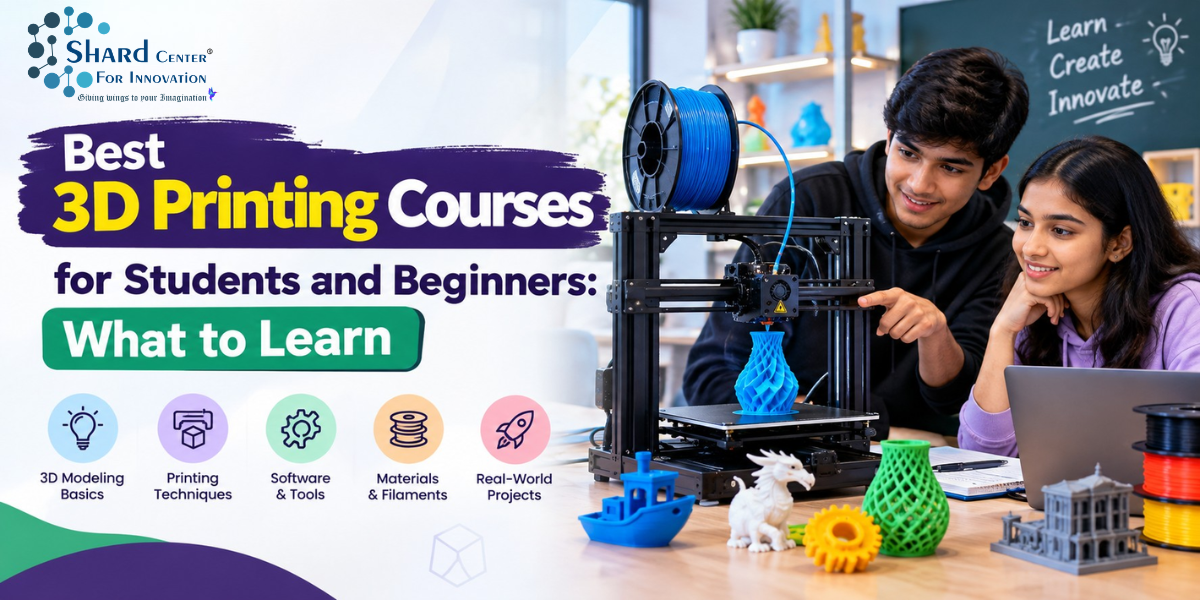
3D printing is a novel technology with widespread utilization across different industries, especially education and healthcare. This is due to its ability to transform abstract ideas into physical objects. Students can digitally design an object on the computer, print it, identify any problems, and further improve the design.
The qualities make 3D printing an important tool for hands-on learning. It can be utilized in the following diverse manners:
- Engineering prototypes
- Robotics components
- Architectural models
- Product prototypes
- Customized tools and accessories
- Educational models
- Mechanical parts
- Art and design projects
3D printing also develops skills such as problem-solving, creativity, and design thinking, which have several applications.
What Should a Beginner 3D Printing Course Include?
A beginner’s course in 3D printing should encompass the entire process, from creating a model digitally to creating a physical object. The program should cover the following core areas:
1. Fundamentals of 3D Printing
Students should first be taught how 3D printing is utilized. 3D printing involves additive manufacturing, wherein an object is created layer by layer. The course should shed light upon commonly used technologies such as FDM/FFF, SLA, and resin printing. The advantages and limitations of the different technologies should be mentioned. Among these, the FDM/FFF technologies are useful for beginners because they are utilized in education, prototyping, and desktop manufacturing.
2. 3D Modeling and CAD
3D modelling is an important skill to be learned before additive manufacturing is practiced. This is because a printer requires a digital model before it can create 3D prints of the objects. Software such as Tinkercad, Fusion, FreeCAD, or SolidWorks can be utilized to create 3D models. The choice of the software depends upon the goals of the student, as students of engineering can gain from CAD tools while art students can utilize software created for sculpting and 3D graphics.
For a beginner, the exercises should include creating shapes, adding holes, setting the dimensions, creating simple mechanical components, and exporting the models for printing.
3. Understanding STL and 3MF Files
Once a 3D model is made, students prepare it for printing using formats such as STL and 3MF. Students should know how to export models, check errors, and import them into slicing software. Any mistakes made in the digital model can result in failed prints or inaccurate parts.
4. Learning Slicing Software
The use of slicing software such as Cura, PrusaSlicer, and OrcaSlicer is to convert a 3D model into instructions for a printer to follow. Students should learn how to adjust settings such as layer height, infill, wall thickness, print speed, nozzle temperature, bed temperature, supports, and retraction.
The focus should not be on memorizing settings but on understanding how changes in different settings affect print quality, strength, speed, and material consumption.
5. Understanding 3D Printing Materials
Selecting the right materials is very important for 3D printing. PLA, PETG, ABS, ASA, and TPU are among the different materials that students can use during 3D printing. A course on 3D printing should explain the differences between these materials and which material should be utilized for a particular application.
6. Printer Setup and Calibration
Using a 3D printer also involves learning how to prepare the build plate, load filament, check the nozzle, calibrate the printer, and achieve a good first layer. Identification of issues such as a blocked nozzle, poor bed adhesion, loose components, or inconsistent extrusion should also be learned.
These skills are important for building any successful 3D printing project.
3D Printing Troubleshooting
There are many times when 3D printing may troubleshoot. These opportunities should be positively used to understand the 3D printing process.
Some common problems are
- Poor bed adhesion
- Warping
- Stringing
- Layer shifting
- Under-extrusion
- Poor surface quality
- Failed supports
- Incorrect dimensions
A course on 3D printing should introduce students to these problems and teach them to avoid and resolve them. 3-D Printing and Design Thinking for Beginners
Design for 3D Printing
It is important that students, along with learning CAD, know how designs should be adapted to the manufacturing process. Design for Additive Manufacturing (DfAM) introduces concepts such as wall thickness, overhangs, support structures, print orientation, tolerances, clearances, and part assembly.
Hands-On Projects Make a Difference
Programs that teach through practical methods rather than only lectures and theoretical lessons are more useful for students. Beginners can try designing and printing a phone stand, key holder, or storage box.
Online vs. Offline 3D Printing Courses
Online and offline courses offer their respective benefits and utilities. Online courses are more flexible and convenient and let students learn at their own pace while being cost-effective. Offline courses, on the other hand, encourage hands-on learning by providing direct access to printers, materials, and instructors. Often a blended approach is the most useful for beginners.
Career Opportunities in 3D Printing
Many career opportunities are available to students of 3D printing, who can work in fields such as product designing, mechanical engineering, industrial design, architecture, robotics, automotive engineering, and manufacturing.
How to Choose the Right Course
Choosing the right course depends upon students’ learning objectives 3D Printing Course for Kids and Beginners:
A good beginner course should include the following:
- 3D-printing fundamentals
- CAD modeling
- Slicing software
- Printer setup and calibration
- Material selection
- Troubleshooting
- Design for 3D printing
- Safety and maintenance
- Hands-on projects
Students should also make sure that access to real printing equipment and proficient instructors is provided.
Conclusion
3D printing is a useful tool that has several applications across different industries and offers the opportunity to turn an idea into a physical object. Learning 3D printing should follow a well-defined structure, from learning 3D-printing fundamentals to CAD modeling, slicing, printer operation, materials, troubleshooting, and design for additive manufacturing. Theoretical knowledge should be complemented with practical hands-on practice. A 3D printing course also offers access to several professions, such as engineering, architecture, or entrepreneurship. It is important to focus on learning practical skills instead of just learning to gain a certificate.
FAQs: Frequently Asked Questions