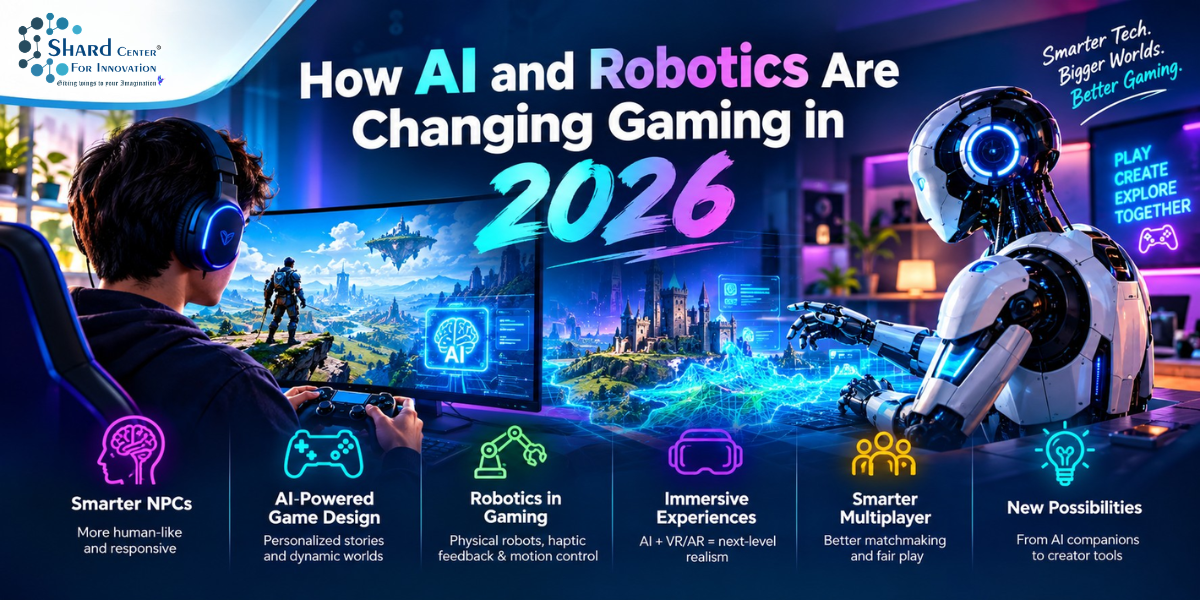
AI today impacts both how the player experiences the game as well as how the studio builds it, as machine learning, generative models, and AI-assisted production tools are impacting the content of video games.
Robotics also contributes towards motion platforms, haptic devices, location-based attractions, and the simulation environments used to train virtual agents and physical machines. This article explains how AI and robotics are impacting the world of video games and how the new technology is proving itself to be useful.
AI and Robotics in Gaming
AI in games utilizes many different techniques, such as pathfinding, finite-state machines, utility systems, and behavior trees. These systems are created by designers and are fast, predictable, and easy to test.
The value of machine learning is that it alters the development model and lets developers train a model from examples, rewards, and player data instead of writing every response. Generative AI also helps with producing text, images, voices, animations, or draft code, while agentic systems can observe a game state, plan, and act accordingly.
Robotics also offers sensors, motors, and control systems that turn digital directions into movement. Gaming and robotics are both utilized together in simulators, haptic hardware, teleoperation, esports research, and embodied AI.
How AI Influences the Player Experience
Smarter non-player characters are the most visible application. While a traditional guard may patrol, investigate noise, and follow the player through a fixed decision tree, a more advanced agent can combine perception, memory, planning, and natural-language interaction. According to NVIDIA, ACE is a set of speech, intelligence, and animation technologies for conversational and actionable game characters [2]. A major design challenge is to keep those characters in line with the story, safe to interact with, and cheap enough to run at game speed.
AI can also regulate the difficulty level and personalization of a game by estimating skill from accuracy, reaction time, failures, and strategic choices. Assistance, opponent tactics, and matchmaking can then be accordingly changed.
Rendering is another use of AI. Neural upscaling and frame-generation systems infer higher-resolution imagery or intermediate frames from lower-cost inputs. NVIDIA's DLSS documentation lists a group of neural rendering technologies that utilize artificial intelligence to improve image quality and performance [3]. The result is not game intelligence in the behavioral sense, but it is one of the most widely deployed uses of AI during play.
How AI Changes Game Production
Many game studios use AI to accelerate concept exploration, asset tagging, animation cleanup, localization drafts, code assistance, and quality assurance. Procedural systems can place terrain, vegetation, buildings, and encounters according to designer-defined rules. Epic's Procedural Content The generation framework is designed for creating tools and content that ranges from asset utilities to entire worlds [4]. Generative models add an extra layer, but human art direction is required to protect visual identity and avoid inconsistent output.
Testing agents can repeat routes, search for unreachable areas, stress economies, and expose rare combinations that manual testers may not encounter. The Unity ML-Agents Toolkit lets developers turn game scenes into learning environments and train agents with reinforcement learning, imitation learning, and related methods [5]. These agents do not eliminate human quality assurance. They are strongest at repetition and measurement; individuals are better at judging fun, clarity, tone, and unexpected player frustration.
Where Robotics Enters the Gaming Ecosystem
Robotics encompasses more than just toy robots. Racing rigs, motion platforms, force-feedback controls, and haptic wearables produce physical responses to digital events, while location-based games can use tracked props, robotic targets, or moving scenery. At the development level, the same real-time engines that are utilized for games can simulate cameras, joints, collisions, and sensor noise for robots.
NVIDIA has a robotics simulation application, Isaac Sim, built on the company's Universe platform, with tools for developing, testing, and training AI-driven robots in physically based virtual environments [6]. Unity also has a Robotics Hub with examples and interfaces for connecting robot software to Unity simulations [7]. This overlap matters because a game engine offers interactive graphics and physics, while robotics adds requirements such as sensor modelling, control loops, and transfer from simulation to real machines.
Important Limits and Risks
A few cautious points are that AI output can be wrong, repetitive, biased, or even inconsistent with game lore. Real-time models also consume a lot of memory, processing capacity, and cloud bandwidth. Developers require fallback behavior when a model times out, moderation for open-ended dialogue, clarity with respect to data rules, and deterministic safeguards for competitive play.
Generative production raises questions about training data, performer consent, copyright, job design, and disclosure. Steam's content survey asks developers to describe pre-generated and live-generated AI content and the safeguards applied to live systems [8]. There are different requirements across different platforms and jurisdictions, so studios need legal review instead of relying on a single marketplace policy.
Frequently Asked Questions
Q1: What is the biggest use of AI in games today?
Ans:AI is utilized in NPC behavior, matchmaking, anti-cheat systems, content workflows, testing, and neural rendering. Its use depends on the genre of the game and its platform.
Q2: Will AI take the place of game developers?
Ans: No, as AI can automate or accelerate parts of production, but shipped games still require creative direction, engineering, testing, rights management, and accountability. Roles are more likely to be transformed but will not disappear.
Q3: Are AI NPCs the same as chatbots?
Ans: No. An AI NPC can combine dialogue with perception, memory, navigation, animation, and game actions. A chatbot only deals with generating or retrieving conversation.
Q4: How is robotics used in video games?
Ans: Robotics are used in physical controllers, haptics, motion systems, and interactive attractions. Game engines are also used as robot simulators because they can model 3D worlds and physics.
Q5. Are AI-powered games useful for children and students?
Ans: When designed appropriately, AI-based games can support interactive learning, problem-solving, creativity, and experimentation. Educational games can combine gameplay with subjects such as coding, mathematics, science, and robotics.
Q6. How are AI and robotics connected in gaming?
Ans:AI provides the decision-making and adaptive behavior, while robotics can provide physical movement and interaction. Together, they can create experiences where players interact with intelligent physical systems.
Q7. Will AI replace game developers?
AI is more accurately viewed as a development tool that can automate or assist with certain tasks. Game design, storytelling, creative direction, user experience, testing, and many technical decisions still require human input.
Q8. How can students learn about AI and robotics through gaming?
Ans: Students can explore beginner-friendly coding, game development, robotics kits, simulations, and AI projects. These activities can help them understand programming and computational thinking through hands-on experimentation.
Q9. What are the benefits of AI-powered gaming?
Ans: Potential benefits include more personalized experiences, adaptive difficulty, smarter non-player characters, faster development workflows, and new forms of interactive storytelling.
Q10. What challenges can AI bring to gaming?
Ans: Important considerations include data privacy, intellectual property, transparency, content quality, responsible AI use, and maintaining meaningful human creativity in game development.
References
1. Epic Games, Behavior Trees in Unreal Engine
3. NVIDIA, Deep Learning Super Sampling
4. Epic Games, Procedural Content Generation Framework
5. Unity Technologies, ML-Agents Toolkit
7. Unity Technologies, Unity Robotics Hub
8. Steamworks Documentation, Content Survey and Generative AI Disclosure