Introduction
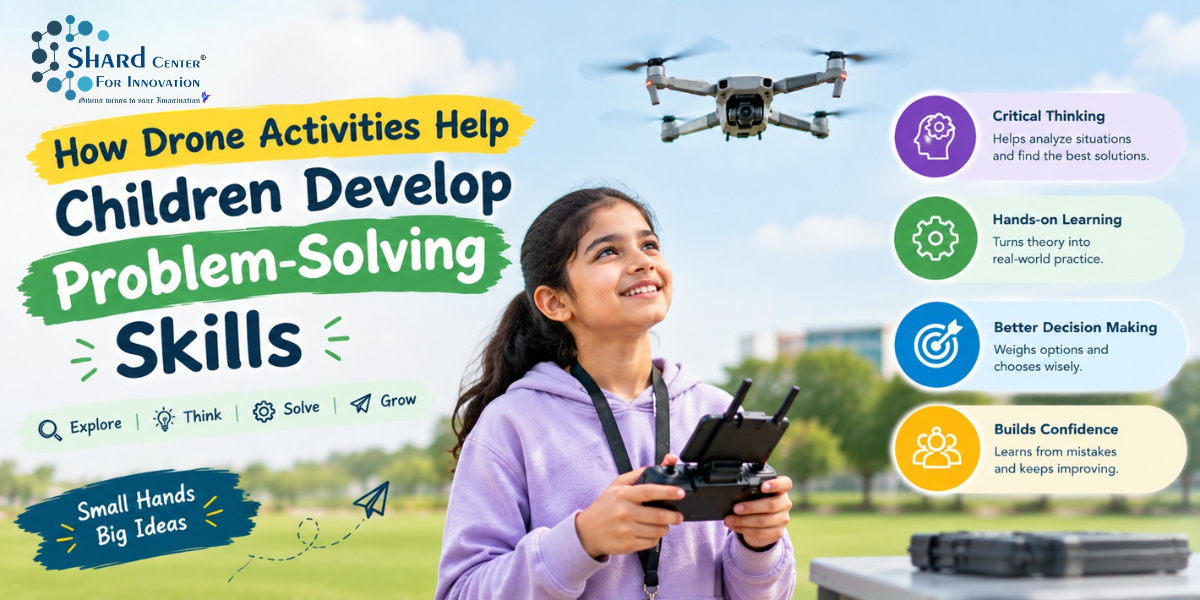
Children develop their skills best when they are able to explore, experiment, and see how their ideas work in the real world. Drone technology offers students an opportunity to apply their ideas practically by teaching them how to plan a flight path, learning how controls work, or programming a drone to complete a simple task. As they work with suitable equipment and adult supervision, they learn how to develop critical thinking and problem-solving skills in a practical and engaging method.
1. Encourages Planning and Step-by-Step Thinking
Many factors demand consideration before a drone can successfully fly. A goal needs to be identified, a flying area needs to be selected, a safe route has to be chosen, and many other actions need to be performed (such as guiding a classroom drone around a set of markers). Building a drone encourages students to break a big task into smaller ones, which is also a systematic way to approach school assignments, science projects, and everyday challenges.
2. Develops Logical and Computational Thinking
Drones provide children with a good training in logical and computational thinking, as they allow students to give instructions using visual coding blocks or simple commands. They can develop a sequence that makes a drone rise, move, turn, and land. In case of the drone not following the route, students can review the instructions and identify the sequence that must be changed.
3. Teaches Children to Learn from Mistakes
On many occasions, STEM projects are not successful on the first try. Iterations and modifications are often required to make the project work. A flight may not go as planned due to the drone turning too far, stopping before reaching a marker, or failing to execute a programmed route. Students should investigate what went wrong and suggest possible ways to improve the design. These hands-on experiences can also help students make informed decisions when exploring admission opportunities in STEM, robotics, and drone training programs.
4. Builds Observation and Critical Thinking
Children build their observation and problem-solving skills as they learn to operate a drone. Simple observations such as noting how a drone responds to commands and how long a battery lasts enables the drone to fly smoothly. Students can record observations and compare their attempts. They can ask questions based on their observations and strengthen their flying experience.
5. Inspires Creativity and Flexible Solutions
Children utilize their creative thinking skills when they learn to solve drone challenges. Children can change original drone designs and movements and strengthen their adaptability skills. These skills are valuable while studying subjects such as mathematics, science, design, and technology.
6. Encourages Teamwork and Communication
As drone projects are best developed in small groups, with each child taking different roles. Team members should learn to explain their ideas and adapt according to suggestions. By sharing responsibilities, children develop their problem-solving skills and learn to collaborate. They develop their communication skills and learn to solve complex challenges by collaborating.
7. Connects STEM Concepts to Real-Life Applications
Drone activities introduce children to complex concepts in science, technology, engineering, and mathematics (STEM). Designing and flying drones helps children understand force and motion, computing, planning, and spatial reasoning. Teachers can also explain the real-world applications of drone technology in environmental monitoring, agriculture, and search and rescue support. For parents and students exploring future-ready learning opportunities, understanding these benefits can help them choose the Right Skill Development Course based on practical experience, technical interests, and long-term learning goals.
How Parents and Teachers Can Support Drone-Based Learning
Parents can plan a route on paper, use a simulator, or program a small educational drone to move between marked points. Guiding questions such as “What happened differently from the plan?” and “How would you change the next plan?” help children develop reasoning and problem-solving skills. Similar practical learning approaches are also useful in short courses for professionals, where learners can strengthen their technical knowledge through hands-on activities. Age-appropriate equipment should be used, and the manufacturer’s instructions and local rules should be followed to protect bystanders.
Conclusion
Drone training activities offer many learning experiences to students and introduce them to new technology. They also develop students' reasoning and critical thinking skills. Under parental guidance, drone-based learning makes STEM more engaging for students and provides them the confidence to solve problems in schools and everyday life.
Frequently Asked Questions (FAQs)
Q1. At what age can children begin building drones?
Ans: Children can begin using drones between the ages of 5 to 7, under adult supervision.
Q2. What subjects can children learn through drones?
Ans: Students can learn the subjects of mathematics, physics, computer science, and engineering through developing and flying drones.
Q3. How is drone technology different from robotics?
Ans: Drone technology is a form of robotics, as it utilizes robotics, sensors, and electronic controllers. Learning about drones familiarizes students with robotics.
Q4. How do drone activities help children develop problem-solving skills?
Ans: Drone activities encourage children to identify challenges, test solutions, understand mistakes, and improve their approach through hands-on learning.
Q5. What skills can children learn through drone activities?
Ans: Children can develop critical thinking, problem-solving, creativity, spatial awareness, teamwork, and basic technical skills.
Q6. Are drone activities suitable for beginners?
Ans: Yes. Beginner-friendly drone activities can introduce children to basic controls, navigation, safety rules, and simple flight challenges.
Q7. How do drones support STEM education?
Ans: Drones connect science, technology, engineering, and mathematics through practical activities involving flight, movement, distance, and basic programming.
Q8. Can drone activities improve children's critical thinking?
Ans: Yes. Children learn to observe flight behavior, identify problems, analyze possible causes, and adjust their actions to achieve better results.
Q9. How do drone activities encourage teamwork?
Ans: Group challenges allow children to share ideas, assign roles, communicate clearly, and work together to complete flight-based tasks.
Q10. What role does drone training play in children's learning?
Ans: Drone training provides practical experience that helps children understand technology, build confidence, and apply classroom concepts to real-world challenges.