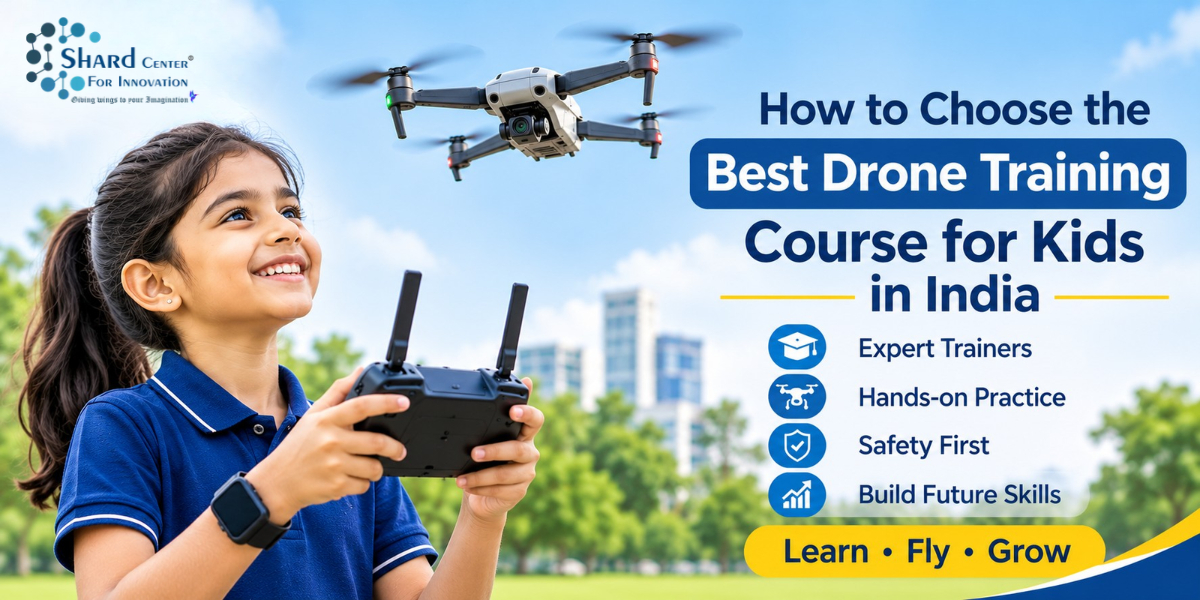
Drones are increasingly being utilized in the modern world, with applications ranging from photography to agriculture, mapping, disaster management and other fields. Learning about drones teaches students to be familiar with the science, technology, engineering and mathematics (STEM) fields. A good training programme introduces students to concepts in aerodynamics, coding, problem-solving and using technology responsibly. How to Choose the Best Drone Training Course for Kids in India is important as it discusses the qualities that a drone flying program must have to yield the maximum benefits to the children.
1. Course Suitability with the Child’s Age
It is important that drone courses should match the child’s age, understanding and existing knowledge. Children benefit from simple demonstrations and beginner-friendly equipment, while older students can be introduced to more advanced topics such as drone components, flight principles and mission planning. Students should enquire how the lesson provider adapts teaching to suit the different age groups and levels. A good course should maintain beginner’s interest and not overwhelm them.
2. Bridge Between Theory and Practical Training
A good course should be able to deliver theoretical lessons along with practical training. It should make students understand how a drone works and control it. It should also explain the basic components of a drone, such as the frame, motors, propellers, battery, sensors and controller. Students should be taught simple principles of lift, thrust, balance and movement. Along with watching demonstrations and listening to lectures, students should receive hands-on practical sessions to develop their skills.
3. Ensure Safety of the Children
Safety should be paramount during every drone training session. Students must be taught how to inspect a drone before use, handle batteries and keep a safe distance from people and property. Training should be held under adult supervision, and rules related to take-off, landing and equipment handling should be followed. Students should enquire about the emergency procedures, instructor-to-student ratios and safety measures during flying sessions.
4. Examine the Trainers’ Experience
The skills and experience of the trainer makes a huge difference to a child’s learning experience. Trainers who are skilled in operating drones and those who can skillfully share their ideas and explain concepts in a simple and clear manner should be preferred. Parents and students should enquire about their qualifications and teaching experience and how they deal with students who require extra support.
Read more: Drone Flying Lessons for Kids: What Parents Should Look For
5. Understand the Course Curriculum
A comprehensive curriculum should include topics related to drone parts and functions flight controls, aerodynamics, basic coding, obstacle navigation, photography, mapping and real-world applications. Activities that are project-based help students in applying what they have learnt. Parents should request written syllabus and check learning outcomes.
6. Check the Equipment and Learning Facilities
Check whether the equipment is age-appropriate for children. Drones should be beginner-friendly and lightweight to make flying practice more engaging. The equipment should be well maintained, and enough devices should be available for practice. There should be available a dedicated indoor or outdoor training area. Simulators can also be utilized before students begin practice supervised flights.
Read more:What are Drones and Why They Matter for Kids: A Beginner’s Guide

7. Check Certification and Regulatory Claims
There must be a difference between children’s educational workshops and professional remote pilot training. In India, the DGCA’s Remote Pilot Certificate requirements list the pilot’s age to be least 18 years along with a Class 10 qualification. Hence, a course for children should not be advertised as a DGCA Remote Pilot Certificate unless the child is legally eligible and the program is conducted through an appropriately authorized organization. Parents should enquire which certificate is awarded and what it recognizes. A participation certificate is different from a statutory pilot credential.
8. Ascertain Fees, Duration and Parent Feedback
Before enrolling your child in a drone training course, consider the course fees along with the number of sessions, practical flying time, equipment and learning support provided. A higher fee does not necessarily mean better teaching. Parents should consider what other parents say about the course, ask for sample activities and attend a demonstration class. They should check batch size, attendance policy and whether parents receive feedback on their child’s progress.
Conclusion
A good drone training course should let children develop real skills in drone flying through a project-based approach. It should be safe, and be provided by experienced and qualified trainers. Parents should check the curriculum, facilities and safety standards before enrolling their child.
Shard Center for Innovation provides a hands-on Drone Training programme for children, designed to make them learn drone piloting in an innovative manner.
Enquire more and enroll your child today.
Frequently Asked Questions (FAQs)
Q.1 Are drone training courses suitable for beginners?
Ans: Yes. Beginner-friendly courses let students understand the fundamentals of drones. Previous experience is not necessary.
Q.2 What safety considerations are important while flying a drone?
Ans:Students should become familiar with pre-flight inspections, safe distances, battery handling, weather conditions, restricted flying areas and emergency procedures.
Q.3 Do children need prior knowledge of coding or robotics?
Ans: No, previous coding or robotics experience is not required. Children can develop their basic programming skills gradually through drone-based activities and exercises.
Q.4 What is the cost of drone training courses for kids in India?
Ans:The cost depends upon the course duration, drone equipment, instructor expertise, practical flying sessions and learning materials.
Q.5. Do kids need prior technical knowledge to learn drone flying?
Ans: No, beginner-friendly courses teach children the basics step by step.
Q.6. What skills can children develop through drone training?
Ans: Drone training can develop problem-solving, coordination, creativity, technical understanding and logical thinking.
Q.7. How long does a drone training course take?
Ans: Course duration varies depending on the training level, practical sessions and learning objectives.
Q.8. Can school students learn drone programming?
Ans:Yes, some advanced courses introduce basic drone programming, automation and coding concepts.
Q.9. What should parents check before enrolling their child?
Ans:Parents should check instructor experience, course content, drone safety measures, equipment and practical training opportunities.
Q.10. Where can kids learn drone flying in India?
Ans:Children can explore drone learning programs at technology and STEM training centres such as Shard Center for Innovation.
References
• Ministry of Civil Aviation – Drone Rules, 2021: https://www.civilaviation.gov.in/ministry-documents/rules/drones-rules-2021-dated-25-august-2021
• IGRUA – Drone Training eligibility and course information: https://www.igrua.gov.in/drone-training