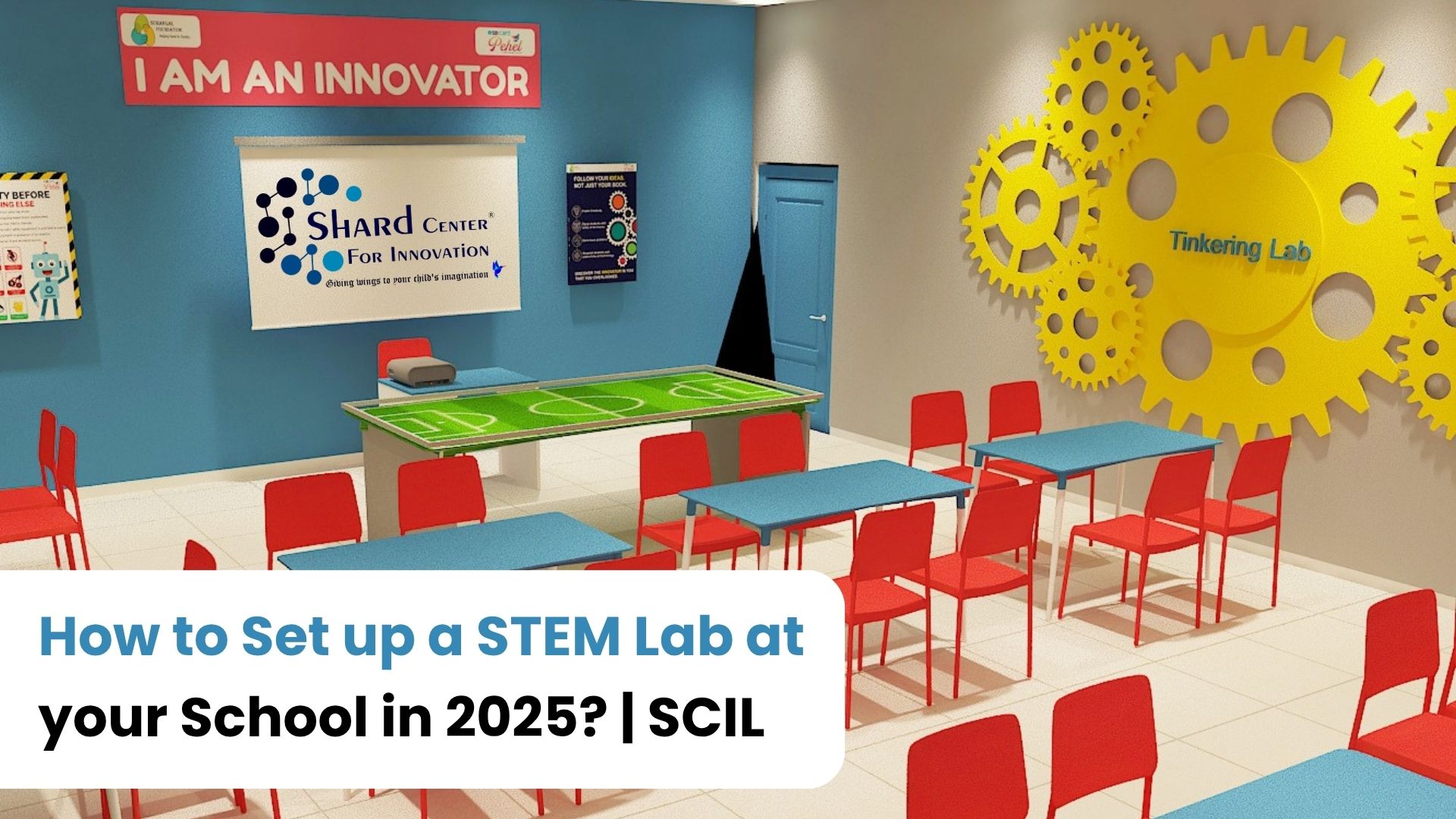
Hands-on STEM Training at schools is increasingly crucial in today’s age to enable young learners to succeed in their education. By moving out of textbook-based learning and applying practical knowledge to projects, students learn critical skills and develop a keen interest in scientific pursuits.
NEP 2020 and NCF-SE recognize the importance of skill-based learning in the academic curriculum at all stages of school education. A STEM Lab enables students to gain an experiential understanding of many STEM concepts by practically applying concepts under expert supervision.
Find out about the importance of a STEM Lab and how to set it in your school.
What is a STEM Lab?
A STEM Lab is an experiential learning space which specifically designed to provide age-appropriate practical training in several STEM fields such as Robotics, Drone Technology, 3 – Printing, Artificial Intelligence and Machine Learning. It offers the infrastructure and technical expertise through learned instructors to allow students to create STEM based projects themselves and learn several practical skills.
CBSE promotes the setting up of such labs in affiliated schools to provide training in advanced technologies to students. Since 23rd August, 2024, schools seeking CBSE affiliation are required to set up such composite labs to train students and provide them with an experiential hands-on education.

Prerequisites to Setup a STEM Lab
- Adequate Space: Schools are required to build a lab with adequate space to ensure collaborative learning
- Teacher Training: Willingness to train teachers with the technical skills for instruction
- Regular Maintenance: Regular and careful upkeep of scientific tools and DIY materials
- Infrastructure: Basic requirements such as electricity, internet connection and water supply
Smart classroom features such as interactive class boards and projectors, as well as optimal storage cabinets can aid the STEM Lab learning experience. By allowing students to imbibe theoretical learning through practical training, STEM Labs ensure that they learn skills that enhance their academic learning as future professional success.
- Learn scientific concepts in an interactive setting
- Explore various scientific careers
- Develop their interpersonal and critical thinking skills
Shard Center for Innovation provides learners with hands-on learning in the domains of Artificial Intelligence, Machine Learning, Robotics, Drone Technology, Design Thinking, Internet of Things (IoT) and 3-D Printing through a curriculum aligned with NEP 2020 and tailored for various age groups.
We ensure expert training for students to prepare their future success in STEM academic fields and careers by offering
- DIY STEM Tools
- State-of-the-art Curriculum Support and Updates
- Qualification and Assessment Tools
- DIY Materials and Teaching Support
- Branding and Marketing Assistance
- Digital Connectivity and Access
- In-person Workshops and Launching Guidance

Starting an SCIL Franchise at Your School in India
SCIL India provides complete support in the installation of your STEM education franchise with the following features:
- Space Requirements of 2000 Sq. Ft. and Above
- Investment Cost of 12 -15 Lakhs (approx.)
- A Return on Investment (ROI) of 40 – 50 %
- Custom Solutions, Training and Assistance at Every Step
Our offerings include the Young Scientist Program for the Primary (7-10 yrs), Intermediate (11-14 yrs), and Advanced (15-18 yrs); and Professional Courses including the Certificate Course (6 months) and Advanced Certificate Course (9 Months).
Contact us at at +918882091091 and info@scilindia.org for more information.
Conclusion
SCIL India provides the unique opportunity to set up an SCIL STEM Lab at your school with complete infrastructure and expert assistance to upskill young learners for a scientific career. Bring Shard Center for Innovation to your school today to equip students with the best of AI, Robotics, Machine Learning, Drone Technology, IoT, and 3D Printing education, and train them under expert guidance to excel in scientific fields.
Enquire now for this franchise business opportunity to bring holistic STEM education to your school.
(FAQs) Frequently Asked Questions
Q1. What is a STEM lab in a school?
A STEM lab is a learning environment where science, technology, engineering, and mathematics are taught through projects and experiments.
Q2. Why should a school consider having a STEM lab?
In a STEM lab, students are able to develop creativity, analytical thinking, problem-solving skills, collaboration competencies, and technological learning.
Q3. What equipment do we need to get for a STEM lab?
We need to consider the curriculum that the school wants to cover, but a STEM lab may require robotics, electronics, programming equipment, 3d printers, sensors, and other lab equipment.
Q4. How big should the STEM lab be?
A STEM lab does not need to be very big because the size depends on the number of students, equipment, and activities in it.
Q5. Who can join the STEM lab?
Anyone can join according to their level since the equipment and activities can be selected based on their age and abilities.
Q6. Do teachers need any training for STEM?
Yes, teachers need training so that they know how to operate the equipment and activities in the lab for their students.
Q7. Can a school start small on a STEM lab?
Yes, it is possible because there are options for equipment and budgets, so schools can begin with what they need and move on to the next level.
Q8. What activities can a school carry out in a STEM lab?
Robotic competitions, coding, electronics, scientific experiments, 3d printing, Internet of Things, and engineering activities can be performed in a STEM lab.
Q9. How can a STEM lab encourage project-based learning?
In a STEM lab, students can develop project-based learning approaches by designing and developing their own projects according to their interests and needs. A lab allows students to propose a product or solution to a problem and test it.
Q10. How can a school start working on a STEM lab?
A school can begin by defining the goals and equipment, acquiring skills for operating the lab, designing a safe workspace, and developing activities appropriate for the students’ ages.
Related Blogs:
- How Kids Can Learn Machine Learning in India – Starter Programs Explained
- 3-D Printing and Design Thinking for Beginners | SCIL India
- Artificial Intelligence Training in India: Masters Program for Professionals
- School STEM Education Franchise Opportunity | SCIL India
- How to Start a Career in Data Science in India (2025 Guide)
- Robotics Institute Franchise Business in India: A Future-Ready STEM Education Opportunity