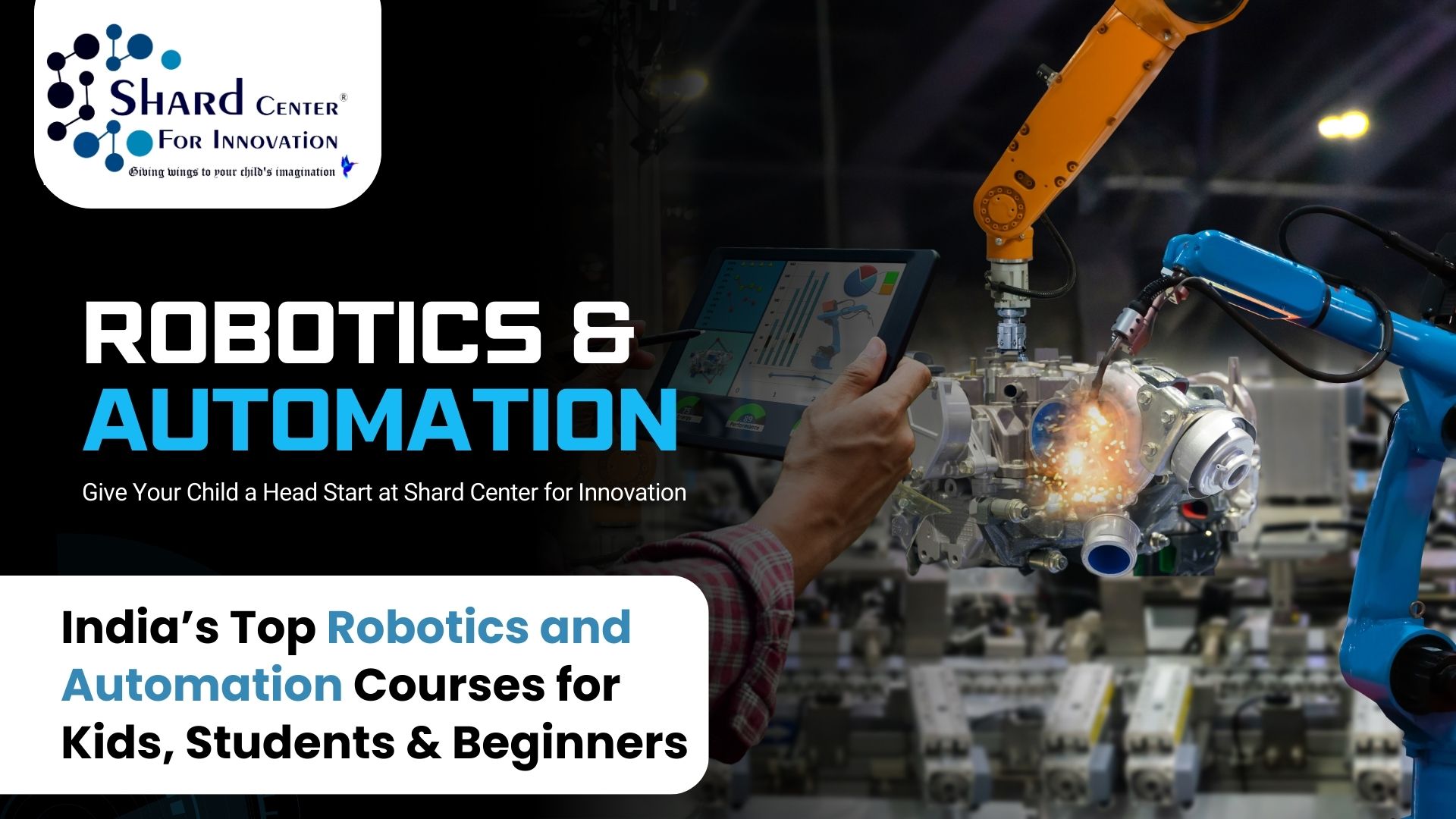
Have you ever noticed the eyes of a child illuminating when a robot moves? The moment they realize they have brought something to life is the point at which robotics education is all about.
In modern society, children are raised in an environment that is filled with technology. Robotics and automation classes are also beneficial to children, students, and novices, not only for consuming technology but also for producing it.
The blog discusses the importance of robotics and automation, what constitutes a good course, and why learning early can significantly impact your future as a parent.
Why Robotics Education Matters Today
A recent report by the World Economic Forum states that by 2025, up to 97 million new employment opportunities will be created due to the use of technology, replacing approximately 85 million jobs that are going to be automated. That statistic is not just data, but it gives us an idea of what our children will become.
Educating children in robotics equips them with work skills as well as a mentality that excels at problem solving, creativity, and innovativeness. Children who create robots get to think logically, work in groups, and learn to bring ideas to reality.
Simply put, the robotics classes are the new form of the building blocks, only that the blocks today can blink, move, and think.
What Makes a Good Robotics and Automation Course
You may be a parent or student looking into the choices you have to make; you must know what makes the difference between a good course and an average course. A good course in robotics and automation Course gives attention to three things:
Practical Learning
Children are to construct and interact, not merely watch videos and read slides. It does not matter whether it is the task of building a line-following robot or developing a mini traffic light system; practical work counts.
Simplified Coding
There is a brain behind all the robots, and the brain is called coding. The most effective ones involve child-friendly platforms such as Scratch with the younger students and Python or Arduino with the older students. It is hoped to ensure that logic is entertaining, not scary.
Real‑World Connection
Great courses connect the classroom studies to reality. They can be used as an example of how factories are automated, how packages are transported by drones, or how sensors are used to control smart houses.
Programs developed in institutes such as SCIL are fun and education-based. The level presents new challenges and tools that correspond to the age and curiosity of the learner.

Robotics and Automation Learning Paths
No two children have the same way of learning, and an excellent curriculum acknowledges the fact. The following programs are frequently established at different ages:
For Kids (Ages 6‑10)
Children are introduced to movement, sensors, and energy in colorful kits and excellent experiments. They may create robots that trace lines, keep clear, or produce noise—learning the principles of logic and mechanics without even the least attention.
Our Young Scientist program is a combination of fun and exploration. Parents find themselves caught off guard when children begin to use terms such as "sensor," "motor," or "algorithm" and clarify them more than most adults.
For Students (Ages 11‑16)
Learning is now more organized at this stage. Students explore further in the field of automation, logic, and design of robots. They get to know how robots can do tasks in the real world, sorting items, taking orders, or performing on a programmed schedule.
They also gain knowledge on how to work together. Robotics competitions are held in many schools and training institutions, wherein students work together to solve a problem innovatively. These projects not only create technical knowledge but also leadership, patience, and collaboration.
For Beginners & Teens (16+)
Elderly students shift to more advanced issues, such as IoT integration, automation systems, and AI-based robotics. They work with microcontrollers such as Arduino or Raspberry Pi and understand how sensors transmit data.
This step explains the relationship between robotics and future employment. Students witness how automation is propelling industries, both in manufacturing and agriculture, into the healthcare sector and transportation.
The Real Value: More Than Just Technology
When we talk about robotics, we often focus on machines. But the real change happens inside the learner.
Learning robotics makes a child curious. They pose questions of why and how on everything. They get to know that failure is not mistakes, but it is feedback. Each mistake in the coding or design is another step to success.
Such a transformation lays the groundwork for life, which is founded on endurance, patience, and problem-solving.
Parents observe that children taking robotics classes are more attentive and assertive and are interested in studying science and math at school. This is precisely what an education ought to do: motivate, not train.
Conclusion
India rapidly emerges as the center of technology and innovation. Due to the increasing automation and AI, the market of creative professionals will grow.
It is about the sowing of a seed of curiosity that may become the next big innovation. Inclined to become an engineer, an artist, or an entrepreneur, robotics will provide your child with a mentality to learn the world, as well as to transform it.
Admissions Now Open: Give Your Child a Head Start at Shard Center for Innovation
Frequently Asked Questions
Q1. How do robotics courses help children develop life skills beyond technology?
Ans. Robotics not only provides education in code or machines but also patience, teamwork, problem-solving, and creativity. Planning, testing, and troubleshooting are part of what children do, and these make them more focused and confident in life in general.
Q2. How does SCIL use robotics to make learning interactive and interesting to young minds?
Ans. At SCIL, kids learn by doing. They make actual robots, solve small-scale tasks, and have fun experiments. This is an experimental style that makes classrooms innovation labs.
Q3. What kind of career or academic advantage does early robotics learning provide?
Ans. Learning robotics early helps children build strong logical reasoning and problem-solving skills, key foundations for careers in AI, automation, and engineering. It also gives them an edge in school STEM subjects and global competitions.
Q4. How is SCIL different from other robotics training centers in India?
Ans. SCIL (Shard Centre for Innovation) stands out because it focuses on concept clarity and creativity over rote learning. The programs combine robotics, automation, and coding in a structured yet fun way, nurturing young innovators, not just learners.