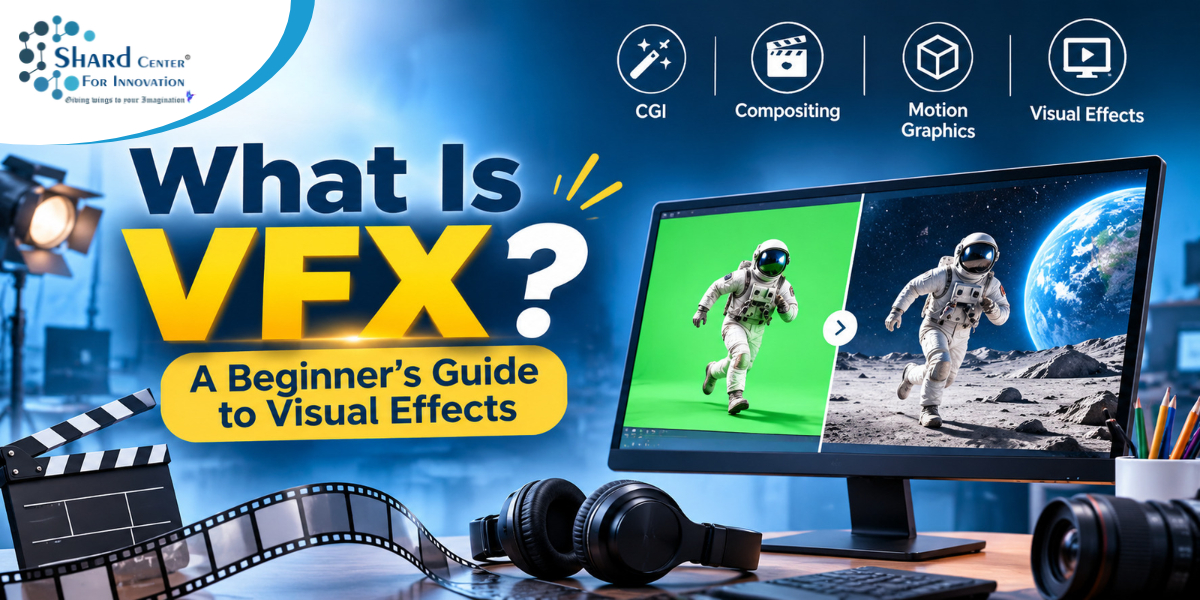
If you have ever watched a superheroes movie, with explosions, imaginary creatures or futuristic landscapes, you would have noticed that many of the scenes utilise Visual Effects (VFX). VFX is an important component of modern filmmaking, television, advertising, gaming and digital media and lets creators to bring ideas to life by utilising computer-generated imagery and other digital techniques.
This article discusses the basics of VFX and its applications in animation, filmmaking and digital creativity, aimed at beginners.
What is VFX?
The full form of VFX is Visual Effects, which is the process of creating, modifying or enhancing images and videos using technology. These modifications are made after producing a scene and after filming has been completed.
VFX lets filmmakers depict scenes that may be too expensive, dangerous or difficult to capture in real life. By combining imagination with story-telling, VFX makes content more realistic and engaging.
How Does VFX Work?
There are several stages involving visual effects, before the final scene can be produced.
1. Pre-production and Planning
Filmmakers have to plan how the visual effects appear in a scene before creating VFX. They use sketches, storyboards and digital models to visualise the final result.
2. Filming and Capturing Footage
Live-action scenes are captured using cameras, lighting equipment and green screens, which allow artists to replace the background with digital environments.
3. Creating Digital Elements
Through VFX, it becomes possible to create computer-generated objects, characters, backgrounds and environments.
4. Compositing
Through compositing, it becomes possible to combine different visual elements such as live-action footage, digital backgrounds and computer-generated objects into a single scene.
5. Final Editing and Refinement
At the final stage, lighting, colours, shadows and other details are adjusted to make the visual effects blend naturally with the original footage.
Different Types of VFX
Many different types of visual effects are utilised in films, advertisement and digital entertainment.
1. CGI (Computer-Generated Imagery)
CGI creates digital images, objects, characters and environments using computer software, and is commonly used to create imaginary creatures, buildings and futuristic landscapes.
2. Green Screen Effects
Through green screen technology, filmmakers replace a plain green background with digitally created locations or environments.
3. Motion Capture
Through motion capture, it becomes possible to record the movement and expressions of real people and convert them into digital characters. It is utilised in animated films and video games.
4. 3D Modelling
Through 3D modelling, it becomes possible to create three-dimensional digital objects, characters and environments that can be viewed and animated from different angles.
5. Digital Compositing
Digital composting involves combining multiple images and visual elements to create a complete scene. For example, it can combine an actor’s footage with a digitally generated space environment.
Read more: -VFX Course for Professionals: Skills, Software and Career Guide