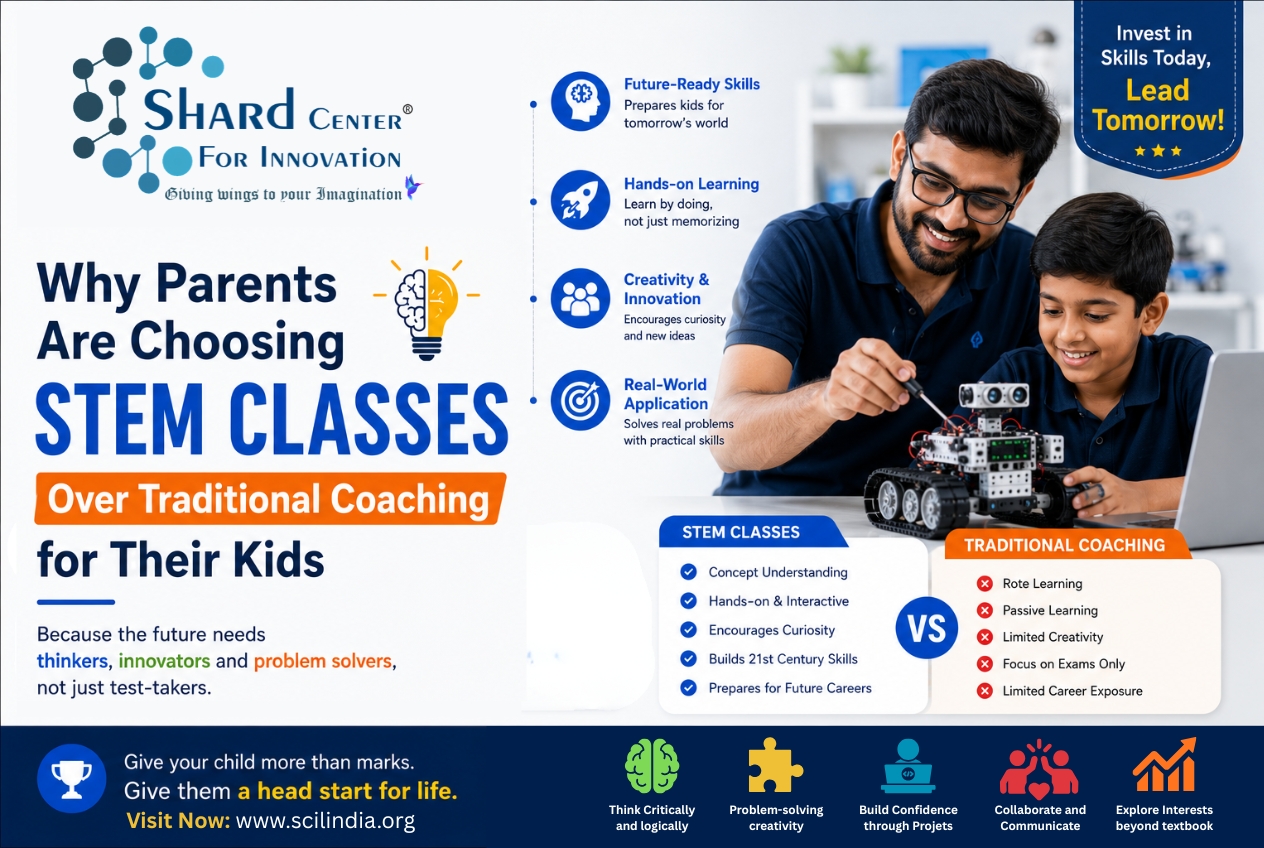
Regular coaching classes can improve your child's grade, but they rarely help them think differently. As our world becomes a technology-driven, creative, and problem-solving place, more parents are asking if memorizing answers is sufficient.
That's why STEM learning is becoming a serious alternative for families who want something more practical and future-focused for their children.
Why Parents Are Rethinking Traditional Coaching
Repetition is the key that most tuition classes are organized around. Your child hears, remembers, takes tests, and repeats all steps. But when you differentiate between STEM classes and traditional coaching, however, it is straightforward: STEM classes ask kids to create, experiment, and solve problems instead of only remembering information.
That shift changes how children learn and how they think. Some of the biggest benefits of STEM Classesinclude:
Your child learns to problem-solve rather than wait for answers.
Creativity and independent thinking are enhanced through hands-on projects.
Communication and teamwork are developed organically in group activities.
Learning is more interesting through robotics, coding, and experiments.
Children are building and testing authentic ideas to grow in confidence.
These experiences enable your child to become more curious, adaptable, and comfortable with learning itself.
Why a STEM Education Center Feels Different From Tuition Classes
A regular tuition center typically concentrates on finishing chapters and taking tests. A STEM Education Centeris built around exploration. Your child may design a robot, create a simple game, experiment with a scientific idea, or build a coding project that they relate to real-life situations.
When searching for the best STEM Classes, avoid focusing only on branding or marketing. Look closely at how children are actually learning. Are they building projects? Are instructors experienced with STEM tools and technologies?
A strong STEM programcombines technical skills with independent thinking.
The Skills Your Child Builds Through STEM Matter Beyond School
Many careers your child may enter in the future do not even fully exist yet. But the skills employers already value are becoming very clear: adaptability, logical thinking, creativity, and technological understanding.
That is why STEM learning focuses on practical skill-building from an early stage.
Your child slowly develops the following:
Logical thinking through coding and structured problem-solving.
Basic robotics and engineering concepts through hands-on projects.
Data interpretation skills by working with patterns and results.
Creative problem-solving through experiments and innovation tasks.
Communication skills through presentations and collaborative learning.
These skills are not limited to academic skills. They shape how your child approaches challenges, ideas, and opportunities throughout life.
And that brings you back to the decision you are making now as a parent.

Conclusion
Choosing how your child learns is just as important as what they learn.
Traditional coaching may improve marks for a while, but STEM education helps children build skills they will continue using long after school ends. If you are exploring better learning options for your child, visit our STEM center. Observe a class, and see how your child responds to learning that feels active, practical, and real.