What if the solution to a problem in healthcare, agriculture, education, or climate change is developed by a school student?
Students across India are being introduced to many innovations in artificial intelligence, automation, and rapidly evolving technological transformations. These new futuristic developments require students to not only learn how to use new technologies but also to question, experiment, and create technological solutions that can solve important problems that affect society.
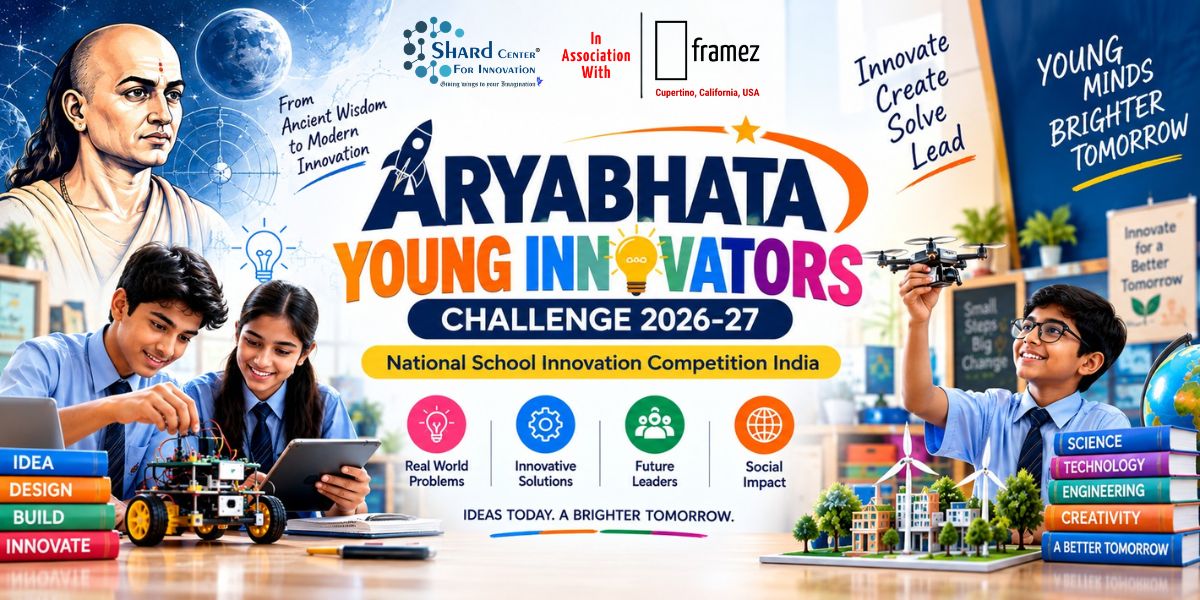
This is the idea behind the Aryabhata Young Innovators Challenge 2026 – 2027, a national school innovation competition being held by the SHARD Center for Innovation in association with Framez, California, USA.
The challenge provides an opportunity for school children to develop an idea into a tech-led solution to solve a practical problem at the intersection of artificial intelligence, machine learning, design thinking, hands-on innovation, and real-world problem solving. Registration for the challenge is free.
Why Innovation Skills Matter for Students Today
The way students learn today has been transformed by policies such as India’s National Education Policy (NEP) 2020, which places significant emphasis on leading education towards conceptual understanding, critical thinking, and experiential learning instead of rote learning and memorization. Education is increasingly tech-led, and these skills are required by young individuals to understand and solve complex problems. The National Curriculum Framework for School Education 2023also emphasizes the role of active participation and hands-on projects as methods to enhance learning. The message is clear: education today is not only about learning facts but also about discovering problems and creating solutions.
The Aryabhata Young Innovators Challenge has been developed with these ideals in mind.
What Is the Aryabhata Young Innovators Challenge?
The Aryabhata Young Innovators Challenge 2026-27 is a nationwide innovation competition for school students that is developed to identify, recognize, and reward promising young innovators from schools across India.
This competition involves participating schools conducting an intra-school round and nominating their strongest projects. The selected innovators undergo evaluation stages towards regional selection and the national finale. The challenge encourages students to identify problems and explore methods of solving them through technology and innovation.
Students are introduced to a technological journey that includes:
- Artificial Intelligence and Machine Learning
- Design Thinking
- Research and observation
- Problem identification
- Ideation
- Hands-on development
- Prototyping
- Expert mentoring
- Project presentation
The desired goal is to encourage students to think like tech innovators.
From a Problem to a Solution
The participants begin by asking simple questions: 'Why does this problem exist’, and ‘How can we solve it differently?’. Students are influenced to identify problems to solve by observing the world around them, from broad areas such as healthcare, agriculture, rural development, education, environment, sustainability, community development, public safety, and climate and resource management.
Areas can be identified from beyond the suggestions, but innovation remains central to the challenge.
One student may try to develop a solution for farmers facing low rainfall, while another could ideate a solution that can improve accessibility for people with disabilities. Someone else could develop an idea around water conservation, waste management, education, community development, or public safety.
The problems could be very different, with different approaches towards identifying solutions. The motive is to turn knowledge into actionable insights.
Where AI Meets Design Thinking
One of the innovative elements of the Aryabhata Young Innovators Challenge is its combination of AI/ML and design thinking.
Artificial intelligence is a powerful tool at the disposal of students today that can empower students’ innovations. To create tech-led solutions, students should first understand the people who are affected by a particular problem, inquire why the problem exists, ideate upon possible solutions, test assumptions, and improve ideas. Design thinking plays a major role here. By utilizing it together with artificial intelligence, students can understand the capabilities of technology and how it can be used to benefit society.
Learning by Building
There is a major difference between learning about innovation and actually innovating to develop a solution.
Imagine first a student reading about environmental sustainability in a textbook. Now imagine that same student identifying an environmental problem in his or her community, researching its causes, developing a solution, building a prototype, receiving feedback, and eventually presenting the idea to others.
The second set of actions not only demands conceptual knowledge but also creativity, analytical thinking, communication, collaboration, and resilience. Developing these skills is the contribution of hands-on learning to education.
The Aryabhata Young Innovators Challenge seeks to extend the spirit of hands-on learning into a structured national innovation journey where students can develop their creativity, design mindset, and computational thinking.
More Than a Competition
The process of understanding a problem, researching about it, developing solution prototypes, and finally communicating the findings with others builds capabilities that extend beyond a single competition. Through the competition, participants can develop skills such as creative and analytical thinking, AI/ML skills, design thinking, prototyping, communication, and self-confidence. These are very valuable skills for the students’ future professions as an engineer, researcher, designer, doctor, or scientist—or for completely different career paths.
A National Platform for Young Innovators
The challenge takes students through a structured 7-phase innovation journey, progressing from planning and innovation development towards regional selection and ending with the national finale.
For the best projects, there is also national recognition. The Top 13 National Innovators will receive recognition through the national evaluation process.
The announced awards for 2026-27 include:
- 1st Prize - Rs. 51,000: Cash Prize + Trophy + Certificate
- 2nd Prize - Rs. 21,000: Cash Prize + Trophy + Certificate
- 3rd Prize - Rs. 11,000: Cash Prize + Trophy + Certificate
- 10 Consolation Awards—Rs. 2,100 each: Cash Prize + Consolation Certificate
- Dronacharya Award—Special Recognition for Mentors
The challenge also includes the Dronacharya Award, providing special recognition for mentors who support young innovators.
Who Can Participate?
Schools can participate in the Aryabhata Young Innovators Challenge by first conducting an intra-school competition and nominating their best project or projects. Nominations must be submitted by an authorized school representative through the school's official email address.
This school-led approach creates an opportunity for innovation to begin much earlier than the national stage. A school may have dozens of students with ideas, and an internal innovation competition lets those students explore them. The strongest ideas then progress to the wider challenge.
Could the Next Great Idea Come From Your School?
Every major innovation begins before there is a prototype, a company, or a patent, with an individual observing a problem and believing that there might be a better solution. We believe that age doesn't determine the quality of that observation.
The Aryabhata Young Innovators Challenge 2026-27 is an invitation to schools across India to find their innovators and give them a platform, because a school project today could be the bedrock of breakthroughs tomorrow.
Register for the Aryabhata Young Innovators Challenge 2026-27.
Schools can now register for the Aryabhata Young Innovators Challenge 2026-27—a national school innovation competition in AI/ML & Design Thinking.
Registration is free of cost. Schools should nominate their selected project(s) through an authorized representative using their official school email ID.
Learn more and register: https://scilindia.org/innovation-challenge/aryabhata-young-innovators-challenge
Nomination enquiries: shardinnovationchallenge@gmail.com
Challenge enquiries: +91 76698 50233 / +91 98732 38205
Giving Wings to Your Imagination.
Frequently Asked Questions (FAQs)
Q1. What is the Aryabhata Young Innovators Challenge 2026–27, and why should students participate?
Ans. The challenge encourages school students to think creatively, identify real-world problems, and develop innovative solutions using science, technology, and STEM-based learning.
Q2. Who can participate in the Aryabhata Young Innovators Challenge 2026–27?
Ans. Students from eligible schools and grade levels can participate according to the official competition guidelines. Schools should check the current eligibility criteria before registration.
Q3. What kind of innovative ideas can students present?
Ans. Students can explore ideas related to artificial intelligence, robotics, IoT, sustainability, smart technology, science, the environment, and everyday problem-solving.
Q4. How can a student turn a simple idea into an innovative project?
Ans. Start by identifying a real problem, research possible solutions, brainstorm alternatives, build a simple prototype, test it, and improve the idea based on the results.
Q5. Do students need to be experts in coding or robotics to participate?
Ans. No. Innovation starts with an idea and a problem to solve. Students can choose projects appropriate to their knowledge and receive guidance from teachers or mentors where permitted.
Q6. What skills can students develop through an innovation competition?
Ans. Students can develop creative thinking, critical thinking, research, teamwork, communication, problem-solving, project planning, and presentation skills.
Q7. Can a school project become a real-world innovation?
Ans. Absolutely. A school project can be the starting point for a practical solution. Students can focus on making their idea useful, achievable, and relevant to a genuine problem.
Q8. How should students choose a winning-quality project idea?
Ans. Instead of simply choosing a complicated project, students should look for a genuine problem and develop a solution that demonstrates original thinking, usefulness, feasibility, and measurable impact.
Q9. Can AI and robotics projects be included in the challenge?
Ans. If permitted under the official competition rules, AI, robotics, IoT, and other emerging-technology projects can be excellent ways for students to demonstrate innovation and practical problem-solving.
Q10. How can parents and teachers help young innovators?
Ans. Parents and teachers can encourage curiosity, help students research their ideas, provide constructive feedback, and support safe experimentation while keeping the student's own creativity at the center.