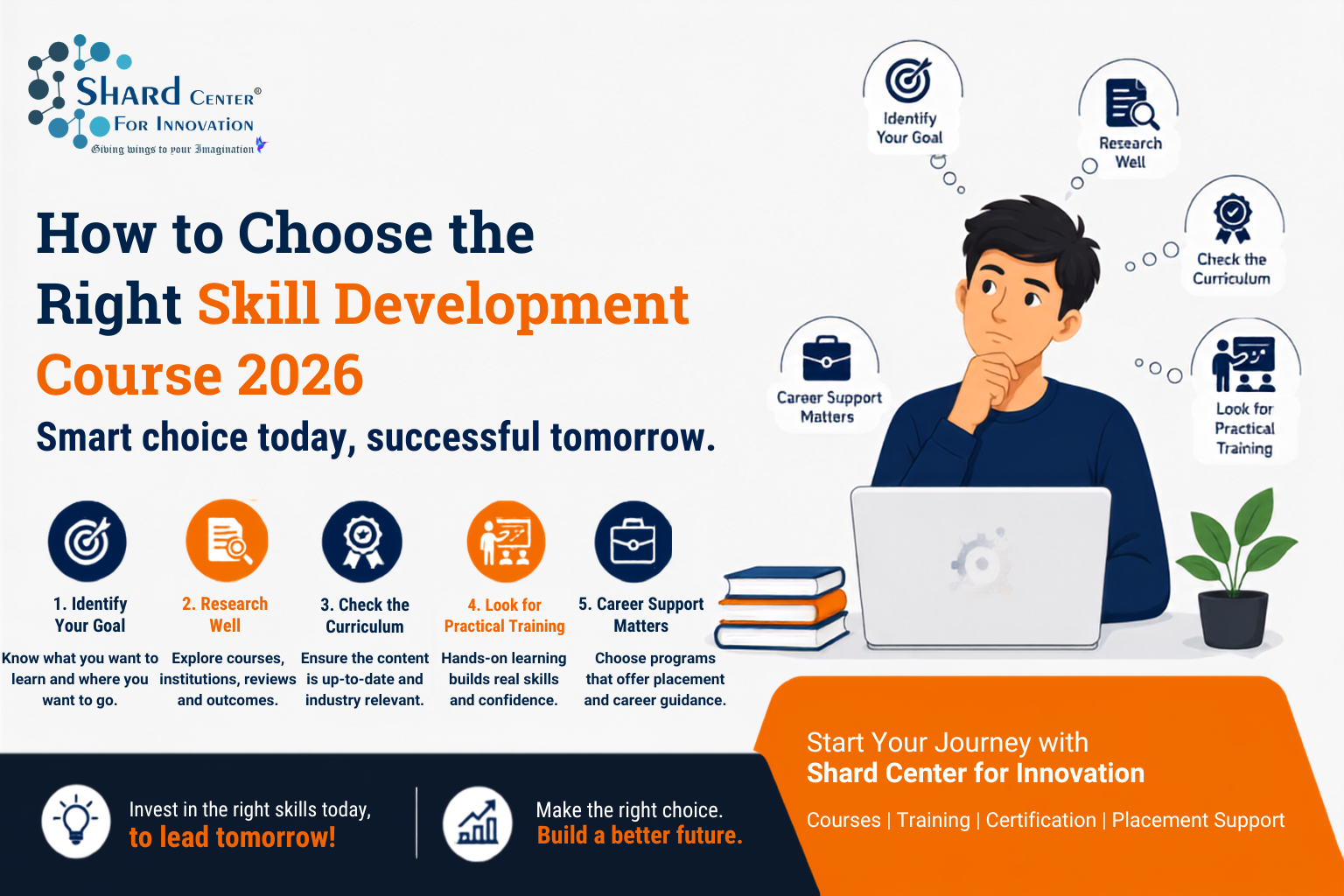
How to Choose the Right Skill Development Course
Choosing a skill development course after 12th can feel overwhelming. There are thousands of options, every ad promises the world, and the wrong choice costs you time, money, and momentum. So how do you choose well? This is a practical, honest framework, no hype, just the questions that actually matter.
The core principle to hold onto: the best course isn't the most famous or the most expensive. It's the one that fits you, your interests, your goals, and how you learn.
Step 1: Start With Yourself, Not the Course
Before comparing courses, understand what you want. Ask yourself three honest questions. What genuinely interests me, do I light up around AI, building robots, working with data, designing things? How do I learn best, hands-on and practical, or theoretical and analytical? And what's my goal, a skill alongside my degree, a fast route to earning, or exploring a field I'm curious about?
Your answers narrow the field immediately. A course you're genuinely curious about is a course you'll actually finish, which matters more than any brochure claim.
If you're still early in this journey, even in school, SCIL's Young Scientist Programme is a low-pressure way to explore several fields and discover what genuinely excites you before committing.
Step 2: Judge the Course on What Matters
Once you know what you want, evaluate courses on the things that actually predict value, not the marketing.
Is it hands-on? The single biggest factor. Look for real projects and building, not just videos to watch. You learn skills by doing them.
Who teaches it? Instructors with genuine industry experience bring current, practical knowledge that a purely academic teacher often can't.
Is there a real progression? Good courses build step by step, from fundamentals to genuine capability, rather than dumping information.
Does it produce a portfolio? You should finish with things you built and can show. If a course produces nothing demonstrable, be cautious. (This ties directly to Certification Programs for Students Is it current? Technology moves fast. Check the curriculum reflects what industry uses now.
Step 3: Match the Format to Your Life
Courses come in different intensities, and the right format depends on your situation. Short courses for professionals suit you if you want to add a specific skill alongside a degree, test a field before committing, or upskill quickly. Full-time courses for professionals suit you if you're ready to commit seriously and want deeper, career-ready expertise.
Neither is better in the abstract, they're better for different people and goals. Be honest about how much time and commitment you can genuinely give. (Still deciding on a field? Revisit Top 10 Skill Development Courses After 12th
Step 4: Check the Provider, Not Just the Course
The institute behind a course matters. A credible provider offers better mentorship, more recognised certification, and a curriculum that's kept current. Look at their track record, their approach to teaching, and whether their philosophy matches how you want to learn.
For instance, it's worth understanding why SHARD Center for Innovation built its model around experiential, project-based learning aligned to NEP 2020, precisely the hands-on approach this framework points toward, rather than the passive, lecture-based format.
Step 5: Avoid the Common Traps
A few honest warnings. Don't choose by hype alone, the trendiest course isn't automatically right for you. Don't fall for inflated salary promises, real careers are built over years, not guaranteed by one course. Don't pick purely on price, the cheapest video course with no projects often costs you more in wasted time than a slightly pricier hands-on one. And don't ignore your own interest, the "practical" choice you have no passion for is the one you'll abandon.
A Simple Decision Checklist
Before you enrol, tick these off:
□Does this genuinely interest me?
□Is it hands-on and project-based?
□Do the instructors have real industry experience?
□Will I finish with a portfolio I can show?
□Is the format (short or full-time) right for my situation?
□Is the provider credible and the curriculum current?
If you can tick most of these, you've likely found a course worth your time.
The Takeaway
Choosing the right skill development course comes down to knowing yourself first, then judging courses on substance, hands-on learning, real teachers, genuine progression, and a portfolio, rather than marketing. Match the format to your life, check the provider, and avoid the hype traps. Do that, and your time and money go toward something that actually pays off.
Ready to find your fit? Explore SCIL's admissions and talk through the programme that matches your goals.
(FAQs) Frequently Asked Questions
Q1: How do I know which skill course is right for me?
Ans. Start with your own interests, learning style, and goals, then choose a hands-on, project-based course in a field you're genuinely curious about. Fit matters more than fame or price.
Q2: Should I choose a short course or a full-time course?
Ans. Short courses suit adding a skill alongside a degree or testing a field. Full-time courses suit those ready to commit to deeper, career-ready training. It depends on your goals and time.
Q3: How important is the institute behind the course?
Ans. Very. A credible provider means better mentorship, recognised certification, and a current curriculum, all of which affect how much the course actually helps you.
Q4. Should we choose a certification course or a skill-based course?
Ans. It depends on which course you would like to pursue; a certification course provides certificates of recognition, whereas a skill-based course focuses more on skill development, so it is always better to choose a course with both skill development and certification.
Q5. How do we get to know if a particular course is best suited for a beginner?
Ans. We can look at the eligibility and the level of the course. Mostly courses that have beginner-friendly syllabus are best suited.
Q6. How important is the course curriculum?
Ans. The course curriculum is extremely important because it defines what you will be learning in the course. It is better to choose a course with an updated syllabus and one that provides practical knowledge about the skill needed in the market.
Q7. How important is the reputation of the institution for choosing a skill development course?
Ans. A lot of people choose their course based on the reputation of the institution. So it is better to check out the credibility, experience, faculty, feedback, practical exposure, certifications, and placement opportunities offered by the institution before choosing any course.
Q8. Should placement support be a deciding factor while choosing the course?
Ans. Placement support or career assistance is more important if our prime motive was career development; hence it is better to go through the services available, like interview preparation, career counseling, internships, and job placements.
Q9. Does a skill development course have a time limitation?
Ans. There is no specific time frame for skill development courses since it mostly depends on the subject or the course which one is looking to enroll in. It is better to choose a course that has sufficient time for you to grab theoretical as well as practical knowledge.
Q10. What are the advantages of choosing the right skill development course?
Ans. The advantages of choosing the right skill development course include enhanced knowledge and practical learning, self-confidence, job opportunities, certifications, and recognition.