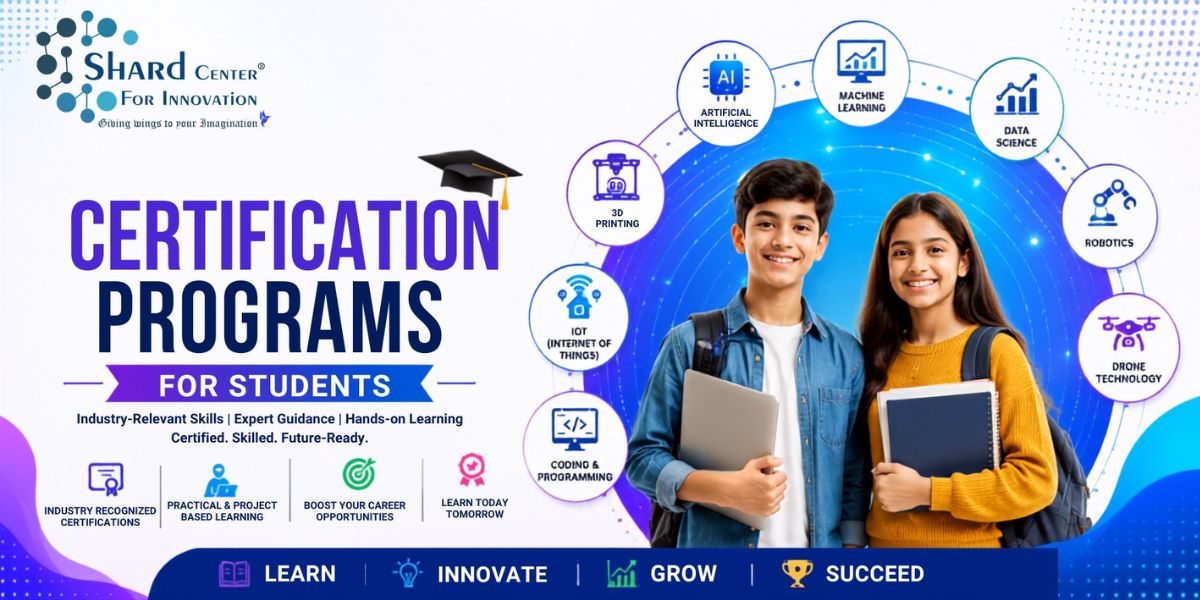
Certification Programs for Students
"But is it certified?" It's one of the first questions students and parents ask about any skill course, and rightly so. A certificate feels like proof that the time and money were worth it. But certifications are widely misunderstood; some are genuinely valuable, others are barely worth the PDF they're printed on. Here's an honest guide to which is which.
Let's start with the uncomfortable truth: a certificate on its own doesn't get you hired. What it does, when it's a good one, is back up something more important. Let's unpack that.
What a Certification Actually Does
A good certification does three real things. It validates that you've learned a defined set of skills. It signals to schools, colleges, and employers that you took the initiative to build them. And it structures your learning, giving you a clear path and a goal to work toward.
What it does not do is substitute for actual ability. This is the key misunderstanding. In technology fields especially, a certificate paired with a portfolio of real projects is powerful; a certificate with nothing behind it is just a piece of paper. Employers can tell the difference quickly.
If you're building these credentials from a young age, SCIL's Young Scientist Programme lets school students earn recognised certifications while they learn, giving them an early, genuine head start.
What Makes a Certification Genuinely Worth Having
Not all certificates carry equal weight. The valuable ones tend to share a few features. They're backed by real projects, so the certificate reflects things you actually built. They come from a credible provider whose name means something to schools or employers. They're skill-specific, certifying a defined, in-demand ability rather than a vague "completion." And they're current, covering skills the market actually wants now.
A certificate that ticks these boxes is a genuine asset. One that's simply a "certificate of attendance" for watching some videos is not.
How Employers and Colleges Actually View Them
Here's the honest reality, and it varies. For college applications, a strong certification demonstrates initiative and genuine interest, which admissions teams value. For employers, particularly in tech, what matters most is proof you can do the work, so a certificate supported by a demonstrable portfolio carries real weight, while a bare certificate carries little.
The pattern is consistent: a certification is a supporting actor, not the star. The star is what you can actually build. That's why the best programmes tie certification tightly to hands-on projects. (This connects directly to How to Choose the Right Skill Development Course.
The Certificate-Plus-Portfolio Formula
The single most important idea in this article: certification and portfolio work together. Think of it this way, the certificate says "I learned this," and the portfolio says "here's proof." Together they're convincing. Apart, each is weak.
So when you take any certified course, treat the projects as seriously as the certificate itself. Save your work, document what you built, and be ready to show it. That combination is what actually opens doors, a theme we return to in Career Opportunities After Skill-Based Training.
Certifications Through Short and Full-Time Courses
You can earn worthwhile certifications at different depths. Short courses for professionals give you focused, certified skills quickly, ideal alongside a degree, while full-time courses for professionals offer deeper certification backed by substantial project work. Both, done well, come with the portfolio that makes the certificate meaningful.
A Realistic Warning
Be wary of "certificate mills", courses that promise impressive-sounding certificates for minimal effort and no real projects. They're often expensive, and employers see through them fast. A cheaper course that makes you build real things will serve you far better than a costly one that just hands out paper. Value the learning, not the certificate for its own sake.
How to Present a Certification So It Actually Helps
Earning a certificate is only half the job, using it well is the other half. Once you've completed a certified course, make the certification work for you. Add it to your CV or college application with the specific skills it represents, not just the course name. Link it to the projects you built, so anyone reviewing it can see the proof behind the paper. Mention it in interviews as evidence of initiative and genuine interest, not as the whole argument for hiring you. And keep a simple, shareable portfolio, a folder, a website, a GitHub, where the certificate and the work sit side by side. Presented this way, a good certification stops being a passive line on a page and becomes active evidence of what you can do.
The Takeaway
Certification programs for students are genuinely worthwhile, but only when the certificate reflects real, demonstrable skill. Choose credible, project-based, skill-specific programmes, and always pair the certificate with a portfolio that proves what you can do. That combination is what actually helps your college applications and career.
Ready to earn a certification that means something? Explore SCIL's admissions and find a project-based, certified programme to start with.
(FAQs) Frequently Asked Questions
Q1: Are certification programs worth it for students?
Ans: Yes, when they're project-based and from a credible provider. A certificate backed by real work you can show is valuable; a certificate with nothing behind it is not.
Q2: Do employers value certifications?
Ans: In technology fields, employers value proof of ability most. A certification supported by a demonstrable portfolio carries real weight; a bare certificate carries little on its own.
Q3: Can school students earn recognized certifications?
Ans: Yes. Programs like SCIL's Young Scientist Programme let school students earn recognised certifications while learning, giving them an early advantage.
Q4. Is online or offline certification better for students?
Ans: Both types can be relevant, but practice and instructor-based training are better since they help students learn the material through experience.
Q5. Does this type of training affect a student’s career in any way?
Ans: Yes, this kind of training may positively influence a student’s future career because it includes both acquiring a necessary skill set and experience which helps develop a strong portfolio.
Q6. Does a student need to have technical skills before or during the training process?
Ans: This question depends on the level of the course because there are courses available for beginners which do not presuppose having technical skills.
Q7. What is the duration of a student certification program?
Ans: The student’s certification program may last for several weeks or months depending on the level and the technology used.
Q8. Are practical projects an obligatory part of the certification program?
Ans: Yes, students must have practical projects because they show a student’s ability to solve problems and possess the knowledge.
Q9. Does certification help students decide on a career choice?
Ans: Yes, certification helps the students know about the appropriate technologies and it can help the students to decide which specialization to choose. The students can do smaller courses to understand their preference and then opt for a career choice.
Q10. What are the things that students need to think about when selecting a certification program?
Ans: The main things that the students should consider when selecting a certification program are as follows: