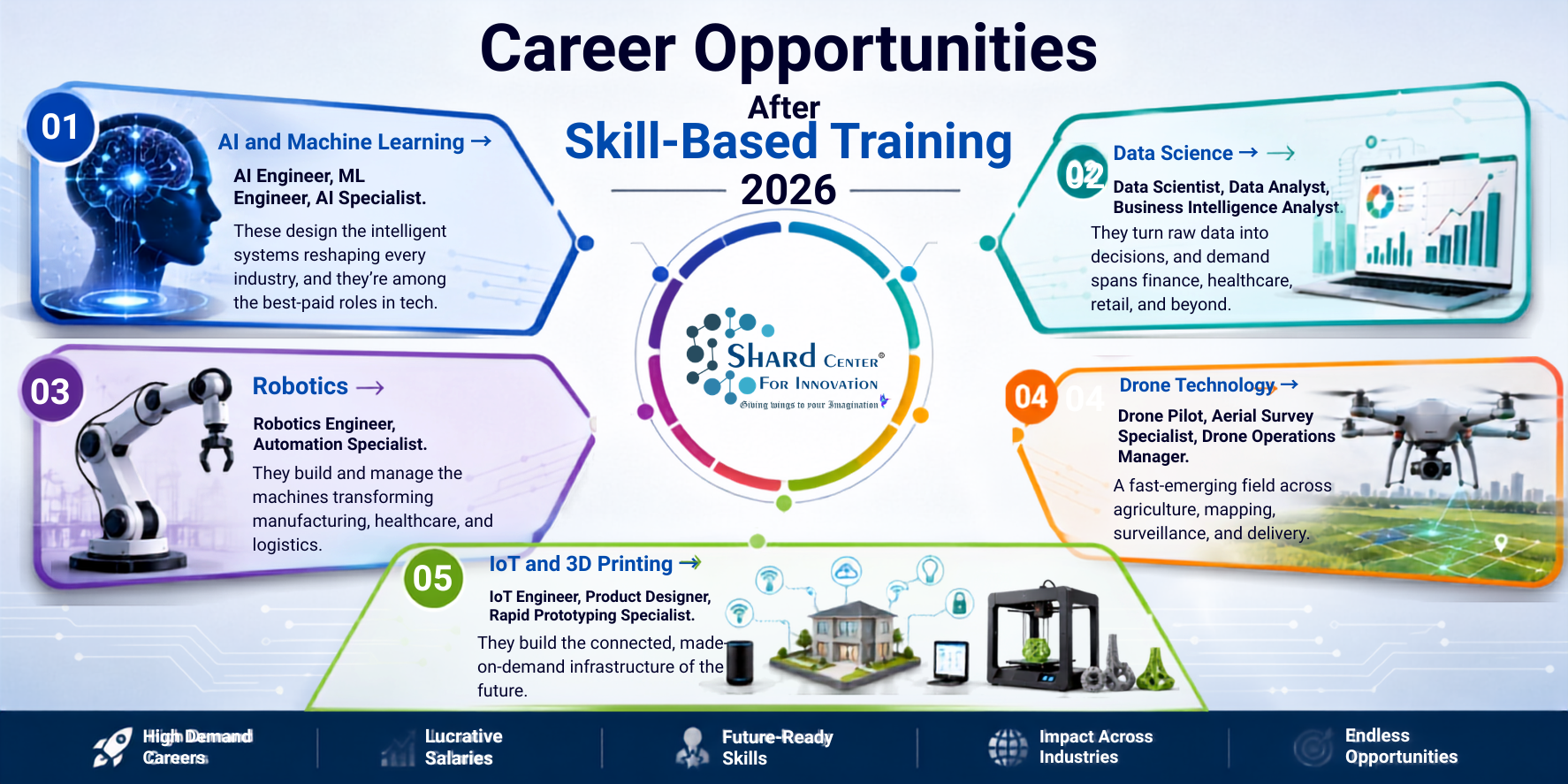
Career Opportunities After Skill-Based Training
Skill development only truly matters if it leads somewhere. So let's answer the question directly: what career opportunities actually open up after skill-based training? The honest answer is genuinely exciting; these skills lead into some of the fastest-growing, best-paid roles of the decade. Here's a clear map of where different paths can take you.
One realistic framing before we start: skills open doors, but you still walk through them. Training gives you the qualification; effort, a portfolio, and continued learning turn it into a career.
Why the Timing Is Good
The job market is shifting in favor of skilled, tech-capable people. The World Economic Forum's Future of Jobs Report 2025 identifies AI and machine learning specialists, big data specialists, and related tech roles among the fastest-growing jobs through 2030. As routine work gets automated, the demand for people who can build and manage technology only rises. Entering this field now, with real skills, is genuinely good timing.
If you're building toward this from school, SCIL's Young Scientist Programme helps students develop these foundations early, so the career door is already opening by the time they finish 12th.
The Career Paths, Explained
Here's what different skill tracks can lead to.
AI and Machine Learning → AI Engineer, ML Engineer, AI Specialist. These design the intelligent systems reshaping every industry, and they're among the best-paid roles in tech.
Data Science → Data Scientist, Data Analyst, Business Intelligence Analyst. They turn raw data into decisions, and demand spans finance, healthcare, retail, and beyond.
Robotics → Robotics Engineer, Automation Specialist. They build and manage the machines transforming manufacturing, healthcare, and logistics.
Drone Technology → Drone Pilot, Aerial Survey Specialist, Drone Operations Manager. A fast-emerging field across agriculture, mapping, surveillance, and delivery.
IoT and 3D Printing → IoT Engineer, Product Designer, Rapid Prototyping Specialist. They build the connected, made-on-demand infrastructure of the future.
Each of these traces back to a specific learning path, which we cover in Technology Courses with High Career Potential .
Beyond a Salaried Job: Other Paths
Employment isn't the only destination. Skill-based training opens several routes.
There's freelancing, offering skills like data analysis, design, or development to clients worldwide. There's entrepreneurship, using tech skills to build your own product or startup, increasingly viable for young founders. There's further study, where a strong skills base makes you a stronger candidate for advanced technical degrees. And there's the gig and project economy, where demonstrable skills let you take on varied, well-paid project work. Skills give you options a degree alone often doesn't.
The Jobs That Don't Exist Yet
Here's a crucial point for anyone planning a career today. Many of the roles you'll eventually hold haven't been invented. A decade ago, "prompt engineer" and "AI ethicist" weren't job titles. Technology creates new roles constantly.
This is exactly why adaptable, foundational skills beat narrow specialization. A student with strong problem-solving, coding, and computational thinking can move into whatever emerges, rather than being tied to one job description that might change. Building that adaptable base is the real career insurance. (It's also why skill development matters in the first place; see Why Skill Development Matters After 12th.
What Actually Turns Training Into a Career
Skills alone don't land the job, a few things bridge the gap. A portfolio of real projects proves what you can do. Continued learning keeps you current as the field moves. Networking and community, contests, clubs, events, and open real opportunities. And initiative, the willingness to build things beyond what a course requires, is what employers notice most.
The deeper your training, the stronger your starting position. Short courses for professionals get you career-relevant skills quickly, while full-time courses for professionals build the depth that higher-level roles reward.
A Realistic Note on Expectations
Let's stay honest. Entry-level roles in these fields are good but not instantly lucrative; the strong salaries come with a few years of proven skill. Not everyone lands their dream role immediately, and building a career takes persistence. But the direction is genuinely favorable: these fields are growing, they pay well over time, and skilled people are in demand. Go in with realistic patience, and the long-term outlook is excellent.
The Takeaway
Career opportunities after skill-based training are real and expanding, from AI and data science to robotics, drones, freelancing, and entrepreneurship. The key is to build adaptable, foundational skills, back them with a portfolio, and keep learning. Do that, and you're positioned for careers that are growing precisely as many traditional ones shrink.
Ready to start building toward one of these careers? Explore SCIL's admissions and take the first real step.
(FAQs) Frequently Asked Questions
Q1: What jobs can I get after skill-based training?
Ans: Depending on your track, roles like AI engineer, data scientist, robotics engineer, drone specialist, and IoT engineer, plus freelancing and entrepreneurship options, are all fast-growing fields.
Q2: Do I need a degree as well as skills to get these jobs?
Ans: Not always, though combining both is strongest. In many tech fields, a solid portfolio of real projects can open doors even without a traditional degree.
Q3: Are these careers stable long-term?
Ans: The fields of AI, data, robotics, and automation are long-term structural growth areas, not fads. Building adaptable, foundational skills keeps you relevant even as specific roles evolve.
Q4. Can skill-based courses help with employment?
Ans: The practical training involved in skill-based education empowers an individual with skills required by employers.
Q5. Can I join any skill-based course for beginners?
Ans: Yes, several courses offer a comprehensive package starting with the basic concepts of a skill before moving onto more complex lessons.
Q6. Are certificates relevant during job placements after undergoing skill-based training?
Ans: Certificates only indicate that one has undergone a certain type of training. Practical knowledge and the implementation of one’s skill-based training are key factors in job placements.
Q7. Does skill-based training help in doing freelance jobs?
Ans: Skills such as graphic designing, coding, and marketing require one to be a freelancer. Freelance opportunities are created through video editing, web development, and other related skills.
Q8. How does practical training during the courses benefit an individual in terms of career?
Ans: Practical training during the courses enables one to gain an in-depth understanding of the concepts and the ability to apply the skills in real-life scenarios and the workplace.
Q9. How to choose the best skill development course?
Ans: The best skill development courses are selected by considering personal interests and career objectives, curriculum, practical training options, teaching staff, certification, and career support.
Q10. Can skill-based training support reskilling for better career growth?
Ans: Skill-based training enables one to obtain new skills or knowledge to further one’s career growth. Reskilling is significant for those seeking to switch careers or specialize in a particular field.