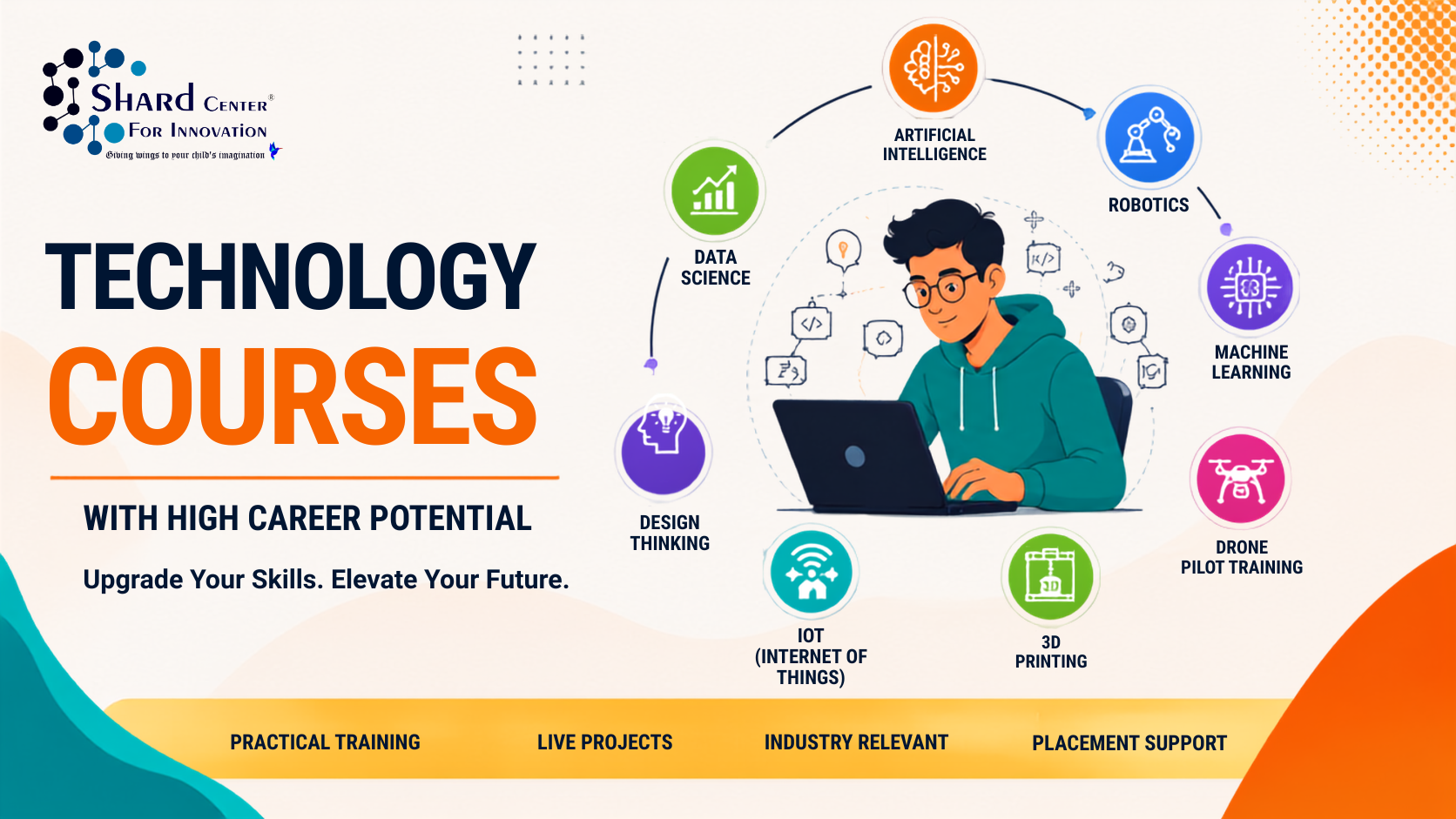
Technology Courses with High Career Potential
Not all skills are created equal. Some open doors to fast-growing, well-paid careers; others are pleasant but crowded. If you're investing time and effort after 12th, it makes sense to know which technology courses genuinely carry the highest career potential in 2026. Here's an honest guide, grounded in where the demand actually is.
A word of realism first: "high potential" doesn't mean "guaranteed job." It means strong, growing demand and good pay for those who build real skill. The effort still has to come from you.
What Makes a Course "High Potential"?
Three things, really. First, demand — are employers actively hiring, and is that growing? Second, pay — do these roles command strong salaries? Third, durability — will the skill still matter in five years, or is it a passing fad? The fields below score well on all three.
The World Economic Forum's Future of Jobs Report 2025 names AI, big data, and technological literacy among the fastest-growing skills of the decade, with 86% of employers expecting AI to transform their business by 2030. That's the backdrop for everything that follows.
If you're still in school and want to build toward these fields early, SCIL's Young Scientist Programme introduces the foundations well before Class 12.
1. Artificial Intelligence and Machine Learning
The clearest high-potential field of all. AI and ML specialists are among the most sought-after professionals globally, and demand keeps climbing as AI spreads into every industry. An AI course or machine learning course positions you at the centre of this shift. The roles, AI engineer, ML engineer, are consistently among the best paid in tech.
2. Data Science
If AI is the engine, data is the fuel, and data scientists are the people who make it useful. Consistently ranked among the highest-paid and fastest-growing roles, data science applies across finance, healthcare, retail, and virtually every other sector. A data science course builds the Python, statistics, and modelling skills at its core.
3. Robotics
Automation is reshaping manufacturing, healthcare, agriculture, and logistics, and robotics engineers are in growing demand to build it. A robotics course develops a rare blend of mechanical, electronic, and software skills that's hard to automate away, which is part of what makes it durable.
4. Drone Technology
A genuinely emerging field with strong momentum. Drones are transforming agriculture, mapping, surveillance, delivery, and inspection, and India's drone sector is expanding fast with government backing. A drone pilot training course opens a specialised niche with relatively little competition today.
5. IoT and 3D Printing
IoT is building the connected, smart infrastructure of the future, while 3D printing is reshaping design and manufacturing. Both are strong, forward-facing skills, particularly valuable when combined with the fields above. (For where all these lead, see Career Opportunities After Skill-Based Training
The Skill That Ties Them Together: Coding
Underneath almost all of these sits one common foundation, coding. Whether you go into AI, data science, robotics, or IoT, the ability to program is the thread that connects them. If you're unsure where to start, building solid coding and computational-thinking foundations first makes everything else easier.
Choosing Depth: Short or Full-Time
High-potential fields reward depth, but you can build it at your own pace. Short courses for professionals are ideal for adding a targeted skill or testing a field, while full-time courses for professionals build the deeper, career-ready expertise these roles ultimately demand. (Not sure which field fits you? Start with Top 10 Skill Development Courses After 12th and How to Choose the Right Skill Development Course
A Realistic Note on "High Salary" Claims
Be a little sceptical of course ads promising huge salaries. Entry-level pay in these fields is good but not extravagant; the strong money comes with a few years of demonstrated skill and a real portfolio. Treat these courses as the start of a career path, not a lottery ticket, and the long-term potential is genuinely excellent.
Combining Skills Multiplies Your Value
One under-appreciated point: these fields are far more powerful together than alone. Someone who pairs data science with domain knowledge, or robotics with AI, or IoT with data analysis, becomes markedly more valuable than someone with a single isolated skill. Employers increasingly prize "T-shaped" people, deep in one area but capable across several. So while you should start with one field you're genuinely drawn to, keep an eye on the natural combinations. A drone specialist who also understands data analysis, for instance, can do things neither pure specialist can, and that intersection is often where the most interesting, best-paid work lives.
The Takeaway
The technology courses with the highest career potential in 2026, AI, machine learning, data science, robotics, drones, IoT, share strong demand, good pay, and staying power. But potential only becomes a career through real, hands-on skill and a portfolio that proves it.
Ready to invest in a high-potential path? Explore SCIL's admissions and find the right programme for your goals.
(FAQs) Frequently Asked Questions
Q1: Which technology course has the highest career potential?
Ans: AI and machine learning currently top the list for demand and pay, closely followed by data science. Robotics and drone technology are strong, fast-growing options too.
Q2: Do these high-potential courses require strong maths?
Ans:Some, like machine learning and data science, benefit from comfort with maths, but good courses build the necessary foundations. Fields like robotics and drones are more hands-on.
Q3: Are these skills future-proof?
Ans: No skill is permanent, but AI, data, and automation are long-term structural shifts, not fads. Building adaptable foundations in these areas is among the safer bets available.
Q4. Is it the right time to get into Data Science?
Ans: Yes! Many industries need skilled people who can analyze data and create insights for the organization to take strategic business decisions; hence, it's a good time to learn data science.
Q5. Is robotics the right field to choose?
Ans: Robotics is a perfect blend of electronics and coding through which you can automate various mechanical machines. These are useful in almost all sectors of the economy.
Q6. Is there a scope in drone technology?
Ans: Drones are used in almost all fields, including agriculture, and will be integrated more in the future
Q7. Do I need to learn coding for all these courses?
Ans: Yes! You need to learn coding to develop your career in AI, machine learning, data science, robotics, and IoT
Q8. Do these courses provide good job security?
Ans: Unfortunately, these courses do not provide job security, but if you have the necessary technical background, it might be easy for you to get a good-paying job.
Q9. Are these skills future-ready?
Ans: You may rest assured that these skills have a great future, as they are the next big thing. It's important to stay updated with the latest technology as it changes rapidly.
Q10. Are these skills needed to be learned all together?
Ans: Yes! You can learn two or more of these skills together, e.g., AI & Robotics, Drones & Data Science, etc.