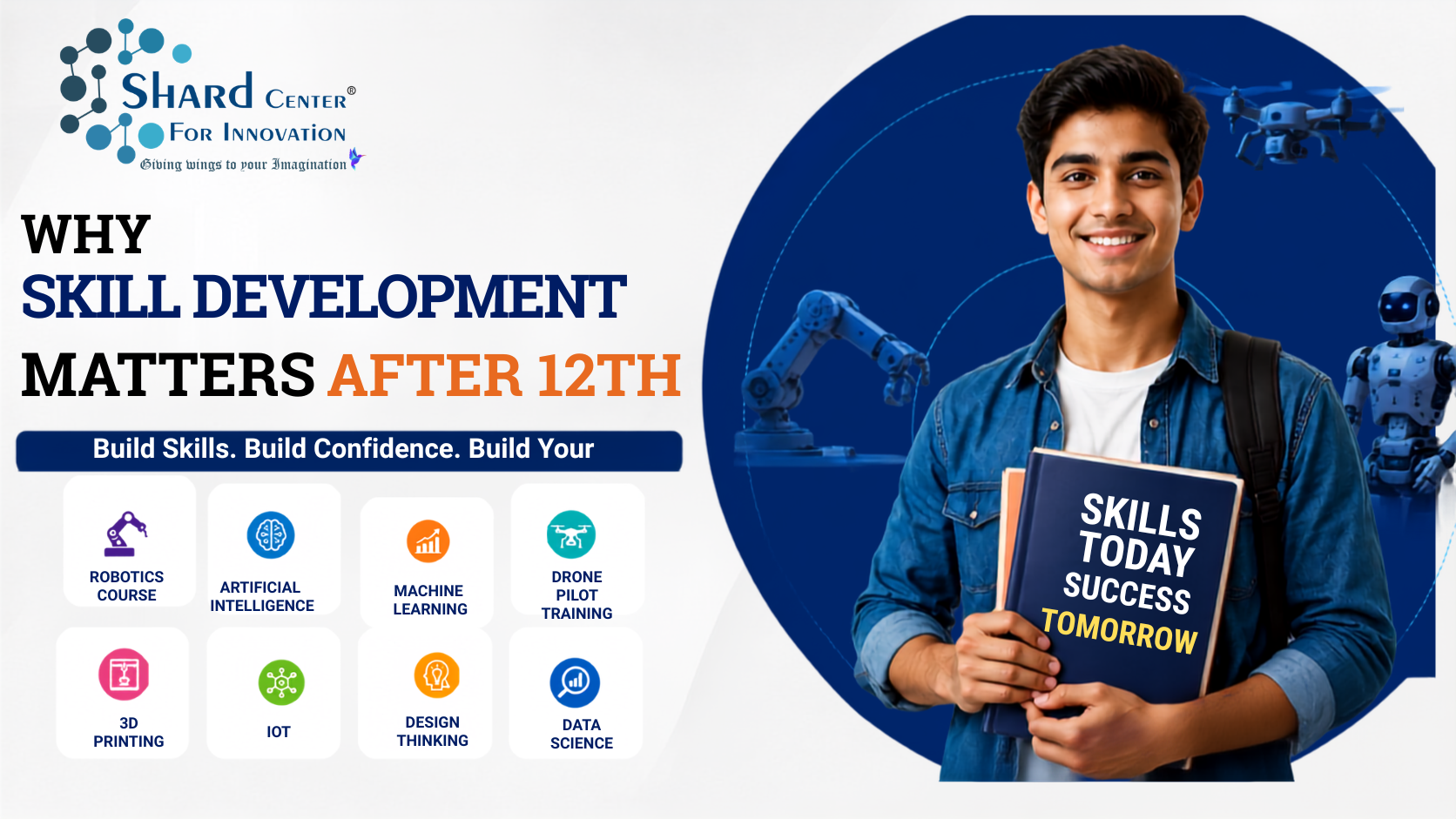
Why Skill Development Matters After 12th
For decades, the path after Class 12 felt certain. Get a degree, and a job would follow. That certainty is gone. Today, lakhs of graduates compete for jobs every year, and a degree alone no longer sets anyone apart. What does? The ability to actually do something useful.
That's the heart of why skill development matters after 12th. This isn't about abandoning education, it's about recognising that the kind of learning that pays off has changed. Let's look at why, honestly.
The Job Market Has Fundamentally Changed
Employers have shifted what they look for. A generation ago, a degree was proof of capability. Now, with so many graduates, it's just a baseline. Hiring managers increasingly ask a different question: not "what did you study?" but "what can you build, right now?"
This is playing out worldwide. The World Economic Forum's Future of Jobs Report 2025 estimates that around 39% of workers' core skills will be transformed or outdated between 2025 and 2030. In other words, the specific skills in demand are changing faster than traditional education can keep up, which makes the ability to learn practical skills quickly more valuable than ever.
If you want to start building that habit early, even while still in school, SCIL's Young Scientist Programme is designed to give students a head start on exactly these future-ready skills before Class 12.
Degree vs Skills: The Honest Truth
Let's be clear, this isn't "degrees are useless." That's an overcorrection. The honest position is more nuanced.
A degree still matters. It's essential for regulated professions, it teaches discipline and depth, and many employers still use it as a filter. But a degree by itself is no longer enough for the fast-growing technology economy. The graduates who struggle are often those who did everything "right" on paper but can't demonstrate a single practical skill.
The winners are the ones who pair the two: a degree for the credential, plus real skills for the edge. Skills are what turn a CV from "one of hundreds" into "let's interview this one."

What Skill Development Actually Gives You
Beyond employability, building real skills after 12th delivers things a lecture hall often can't.
It gives you confidence — the specific, earned confidence of knowing you can build something that works. It gives you a portfolio, tangible proof of ability that speaks louder than marks. It gives you adaptability, because learning how to learn a practical skill is itself a transferable skill. And it often gives you an earlier start, letting you begin earning or freelancing sooner than a degree-only path allows.
It's Not Just About Employment
There's a deeper benefit too. Skill development changes how you see yourself, from a passive consumer of technology into someone who can create with it. A student who can build an app, pilot a drone, or train an AI model relates to the modern world differently. That creator's mindset is valuable in any career, and in life.
Starting Early Is a Real Advantage
The students who benefit most are those who start before the last-minute scramble. Building foundational skills early means you arrive at big decisions, degree choices, career directions, already ahead, with real experience rather than guesswork.
For those ready to begin seriously after 12th, SCIL offers both short courses for professionals for focused, fast skill-building, and full-time courses for professionals for deeper, career-ready training. Which suits you depends on how much you want to commit, a choice we help you make in How to Choose the Right Skill Development Course.
A Realistic Caveat
Skill development isn't a magic shortcut. Collecting certificates without applying them achieves little; the value comes from actually building things and creating a portfolio. And no skill guarantees a job on its own, what it gives you is a genuine, demonstrable advantage. Approached seriously, that advantage is substantial.
The Cost of Doing Nothing
It's worth naming the flip side plainly. Choosing not to build any practical skills after 12th carries a real, if invisible, cost. Every year, more graduates enter the market with the same degrees, and the ones without demonstrable skills increasingly blur together in a hiring manager's inbox. The gap between "has a degree" and "can actually do the job" is widening, and those on the wrong side of it face longer job hunts and lower starting offers. Skill development isn't just about gaining an advantage, it's increasingly about not being left behind.
The Takeaway
Skill development matters after 12th because the world has changed. Degrees remain valuable, but on their own they're no longer enough. What sets students apart now is the ability to do real, useful things, and to keep learning as the world shifts. (For where this leads, see Career Opportunities After Skill-Based Training , and for the best options, Top 10 Skill Development Courses After 12th.
Ready to take the first step? Explore SCIL's admissions and find a programme that fits where you are right now.
Why Skill Development Matters After 12th
For decades, the path after Class 12 felt certain. Get a degree, and a job would follow. That certainty is gone. Today, lakhs of graduates compete for jobs every year, and a degree alone no longer sets anyone apart. What does? The ability to actually do something useful.
That's the heart of why skill development matters after 12th. This isn't about abandoning education, it's about recognising that the kind of learning that pays off has changed. Let's look at why, honestly.
The Job Market Has Fundamentally Changed
Employers have shifted what they look for. A generation ago, a degree was proof of capability. Now, with so many graduates, it's just a baseline. Hiring managers increasingly ask a different question: not "what did you study?" but "what can you build, right now?"
This is playing out worldwide. The World Economic Forum's Future of Jobs Report 2025 estimates that around 39% of workers' core skills will be transformed or outdated between 2025 and 2030. In other words, the specific skills in demand are changing faster than traditional education can keep up, which makes the ability to learn practical skills quickly more valuable than ever.
If you want to start building that habit early, even while still in school, SCIL's Young Scientist Programme is designed to give students a head start on exactly these future-ready skills before Class 12.
Degree vs Skills: The Honest Truth
Let's be clear, this isn't "degrees are useless." That's an overcorrection. The honest position is more nuanced.
A degree still matters. It's essential for regulated professions, it teaches discipline and depth, and many employers still use it as a filter. But a degree by itself is no longer enough for the fast-growing technology economy. The graduates who struggle are often those who did everything "right" on paper but can't demonstrate a single practical skill.
The winners are the ones who pair the two: a degree for the credential, plus real skills for the edge. Skills are what turn a CV from "one of hundreds" into "let's interview this one."
What Skill Development Actually Gives You
Beyond employability, building real skills after 12th delivers things a lecture hall often can't.
It gives you confidence — the specific, earned confidence of knowing you can build something that works. It gives you a portfolio, tangible proof of ability that speaks louder than marks. It gives you adaptability, because learning how to learn a practical skill is itself a transferable skill. And it often gives you an earlier start, letting you begin earning or freelancing sooner than a degree-only path allows.
It's Not Just About Employment
There's a deeper benefit too. Skill development changes how you see yourself, from a passive consumer of technology into someone who can create with it. A student who can build an app, pilot a drone, or train an AI model relates to the modern world differently. That creator's mindset is valuable in any career, and in life.
Starting Early Is a Real Advantage
The students who benefit most are those who start before the last-minute scramble. Building foundational skills early means you arrive at big decisions, degree choices, career directions, already ahead, with real experience rather than guesswork.
For those ready to begin seriously after 12th, SCIL offers both short courses for professionals for focused, fast skill-building, and full-time courses for professionals for deeper, career-ready training. Which suits you depends on how much you want to commit, a choice we help you make in How to Choose the Right Skill Development Course .
A Realistic Caveat
Skill development isn't a magic shortcut. Collecting certificates without applying them achieves little; the value comes from actually building things and creating a portfolio. And no skill guarantees a job on its own, what it gives you is a genuine, demonstrable advantage. Approached seriously, that advantage is substantial.
The Cost of Doing Nothing
It's worth naming the flip side plainly. Choosing not to build any practical skills after 12th carries a real, if invisible, cost. Every year, more graduates enter the market with the same degrees, and the ones without demonstrable skills increasingly blur together in a hiring manager's inbox. The gap between "has a degree" and "can actually do the job" is widening, and those on the wrong side of it face longer job hunts and lower starting offers. Skill development isn't just about gaining an advantage, it's increasingly about not being left behind.
The Takeaway
Skill development matters after 12th because the world has changed. Degrees remain valuable, but on their own they're no longer enough. What sets students apart now is the ability to do real, useful things, and to keep learning as the world shifts. (For where this leads, see Career Opportunities After Skill-Based Training and for the best options, Top 10 Skill Development Courses After 12th.
Ready to take the first step? Explore SCIL's admissions and find a programme that fits where you are right now.
FAQs (Frequently Asked Questions)
Q1: Is a degree still worth it after 12th?
Ans. Yes, especially for regulated professions and for depth of knowledge. But for the technology economy, a degree works best when paired with demonstrable practical skills.
Q2: Can skills alone get me a job without a degree?
Ans. In many technology fields, a strong portfolio of real projects can open doors even without a traditional degree, though combining both is usually the strongest position.
Q3.When should I start skill development?
Ans. As early as possible. Starting before or right after 12th gives you a real head start, with hands-on experience rather than guesswork when making career decisions.
Q4. Are AI and Machine Learning are good skills for students after 12th?
Ans. This set of skills is ideal for the students who have an interest in technical subjects, and want to increase their problem-solving abilities. From basic concepts to real-time application, these skills can be acquired.
Q5. How do skills development boost career readiness?
Ans. With the development of technical expertise, soft skills like communication, teamwork, project management, and problem-solving, and managerial skills, students can easily grab every career opportunity that comes their way.
Q6. Does having a degree matter even in 2026?
Ans. With degrees, students can get in-depth knowledge about a particular domain while skill-based training offers additional skill sets required for the professional world. Thus, both add value to the students learning curve.
Q7. How can students develop the best skill set?
Ans. Depending on one's interests, expertise, understanding, curriculum, training, instructor, and project-based learning, students can choose the best skills needed for their career.
Q8. How can students after 12th develop technical skills?
Ans. After 12th, students can join the best institutes to begin with, the foundational knowledge and training about their area of interest. These learning institutes also offer the basic required skills for an individual to grasp the technical expertise easily and work in the professional world with ease. Thus, technical expertise can be gained by anyone after 12th, provided they have the right mentorship and training.
Q9. What is the importance of hands-on learning in skill development?
Ans. Students can gain adequate theoretical and practical knowledge with enhanced problem-solving abilities and skills through hands-on learning and experimenting in the real-world.
Q10. Why is skills development important in 2026?
Ans. As the world moves towards technological advancements and new developments, students need the best skill set to navigate the changing world and take advantage of new opportunities.