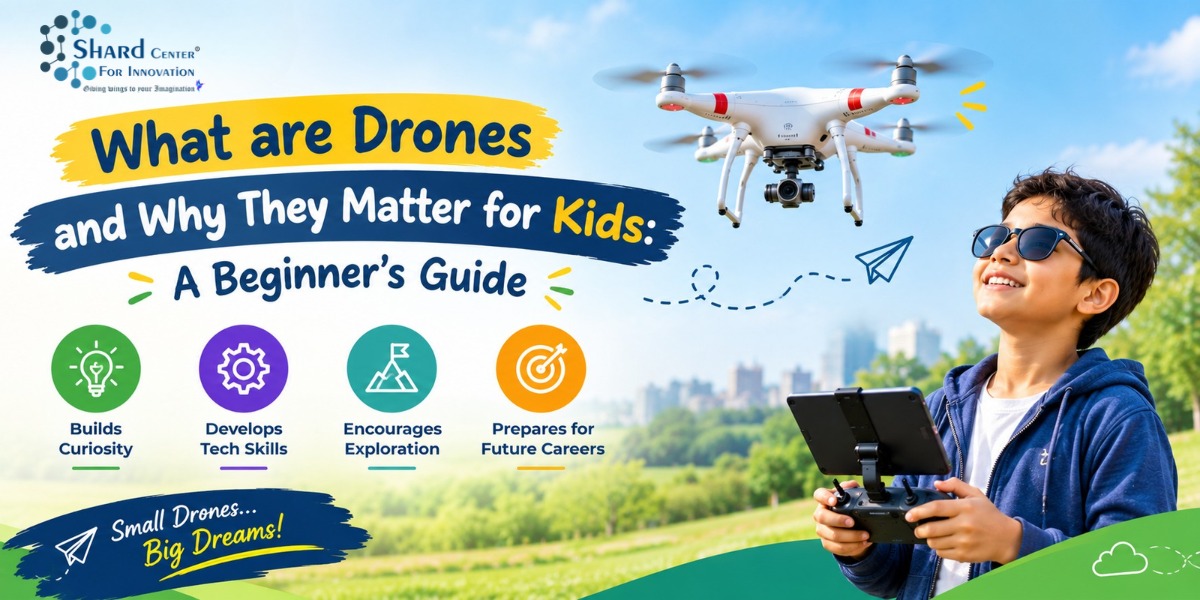
Drones today are utilized in many industries ranging from defense to food deliveries. Learning drone technology matters for kids as it prepares them for many future careers in engineering, defense, logistics, etc. What Are Drones and Why They Matter for Kids: A Beginner’s Guide explains the importance of drone technology for children and their applications.
What is a drone?
A drone is a remote-controllable unmanned aerial vehicle (UAV) that can fly on its own. Drones range from small toy-like shapes to large professional drones that are utilised in industry. They increasingly have applications in logistics, photography, agriculture, defense and education. They are very popular in STEM education, and kids learn drone technology to gain an insight into engineering, robotics and aerodynamics.
How Do Drones Work?
Drones work by utilizing a
combination of flight control systems, sensors and wireless communication. They
include the following basic components: a frame or a structure that
holds components together, motors and propellers that allow the drone to
gain flight, a battery to power the drone, electronic speed
controllers to control the speed of the motors, a flight controller
which is the drone’s brain and controls it for stability and movement, and a remote
control or GPS system which is used in navigating the drone. Many drones
also use gyroscopes and accelerometers to maintain balance and for
smooth flying.
Why Are Drones Relevant for Kids?
Drones offer a rich STEM learning experience to kids by offering them hands-on learning as they learn how to build the drone from scratch. They also develop their problem solving and critical thinking skills as they iterate to make their drones fly and understand troubleshooting. Drone technology also introduces kids to coding and robotics courseas many drones can be programmed to teach children the basics of coding. Children also get the opportunity to practice their creativity and innovate as they develop their drones. Along with its recreational and educative applications, drone technology is also utilised in many industries such as defense and logistics, and provide students with future career opportunities. Integrating drones into education has also shown to improve the learning outcomes of students.
How Kids Can Learn About Drones Through Structured Learning
Students can learn about drone technology through structured, hands-on learning experiences. The process of learning drone technology involves design thinking and innovation as students are encourages to design their own drones through 3D printing learning or MDF structures. It provides a hands-on experience and fosters innovation and creativity as students develop drones through their DIY drone kits. Through structured workshops, students can apply their knowledge to real-world problems and understand how drones are applied in the fields of defense and logistics. Drone projects also introduce the students to aerodynamics, electronics and basic programming, developing their skills in these fields.
Building a Simple Drone
While building a simple drone from a
drone DIY kit, several things must be kept in mind. Firstly, the frame has to
be designed and assembled, either through a 3D frame cut or an MDF structure.
Then a motor has to be attached securely to the frame, and the flight
controller, ESCs and battery have to be connected. The propellers have to be
attached based on the correct rotation direction, and drone software has to be
utilized for programming flight settings. Before conducting the test flight,
ensure that everything is functioning properly. 
Safety Considerations
Safety considerations should be kept in mind while flying a drone. Students should be supervised while flying a drone, and drones should always be flown in open spaces without crowd and buildings. It is important to follow local drone regulations.
The Key Takeaway
Drone technology has become increasingly popular among students as a hands-on STEM activity that builds their applied technical skills. At Shard Center for Innovation, drone training courses are provided to children, which are designed for beginners and teach them how to fly their own drones, giving them a hands-on experience in technology and innovation.
Let your child become a drone course today! Join our drone training course to learn the basics of drone flying
in a fun and engaging manner.
Frequently Asked Questions (FAQs)
Q1. What is a drone?
Ans: A drone is an unmanned flying device controlled remotely or through automated systems.=
Q2. How do drones work?
Ans: Drones use motors, propellers, batteries, sensors, and controllers to fly and move in different directions.
Q3. Why are drones useful for kids to learn about?
Ans: Learning about drones introduces children to technology, engineering, creativity, and practical problem-solving.
Q4. At what age can children start learning about drones?
Ans: Children can explore basic drone concepts from an early age through age-appropriate activities and adult supervision.
Q5. What can kids learn in a drone training course?
Ans:They can learn drone components, basic flight controls, navigation, flying techniques, and safety rules.
Q6. Is flying a drone safe for children?
Ans: Yes, with suitable equipment, adult supervision, safety instructions, and practice in approved locations.
Q7. What skills do children develop through drone learning?
Ans: Drone activities help develop hand-eye coordination, logical thinking, observation, creativity, and problem-solving skills.
Q8. How are drones used in real life?
Ans: Drones are used in photography, agriculture, mapping, surveying, rescue operations, and environmental monitoring.
Q9. Do kids need coding knowledge to learn drone technology?
Ans: No. Beginners can start with basic drone operation. Coding can be introduced as they develop their technical knowledge.
Q10. How can parents introduce children to drone technology?
Ans: Parents can encourage children to join beginner-friendly drone learning programs that include practical activities and supervised flying sessions.