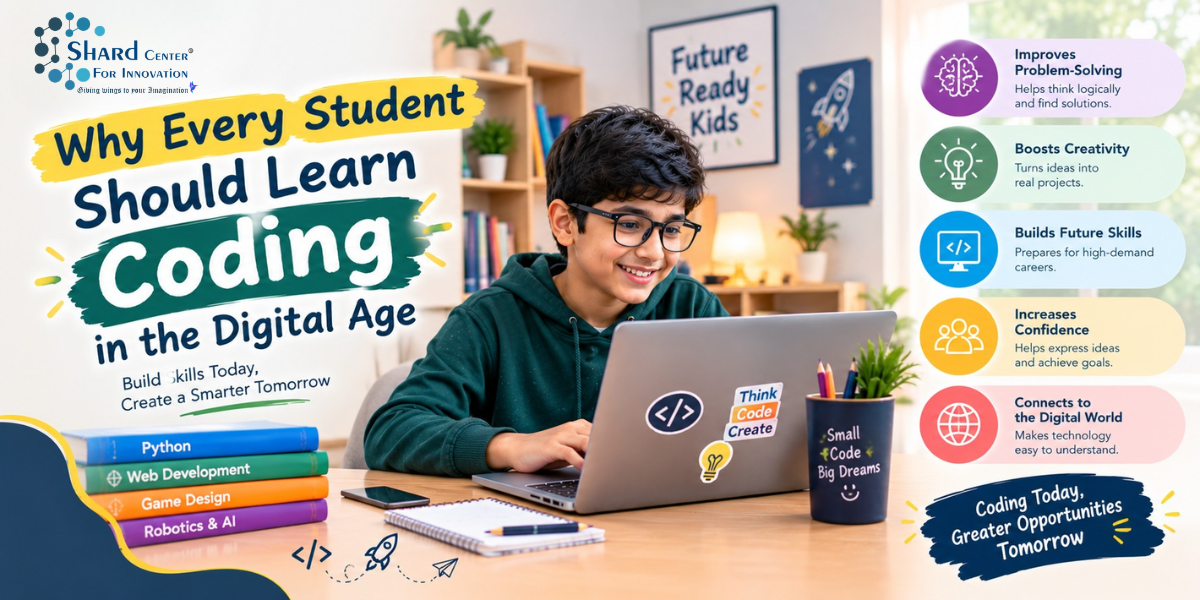
In the present age, coding has become a hype—parents are eager to teach their children coding skills. Why Every Student Should Learn Coding in the Digital Age matters, as it seeks to guide parents on the educational value of coding and shows how the activity can be made enjoyable and sustain learning. It is important for children to develop confidence and understanding of programming languages for their future development, especially if they seek a career oriented to IT and software engineering.
Coding Is More Than Learning a Programming Language
Coding is not merely learning the syntax of a programming language but about solving problems and developing critical thinking skills. Software is a tool that makes students think logically about a problem. Coding also influences everyday decision-making.
Computational Thinking and Breaking Down Problems
Coding encourages students to break down problems, as students require more than a final product to showcase their learning. Computational thinking includes decomposition, pattern recognition, abstraction, and algorithm design. Coding contributes to decomposition skills when bigger problems are broken into smaller ones, while pattern recognition is carried out when students spot reusable structures. Abstraction involves overlooking irrelevant details in coding while algorithm design involves writing code in precise steps.
Logical Reasoning, Patterns and Algorithms
Coding develops logical reasoning, patters and algorithms in an intertwined way. Every program is a reasoning step. Coding also encourages students to spot patterns as they appear and exploit them. Students learn to recognize problem patterns and code patterns as they appear and learn to see the structural similarity across different problems. Coding inherently involves designing, analyzing and implementing algorithms.
Creativity Through Games, Stories and Apps
Coding is creative in itself, as it builds something that doesn’t exist yet. Building a game through coding involves rules, feedback and imagination. Apps develop creativity through problem-solving for real users and design thinking.
Debugging Builds Persistence and Reflection
Debugging is believed to be unpleasant for most people but is an essential character-building activity in coding. It refers to finding and fixing errors in code and builds both persistence and reflection. It is a special process because failure here is guaranteed and informative. It provides objective feedback and encourages personal responsibility.
Digital Literacy and Responsible AI Use
Coding promotes digital literacy and responsible AI use by now converting individuals from passive consumers of technology to active participants. It allows individuals to form an understanding about how systems, including AI, actually work, effectively demystifying technology. Coding also provides the ability to critically assess outputs, understand ethical implications, and maintain human oversight.
How SHARD Can Support Meaningful STEM Learning
SHARD Center for Innovation supports meaningful STEM learning through offering age-appropriate programs in robotics, drone technology, AI/ML, IoT and 3D Printing. While we do not offer a dedicated coding program, many of these programs build similar skills as those taught by coding. Our lab program enables schools to set up interactive STEM labs in their schools, which deliver courses related to the mentioned STEM areas.
Frequently Asked Questions (FAQs)
Q.1. What is the main benefit of coding for students?
Ans: The biggest benefit of coding is in applying ideas, testing them, and improving them through iterations.
Q.2. At what age can students start coding for students?
Ans: Students can code when they are in primary school, and greater independence and technical complexity can be introduced later.
Q.3. Why is coding important for students in the digital age?
Ans: Coding helps students develop logical thinking, creativity, and problem-solving skills. It also helps them understand how digital tools, apps, websites, and games work.
Q.4. At what age should children start learning coding?
Ans: Children can start learning basic coding concepts around ages 5–7 through visual tools, games, and simple block-based programming, depending on their readiness.
Q.5. Does every student need to learn coding?
Ans: Not every student needs to become a software developer, but learning coding basics can help students understand technology and develop useful problem-solving skills.
Q.6. How does coding improve problem-solving skills?
Ans: Coding teaches students to break complex problems into smaller steps, test solutions, identify mistakes, and improve their work.
Q.7. Can students learn coding without prior technical knowledge?
Ans: Yes. Beginners can start with visual programming tools such as Scratch and gradually move to text-based languages such as Python.
Q.8. What career opportunities can coding skills provide?
Ans: Coding can support future pathways in software development, web development, game design, robotics, data science, and artificial intelligence.
Q.9. How can parents encourage children to learn coding?
Ans: Parents can introduce age-appropriate coding games, creative projects, beginner-friendly courses, and activities that encourage children to experiment and build things.
Q.10. How does coding help students develop creativity?
Ans: Coding allows students to turn their ideas into practical projects, such as games, animations, websites, and simple applications. It encourages them to experiment with different solutions, think creatively, and improve their projects through practice.
Authoritative Sources
- https://www.sciencebuddies.org/blog/engineering-challenges-elementary-school
- https://www.sciencebuddies.org/teacher-resources/lesson-plans/paper-bridge-design
- https://www.sciencebuddies.org/teacher-resources/lesson-plans/balloon-car
- https://code.org/en-US/curriculum
- https://studio.code.org/courses/ai-foundations-exploring-ai-and-cs-2026/units/6/lessons/2