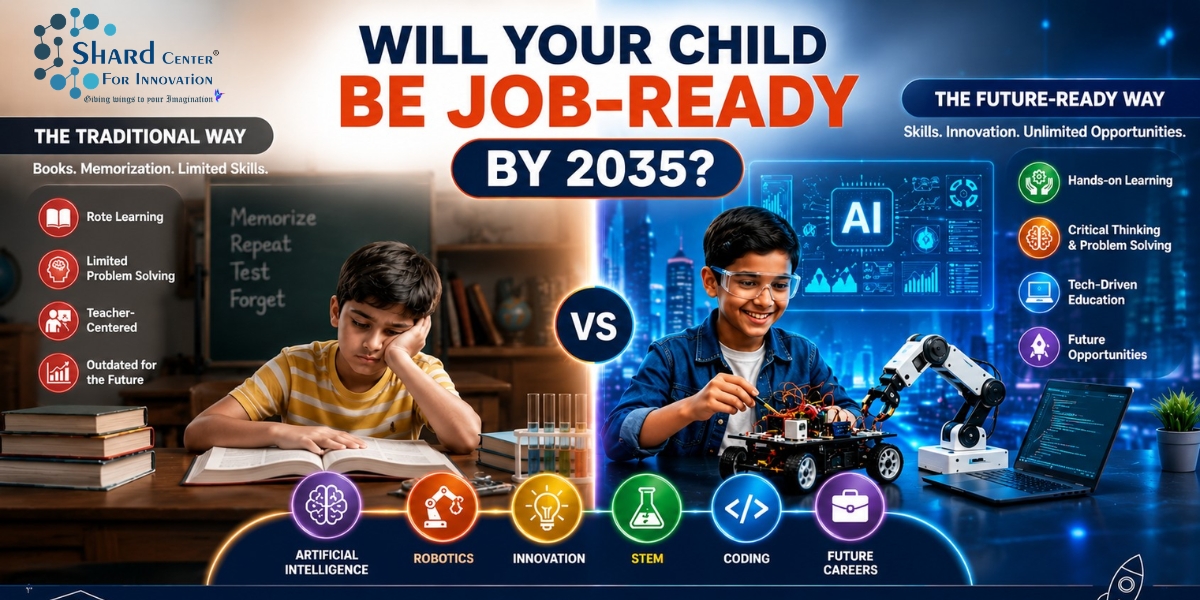
Just think about your kid graduating from college in the year 2035. The jobs market is going to change drastically since most of the repetitive jobs will have been taken over by automation, while many new career opportunities in AI, robotics, machine learning, data science, and automation will keep flourishing.
What parents should be asking at this point is not, “What career path should my child follow?”, but rather, “Does my child have the skills needed to succeed in these career fields?”
This increasing need for future education has already been emphasized in various publications as well. The latest issue of Business Today, for example, has focused on why early exposure to AI and robotics will help kids find jobs in the year 2035.
Why Traditional Learning Alone Isn't Enough
While academic excellence is always going to be valuable, future employers are becoming more interested in skills like:
Critical Thinking
Creativity
Problem Solving
Innovation
Collaboration
Digital Literacy
AI literacy
Knowledge of robotics & automation
Computational thinking
Design Thinking
Such skills can never be developed by simply memorizing things.
Why AI and Robotics Are Becoming Essential Skills
AI is already a part of our lives. Voice assistants, smart suggestions, driverless cars, disease diagnosis, or finance technology - AI is revolutionizing every field.
Likewise, robots have moved beyond factory settings. Robots are increasingly being used in:
Healthcare
Agriculture
Manufacturing
Space Exploration
Smart Cities
Education
Disaster Management
Home Automation
Kids who know how technology works now will innovate better in the future..
What Makes AI and Robotics Learning Different?
Studying AI and robotics is not merely about coding a robot or creating computer programs.
Skills that can be acquired by studying AI include:
Reasoning skills
Analysis skills
Innovative skills
Collaboration skills
Engineering skills
Design thinking
Ability to solve practical problems
It is not about knowing technology but learning how to make technology.
The Young Scientist Program: Learning Beyond the Classroom
As Shard Center for Innovation, we strongly believe that all children have the potential to be innovators.
Young Scientists Program at Shard Center is crafted in such a way that it will help your kids to ignite curiosity by hands-on experience with projects that include science, engineering, artificial intelligence, robotics, electronics, programming, and innovations.
In this program, children are encouraged to do the following:
Create functioning models
Learn science principles through experiments
Think innovatively
Solve problems
Collaborate in projects
Present their work with confidence
Courses That Prepare Students for Tomorrow
Shard Center for Innovation delivers industry-related courses which include both technological and practical education.
Artificial Intelligence (AI)
Students learn the basics of artificial intelligence, generative AI, prompt engineering, computer vision, and AI applications. Working on exciting projects, they see how intelligent systems work to solve routine problems and how intelligent technologies are implemented.
Robotics
In the Robotics course, students design, manufacture, and program robots; they learn about sensors, motors, automation, electronics, and intelligent systems. Exciting projects help students gain practical engineering experience.
Machine Learning (ML)
Students understand the machine learning process – how a machine learns to analyze data, detect patterns, and make intelligent decisions. They get acquainted with predictive analytics and recommendation system.
Data Science
The course familiarizes the students with the basics of data science, which include collecting, analyzing, visualizing, and interpreting the data. The course is designed to enhance the analytical thinking, problem solving, statistical reasoning, and decision making skills of the students.
Internet of Things (IoT)
In IoT course students learn to create intelligent devices with the help of sensors, microcontrollers, cloud computing platforms, and programming.
Design Thinking
The course introduces students to the principles of design thinking, enabling them to identify problems, generate creative ideas, and develop innovative solutions through a structured, human-centered approach. It fosters creativity, critical thinking, collaboration, empathy, and practical problem-solving skills, preparing students to tackle real-world challenges with confidence.
3D Animation
This program familiarizes students with all phases of the entire animation pipeline, from modeling characters to applying rigging and animating them, adding lights, creating renders, and telling a story. Industry standard workflows are learned here to help you enter the animated world.
VFX (Visual Effects)
In this VFX program, students will learn how Hollywood films are produced with the help of compositing, motion graphics, CGI, green screens, particles, and much more.
Architecture Visualization (ArchViz)
This course enables students to learn how architectural ideas can be presented in realistic 3D images with the help of modeling, rendering, lighting, texturing, and walkthrough animations.
3D Design & Printing
In this program, students will learn to create 3D designs and turn them into physical models with the help of advanced printing technology.
Why Parents Should Start Early
Studies show that children who participate in inquiry-based STEM education from an early age develop stronger problem-solving abilities, creativity, and critical thinking skills. Enrolling your child in a STEM admission program provides a strong foundation for future academic success while nurturing curiosity and innovation.
By starting early, kids:
Adapt themselves rapidly to the emerging technologies
Gain confidence
Enhance their communication skills
Grow resilient
Develop independence
Become innovators rather than users of technology
The earlier children get involved with technology, the better they will be at developing these skills.
Future Careers Your Child Could Explore
Tomorrow’s most rapidly expanding careers will definitely have AI, robotics, and technology skills involved.
These are some examples:
AI Engineer
Robotics Engineer
Machine Learning Engineer
Automation Expert
Drone Technology Expert
IoT Developer
Computer Vision Engineer
Cybersecurity Analyst
Space Technology Researcher
Smart Manufacturing Engineer
Product Innovation Expert
To prepare for such career options, one must first build the right foundation.
Why Choose Shard Center for Innovation?
Learning at Shard Center for Innovation is not limited to books.
This includes:
Project Based Learning
Labs for Artificial Intelligence and Robotics
Innovation Challenges
STEM Activities
Expert Mentorship
Practical Experiments
Skill Development for the Future
Industry Relevant Curriculum
Collaborative Learning
Our goal is very clear: enabling students to become creators, innovators, and future problem solvers and not merely users of technology.
Final Thoughts
Future professions in 2035 will be driven by creativity, adaptability, and technological expertise. As highlighted in the Business Today article, "Will your child be job-ready by 2035? Why AI, robotics learning can give your child a head start for future jobs," early exposure to emerging technologies can help children develop the skills needed for tomorrow's workforce.
Parents can give their children a strong foundation by introducing these concepts early through hands-on learning experiences such as the Young Scientist Program and technology-focused courses. These programs encourage problem-solving, creativity, and practical application of STEM concepts in an engaging way.
The future will belong to those who not only use technology but also understand, create, and innovate with it.
Frequently Asked Questions (FAQs)
Q1. At which age can children start learning AI and robotics?
Ans. From 6-8 years old, children can learn about age appropriate AI, robotics, and STEM via practical, project based approaches.
Q2. What is the Young Scientist Program?
Ans. Shard Center for Innovation's Young Scientist Program is designed to inspire and educate children to explore the science, innovation, robotics, AI, and engineering by conducting practical experiments and projects.
Q3. Should children have some programming knowledge before attending the robotics classes?
Ans. No, beginners robotics programs usually teach coding gradually, which makes them accessible even for children without previous experience in programming.
Q4. Why is it good for children to study AI and robotics?
Ans. Learning AI and robotics helps develop logic, creativity, team-working skills, computational thinking, problem solving skills, and confidence; as well as prepare for future career paths.
Q5. Which careers can children get ready for with these skills?
Ans. Students can become specialists in Artificial Intelligence, Robotics Engineering, Machine Learning, Data Science, Automation, Internet of Things, Space Technology, Cybersecurity, and more!
Q6. Why should students learn 3D Animation and VFX from a young age?
Ans. The 3D Animation and VFX will make students more creative and better storytellers. It will enable them to visualize and communicate better with their audiences using digital design. The industry has a lot to offer in terms of career paths for those who are into films, gaming, advertisements, animations, and digital media.
Q7. What is Architecture Visualization and who can learn it?
Ans. The Architecture Visualization (ArchViz) includes the process of making realistic and lifelike 3D models, renders, and walk-throughs of buildings and interior designs. This skill will be perfect for those interested in the fields of architecture, interior design, engineering, and digital visualization.
Q8. Is there project-based learning at Shard Center for Innovation?
Ans. Yes, the programs at the Shard Center for Innovation focus on practical learning through projects, innovations, experiments, and collaboration among others.
Q9. For which students are the AI, Robotics, and Innovation programs designed?
Ans. Our programs are meant for school students, beginners, and those interested in technology. The classes will be arranged based on age and skills.
Q10. How do these programs prepare students for their future careers?
Ans. The programs will ensure that students learn some of the most in-demand skills in the world today. Some of these include Artificial Intelligence, Robotics, Machine Learning, Coding, 3D Animation, VFX, Architecture Visualization, Internet of Things, and STEM. In addition to this, creativity, innovation, critical thinking, communication, and problem-solving skills will also be learned.