Artificial intelligence is everywhere — in the apps your child uses, the videos they're recommended, the voice assistants in your home. It's also the technology most likely to shape their careers. Yet for most parents (and students), AI still feels like a black box.
This guide demystifies it. No jargon, no maths degree required — just a clear, beginner-friendly explanation of what AI is, how it works, and how a student can start learning it.
(This article is part of our complete guide: STEM Education for Future-Ready Students.)
What Is AI, Really?
Strip away the hype and AI is simply technology that can learn from examples and make decisions or predictions — instead of being told exactly what to do for every situation.
A traditional program follows fixed instructions: "if this, then that." AI is different. You show it lots of examples, and it figures out the patterns itself. Show an AI thousands of photos of cats and dogs, and it learns to tell them apart — without anyone writing a rule for what a "cat" looks like.
That's the core idea: AI learns from data. Everything else is detail.
A Simple Way to Explain It to Kids
Here's an analogy students find easy. Imagine teaching a young child what a "dog" is. You don't recite a definition — you point at dogs. "That's a dog. That's a dog too. No, that's a cat." After enough examples, the child just knows, even for dogs they've never seen.
AI learns the same way. It's shown labelled examples, spots the patterns, and then applies them to new things. The technical name for this is machine learning— and it's the engine behind most AI students will encounter.
Where Students Already See AI Every Day
AI isn't science fiction; it's already woven into daily life. Pointing this out makes it click:
• Recommendations — the "you might also like" on YouTube or streaming apps,
• Voice assistants — Siri, Alexa, Google Assistant understanding speech,
• Photo features — your phone recognising faces or sorting images,
• Maps — predicting traffic and the fastest route,
• Chatbots — answering questions in natural language.
Once students notice AI is already all around them, it stops feeling intimidating and starts feeling learnable.

How Does a Student Actually Start Learning AI?
The good news: you don't need advanced maths or years of coding to begin. A sensible learning path looks like this:
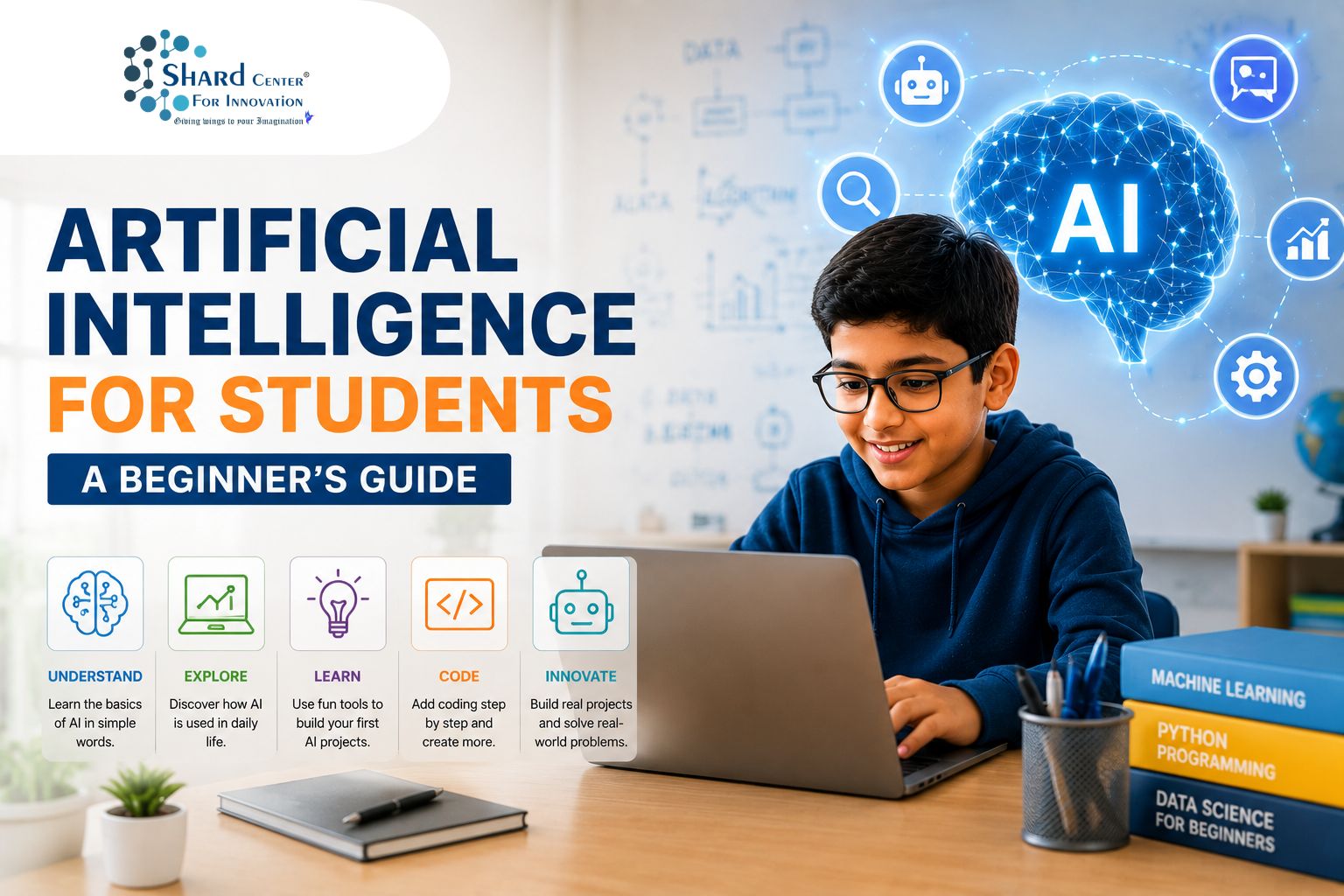
1. Understand the concepts first. What is data? What does it mean for a machine to "learn"? Where does AI work well, and where does it fail? These ideas matter more than any code at the start.
2. Play with friendly tools. Beginner platforms let students train simple AI models by dragging and dropping — teaching an AI and robot to recognise images or sounds without writing complex code. Seeing their own model work is a powerful "aha" moment.
3. Add coding gradually. As students grow comfortable, simple coding (often in Python or visual block tools) lets them build more. Coding and AI go hand in hand — which is exactly why we argue coding has become a new literacy.
4. Build real projects. The best learning comes from making something: an AI that sorts the student's photos, a chatbot that answers questions about their hobby, a model that predicts something they care about.
An Important Note: AI Ethics for Young Learners
Learning how AI works should come with learning how to use it wisely. Even young students can grasp the big questions: Is the AI fair? Where did its data come from? Can it be wrong? Should we always trust it?
Teaching children to think critically about AI — to use it as a tool while questioning its outputs — may be the most important AI skill of all. The goal is creators and thoughtful users, not passive believers.
Why This Matters for Their Future
AI fluency is fast becoming a core career skill. The World Economic Forum's Future of Jobs Report 2025 found AI and big data top the list of fastest-growing skills, with 86% of employers expecting AI to transform their business by 2030. Students who understand AI early won't just adapt to this world — they'll help build it. (We map the careers in Career Opportunities in Robotics, AI, and Emerging Technologies.)
India Is Putting AI in the Classroom
Indian students have official momentum behind them. CBSE introduced AI as a skill subject in 2019, and 18,839 schools now offer it from Class 6, with the 2026–27 curriculum bringing AI and computational thinking from Class 3. What schools introduce, dedicated programmes can deepen into real, demonstrable skill.
The Takeaway
AI isn't magic and it isn't out of reach. At its core, it's technology that learns from examples — and any curious student can start understanding it today, beginning with concepts, then friendly tools, then real projects. Add a habit of thinking critically about how AI is used, and a child is genuinely prepared for the most important technology of their lifetime.
Want to give your child a real, hands-on start? Book a free demo class at a SHARD Center for Innovation near you and watch them train their first AI model.
Frequently Asked Questions (FAQs)
Q1 : What age can a child start learning AI?
Ans : Children can grasp basic AI concepts from around age 9–10 using visual, drag-and-drop tools, with coding-based AI typically starting around age 11–12.
Q2 : Does learning AI require advanced maths?
Ans : Not to begin. Early AI learning focuses on concepts and friendly tools. Maths becomes more relevant only at advanced levels, well after a strong foundation is built.
Q3 : Is it safe for children to learn about AI?
Ans : Yes, especially when paired with AI ethics—teaching children to question AI outputs and understand fairness and bias makes them safer, smarter users of the technology.
Q4: What are the benefits of learning artificial intelligence for students?
Ans : Learning artificial intelligence helps students develop problem-solving, logical thinking, creativity, and digital skills. It also prepares them for future careers in technology and encourages innovation through hands-on projects.
Q5: What is the difference between artificial intelligence and machine learning?
Ans : Artificial Intelligence (AI) is the broader field of creating intelligent systems, while Machine Learning (ML) is a branch of AI that enables computers to learn from data and improve their performance without being explicitly programmed.
Q6: Do students need coding skills to start learning AI?
Ans : No. Beginners can start by understanding AI concepts and using visual, beginner-friendly tools. Coding skills can be learned gradually as students progress to more advanced AI projects.
Q7: What are some real-life applications of artificial intelligence?
Ans : AI is used in voice assistants, recommendation systems, online search, healthcare, smart devices, self-driving technology, education, and customer support. Students interact with AI in many everyday applications.
Q8: Why should students learn artificial intelligence at an early age?
Ans : Early exposure to AI helps students build technology skills, improve critical thinking, understand emerging technologies, and prepare for future careers in an increasingly AI-driven world.