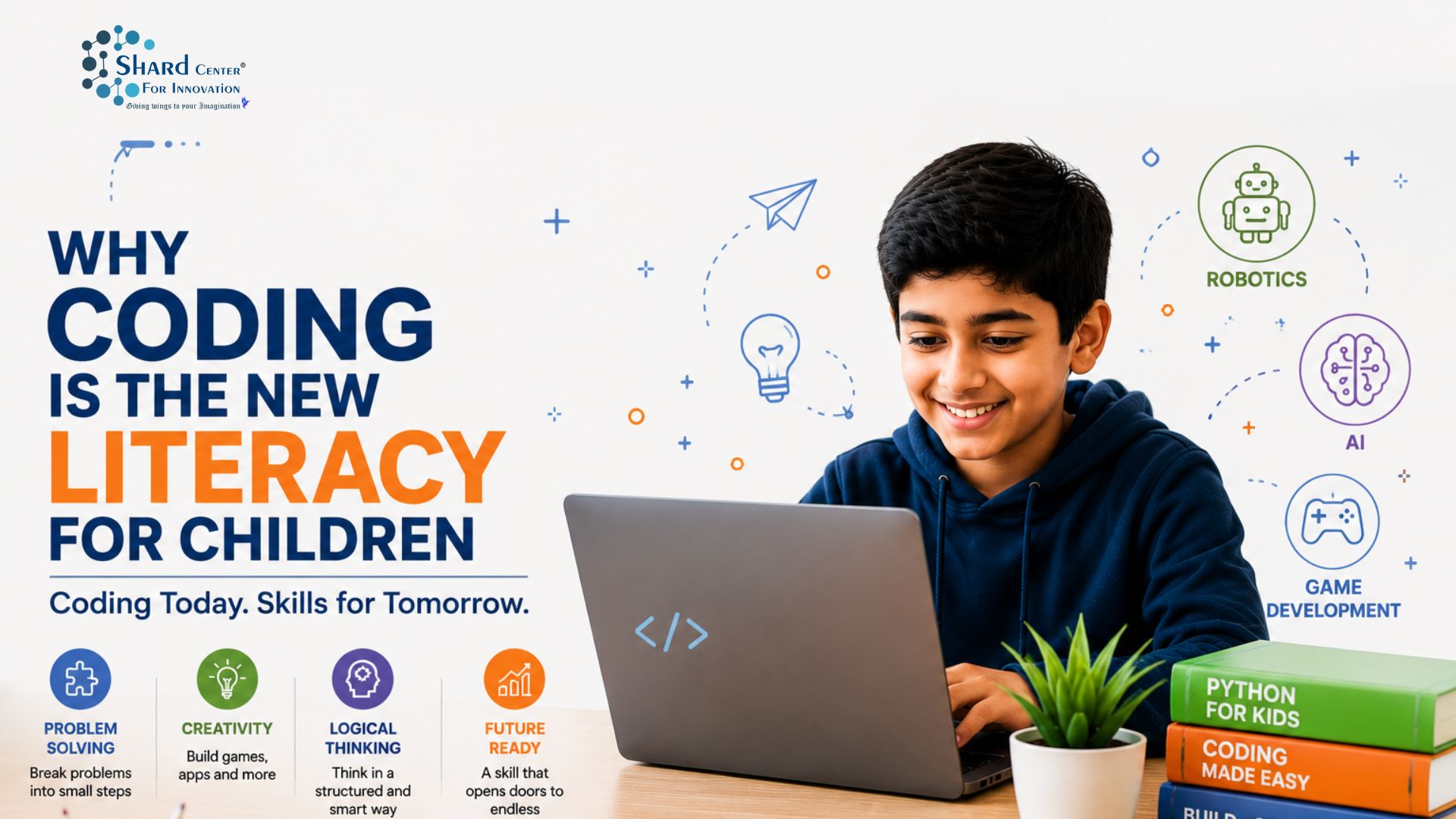
A few hundred years ago, being "literate" meant you could read and write — and those who couldn't were locked out of much of society. Today, a growing number of educators argue we've reached a similar turning point with coding. In a world run by software, understanding how to code is becoming a basic way of participating in — and shaping — the world around us.
But "everyone should learn to code" can sound like hype. So let's look honestly at why coding has earned the title of the new literacy, and what it really gives children.
(This article is part of our complete guide: STEM Education for Future-Ready Students.)
What "Coding as Literacy" Actually Means
The phrase doesn't mean every child must become a professional programmer — just as teaching reading doesn't mean everyone becomes a novelist. It means coding is becoming a foundational skill for understanding the digital world, the way reading is foundational for understanding the written one.
This idea has serious academic backing. Researcher Marina Bers, a leading voice in early childhood technology, frames coding as a new literacy for the twenty-first century — a way for children to become creators of technology, not just consumers of it. That distinction is everything.
The Real Skill: Computational Thinking
Here's the part that surprises parents. The biggest benefit of coding isn't the code itself — it's a way of thinking it builds, called computational thinking.
Computational thinking means approaching problems the way a programmer does:
•Decomposition — breaking a big problem into smaller, manageable parts,
•Pattern recognition — spotting what repeats,
•Algorithms — working out clear, ordered steps to a solution,
•Debugging — finding and fixing what went wrong.
The OECD highlights computational thinking as a key skill for the digital age, and notes children can begin developing it from a young age. The beauty is that these skills apply far beyond a computer — they're exactly how you'd plan a project, organise an essay, or troubleshoot anything in life. (This connects directly to How STEM Education Builds Problem-Solving Skills.)

Coding Teaches Children to Debug Their Own Thinking
There's a quiet life lesson hidden in coding. When a program doesn't work, there's no one to blame and no point getting upset — you simply have to find the mistake and fix it.
Children learn that errors are normal, that the first attempt rarely works, and that persistence solves problems. They stop seeing a mistake as a verdict on their ability and start seeing it as a step in the process. That resilient, "let me figure out what went wrong" mindset is one of coding's most valuable gifts.
It Builds Creativity, Not Just Logic
A common myth is that coding is cold and mechanical. In practice, it's one of the most creative things a child can do. Code is a medium — like paint or clay — for making things: a game, an animation, a story that responds to the player, a robot that moves.
When children realise they can build their own games and apps rather than only playing ones made by others, something shifts. They move from consumer to creator. That creative ownership is deeply motivating, and it's where a lifelong love of building often begins.
How Children Actually Learn to Code
The path is gentler than parents expect, because tools have come a long way:
1. Block-based coding first. Young children start with visual tools (like Scratch) where they drag and snap colourful blocks together. No typing, no syntax errors — just pure logic and creativity. They can build a game in their first session.
2. Then text-based coding. As they grow, children move to real languages like Python, which is famously beginner-friendly and widely used in the real world.
3. Applied to real things. Coding becomes most exciting when it does something — controlling a robot , powering an AI model, or building an app the child actually wants.
Why It Matters for Their Future
Beyond the thinking skills, coding opens doors. Software underpins nearly every industry now, and digital and tech skills consistently rank among the most in-demand. The World Economic Forum's Future of Jobs Report 2025 places technological literacy and AI among the fastest-growing skills of the decade. A child who's comfortable with code has a head start in a vast and growing range of careers. (We explore them in Career Opportunities in Robotics, AI, and Emerging Technologies.)
India Agrees — and Has Acted
This isn't just a Western idea. India's education system has embraced it: the National Education Policy 2020 recommends coding and computational thinking from the middle-school years, and CBSE has woven AI and computational thinking into its curriculum from Class 6, and from Class 3 in the new 2026–27 framework. Coding literacy is now national policy, not just a nice-to-have.
The Takeaway
Coding is the new literacy because it teaches children to understand and shape the digital world they live in — and because the computational thinking behind it (decomposition, logic, debugging, persistence) is genuinely useful everywhere, not just at a keyboard. Best of all, it turns children from consumers of technology into creators.
The earlier and more joyfully a child experiences that shift, the better. Book a free demo class at a SHARD Center for Innovation near you and watch your child build their first program.
Frequently Asked Questions (FAQs)
Q1 : What age should children start coding?
Ans : Children can begin block-based coding around age 6–7, moving to text-based languages like Python around age 10–12 as they're ready.
Q2 : Does my child need to be good at maths to code?
Ans : Not at the start. Early coding is about logic and creativity, and it often builds mathematical confidence rather than requiring it upfront.
Q3 : What's the best first coding language for kids?
Ans : Most children start with Scratch (visual, block-based) to learn logic without syntax, then progress to Python, which is beginner-friendly and widely used.
Q4: What are the benefits of learning coding for children?
Ans : Coding helps children improve logical thinking, creativity, problem-solving, and computational thinking. It also encourages innovation and prepares them for a technology-driven future.
Q5: Which programming language is best for beginners?
Ans : Beginners usually start with block-based platforms like Scratch to understand programming concepts. As they progress, they can move to beginner-friendly languages such as Python.
Q6: Can coding improve a child's academic performance?
Ans : Yes. Coding strengthens logical reasoning, mathematical thinking, and analytical skills, which can positively support learning in subjects like mathematics, science, and technology.
Q7: Is coding useful for students who don't want a career in technology?
Ans : Absolutely. Coding develops transferable skills such as critical thinking, creativity, communication, and problem-solving, which are valuable in almost every profession.
Q8: How can parents encourage children to learn coding?
Ans : Parents can introduce coding through interactive games, beginner-friendly coding platforms, robotics activities, and project-based learning that makes programming fun and engaging.