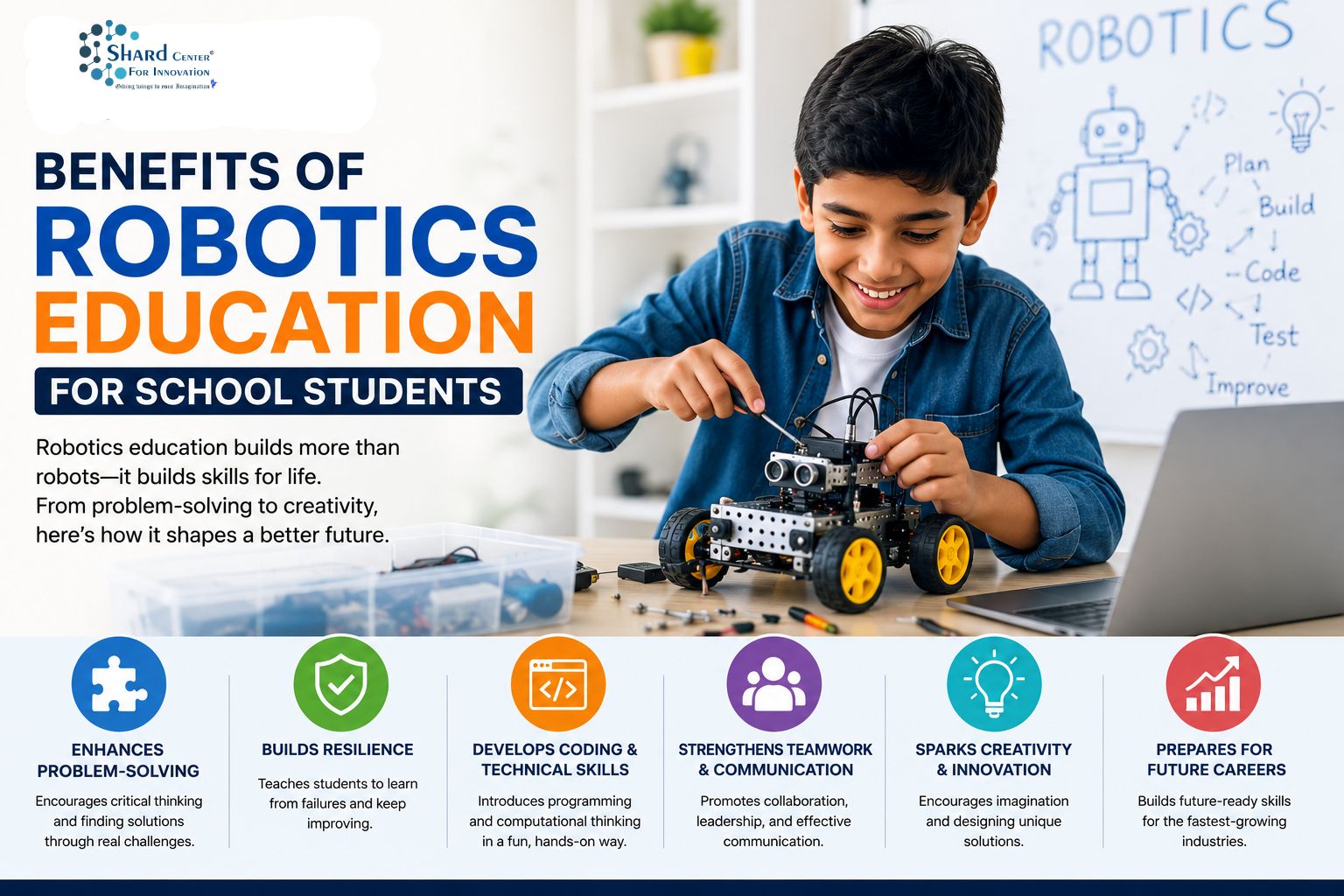
Of all the ways to learn STEM, robotics might be the most powerful — and the most fun. There's a particular magic in the moment a robot a child built with their own hands finally moves the way they programmed it to. But beneath that excitement, robotics is quietly building some of the most valuable skills a student can carry into the future.
Here's what robotics education actually teaches, and why it's worth your child's time.
(This article is part of our complete guide: STEM Education for Future-Ready Students.)
Why Robotics Is the "Complete" STEM Activity
Most subjects teach one thing. Robotics teaches everything at once. To build and program a working robot, a student has to combine:
• Mechanics — how parts fit and move,
• Electronics — wiring motors and sensors,
• Coding — telling the robot what to do,
• Maths — angles, distances, timing,
• Design thinking — making it actually work.
That's the entire STEM family, applied to one tangible goal. And because a robot either works or it doesn't, there's instant, honest feedback — no guessing whether you got it right. This is hands-on learning at its richest. (We explore why that matters so much in Benefits of Hands-On STEM Learning.)
It Builds Real Problem-Solving Skills
Robots fail constantly — and that's the point. A wheel slips, a sensor misreads, the code does something unexpected. Each failure is a puzzle the student has to diagnose: Why didn't it turn? Is it the code, the motor, or the wiring?
This loop of build, test, fail, and fix is the essence of problem-solving. Students learn to break a big challenge into smaller pieces and tackle them one by one — a skill that transfers far beyond robotics. (More on this in How STEM Education Builds Problem-Solving Skills.)
It Teaches Resilience and a Healthy Relationship with Failure
In a normal classroom, a wrong answer feels like a defeat. In robotics, a "wrong answer" is just step one of getting it right. Students quickly learn that failure isn't shameful — it's information.
That mindset shift is enormous. A child who learns to treat setbacks as puzzles rather than verdicts carries a quiet superpower into every part of life.
It Develops Coding and Computational Thinking
You can't make a robot do anything without telling it how — and that means coding. But robotics makes coding concrete. Instead of abstract output on a screen, the student sees their code move a physical object across the floor. When it goes wrong, the bug is visible and real, which makes debugging genuinely engaging. (We make the case for coding in full in Why Coding Is the New Literacy for Children.)
It Strengthens Teamwork and Communication
Real robotics projects are too big for one person. There's a builder, a coder, a tester, a presenter. Students learn to divide work, explain their ideas, disagree constructively, and ship something together.
These collaboration skills are exactly what employers say they value most — and they're hard to teach through worksheets. A robotics team is a miniature version of how the real working world operates.

It Builds Confidence and Creativity
There's no single "correct" robot. Give five teams the same challenge and you'll get five different solutions. That open-endedness gives children permission to invent — and the confidence that comes from creating something that genuinely works.
We've seen students design everything from automatic plant-watering systems to obstacle-avoiding rovers. That creative confidence, the feeling of "I can build things that solve real problems," is one of robotics' most lasting gifts.
It Opens Doors to the Future
This isn't only about skills for their own sake. Robotics sits at the heart of some of the fastest-growing careers of the coming decade. The World Economic Forum's Future of Jobs Report 2025 lists robotics engineers and AI specialists among the fastest-growing roles, as automation reshapes manufacturing, healthcare, agriculture, and logistics. (We map these pathways in Career Opportunities in Robotics, AI, and Emerging Technologies [/blog/careers-robotics-ai-emerging-tech].)
India Is Building the Infrastructure for This
Indian students are well-placed to benefit. Under the Atal Innovation Mission, over 10,000 Atal Tinkering Labs have been established with 50,000 more announced, each stocked with robotics kits, 3D printers, and electronics for students from Class 6 to 12. The tools are arriving in schools; what turns tools into skills is sustained, guided practice.
The Takeaway
Robotics education isn't just about robots. It's about problem-solving, resilience, coding, teamwork, creativity, and confidence — packed into an activity children genuinely love. It's STEM learning at its most complete and most joyful.
The best way to understand its impact is to watch a child's face when their robot finally works. Book a free demo class at a SHARD Center for Innovation near you and see it for yourself.
Frequently Asked Questions (FAQs)
Q1 : What age can children start robotics?
Ans : Many children begin beginner robotics around age 7–8 with simple builds and block-based coding, progressing to programmable, sensor-driven robots by age 10–12.
Q2 : Does my child need coding experience before starting robotics?
Ans : No. Good robotics programmes teach coding alongside building, often starting with visual block-based coding that requires no prior experience.
Q3 : Is robotics only useful for future engineers?
Ans: No. The problem-solving, teamwork, and resilience robotics builds transfer to any field, even though robotics careers themselves are among the fastest-growing.
Q4 : What skills do students develop through robotics education?
Ans: Robotics education helps students build problem-solving, logical thinking, coding, teamwork, creativity, communication, and critical thinking skills. These abilities are valuable for both academic success and future careers.
Q5 : How does robotics support STEM learning?
Ans : Robotics combines Science, Technology, Engineering, and Mathematics into hands-on projects. Students apply concepts from multiple subjects while designing, building, and programming robots to solve real-world challenges.
Q6 : Why is robotics important for the future?
Ans : Robotics is becoming an important part of industries such as manufacturing, healthcare, agriculture, logistics, and automation. Learning robotics helps students understand emerging technologies and prepares them for future opportunities.
Q7 : Can robotics improve a child's creativity and confidence?
Ans : Yes. Robotics encourages students to experiment, test different ideas, and create their own solutions. Successfully building and programming a robot boosts confidence while inspiring creativity and innovation.
Q8: What should parents look for in a robotics program?
Ans : Parents should choose a robotics program that offers hands-on projects, age-appropriate learning, experienced mentors, practical coding activities, and opportunities for students to develop problem-solving and teamwork skills.