Think back to your own school days. The lessons you actually remember — do you recall the chapters you read, or the experiments you did? For most of us, it's the doing that stuck: the volcano that erupted, the circuit that lit a bulb, the bridge that held (or didn't).
That's not a coincidence. It's the whole reason hands-on STEM learning is so powerful. Let's look at why "learning by doing" works so well, and what it gives children.
(This article is part of our complete guide: STEM Education for Future-Ready Students.)
The Core Idea: We Learn by Doing
There's an old saying often attributed to various thinkers: tell me and I forget, show me and I remember, involve me and I understand. Hands-on STEMis built entirely on that last part — involvement.
When a child reads that "circuits need a complete loop," it's an abstract fact that fades fast. When that same child wires a bulb, watches it stay dark, then realises the loop is broken and fixes it themselves — they don't just memorise the rule, they understand it. The knowledge is now tied to an experience, and that makes it stick.
Why Hands-On Learning Sticks Better
A few reasons explain the difference:
It's multi-sensory. Building engages sight, touch, and movement together — giving the brain multiple pathways to encode and recall the same idea, far more than reading alone.
It makes abstract things concrete. "Ten" is abstract; ten beads in your hand are real. Hands-on materials turn invisible concepts (forces, numbers, logic) into things a child can see and manipulate, which is how young minds learn best.
It comes with built-in feedback. When you build something, it works or it doesn't — immediately and honestly. That instant feedback loop is one of the most effective teaching tools there is, and it's exactly what powers robotics learning.
It's emotionally engaging. The excitement of making something real creates the kind of positive emotion that strengthens memory. Children want to keep going.
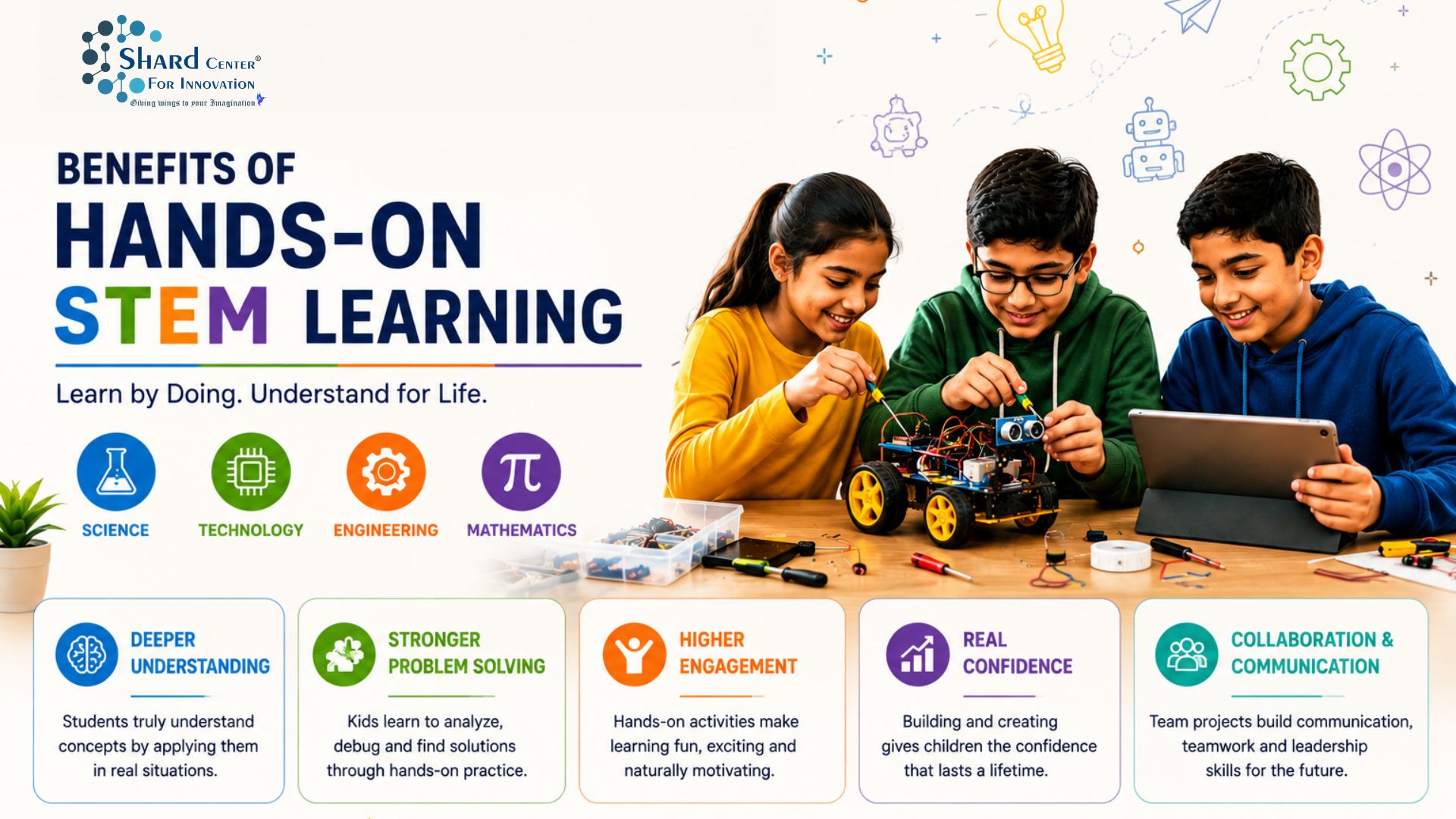
1. Deeper Understanding (Not Just Memorisation)
The biggest benefit is comprehension. Rote learning produces students who can repeat a definition but can't apply it. Hands-on learning produces students who genuinely get the concept — and can use it in new situations. That difference shows up powerfully when learning gets harder later on, because the foundations are real rather than memorised.
2. Stronger Problem-Solving Skills
When children build, things go wrong — constantly. And every time something goes wrong, they have to figure out why and fix it. This is problem-solving in its most natural form, practised over and over. (We dig into this in How STEM Education Builds Problem-Solving Skills.)
3. Higher Engagement and Motivation
Ask any teacher: attention and enthusiasm spike on hands-on, project days. When learning feels like building, experimenting, and working on real-world robotics projects, children don't need to be pushed — they pull themselves forward. That intrinsic motivation is worth more than any reward chart, and it builds a positive relationship with learning itself.
4. Real Confidence
There's a specific kind of confidence that only comes from making something that works. Not praise from an adult — the child knows they did it, because the evidence is right there in their hands. That earned confidence ("I can build things, I can figure things out") is durable and transfers to new challenges.
5. Collaboration and Communication
Most hands-on STEM projects are done in teams. Children learn to share tools and ideas, divide tasks, explain their thinking, and work through disagreements — the human skills that matter in every workplace and that no textbook can teach. Students enrolled in structured STEM programs gain regular opportunities to build these skills through collaborative, project-based learning.

Why This Is Especially Important Today
In an age of screens and passive scrolling, hands-on, active learning is more valuable than ever. Children are surrounded by technology they only consume. Hands-on STEM flips that — it puts them in the maker's seat, building and creating rather than just watching.
This is also why dedicated spaces for making matter so much, an idea we explore in Why Innovation Labs Matter in Schools. And it's why India has invested in over 10,000 Atal Tinkering Labs with 50,000 more announced — physical spaces, full of real tools, where students learn by building.
A Note for Parents Worried About "Mess"
Hands-on learning can look chaotic — spilled materials, half-built contraptions, the occasional failed experiment. It's worth reframing that mess as evidence of learning, not the absence of it. A spotless, silent room often means children are passively receiving information; a busy, slightly messy one usually means they're actively building understanding. The cleanup itself, done by the children, is part of the lesson in responsibility and independence.
The Takeaway
Hands-on STEM learning works because it matches how children's minds actually learn: through doing, sensing, failing, and fixing. It produces deeper understanding, stronger problem-solving, genuine engagement, earned confidence, and real collaboration — outcomes that reading about a subject simply can't match.
The proof is in watching it happen. Book a free demo class at a SHARD Center for Innovation near you and see how much more your child absorbs when they're building, not just listening.
FAQ (Frequently Asked Question)
Q1 : Why is hands-on learning better than textbook learning for STEM?
Ans : Hands-on learning is multi-sensory, makes abstract ideas concrete, and gives instant feedback — all of which help children understand and remember far more than reading alone.
Q2 : Does hands-on learning work for all ages?
Ans : Yes. The activities scale with age — from simple building and sorting for young children to complex robotics and AI projects for older students — but learning by doing benefits every stage.
Q3 : Is hands-on STEM just play, or real learning?
Ans : It's purposeful play that builds genuine skills. The "fun" is what drives engagement, while the building quietly develops deep understanding, problem-solving, and confidence.
Q4 : What are the benefits of hands-on STEM learning for students?
Ans : Hands-on STEM learning helps students improve critical thinking, creativity, problem-solving, teamwork, and communication skills. It also makes complex concepts easier to understand through practical activities.
Q5 : How does hands-on STEM learning improve problem-solving skills?
Ans : Students learn by designing, building, testing, and improving projects. This process encourages them to identify challenges, experiment with solutions, and develop logical thinking through real-world experiences.
Q6 : Can hands-on STEM learning increase student confidence?
Ans : Yes. Completing projects, overcoming challenges, and creating working models give students a sense of achievement, helping them build confidence and become more independent learners.
Q7 : What activities are included in hands-on STEM learning?
Ans : Hands-on STEM learning may include robotics, coding, engineering challenges, science experiments, electronics, IoT projects, model building, and collaborative innovation activities that encourage practical learning.
Q8 : Why is hands-on STEM learning important for future careers?
Ans : Hands-on STEM learning develops practical skills, adaptability, creativity, and teamwork. These skills are valuable across industries such as Artificial Intelligence, Robotics, Data Science, Engineering, Healthcare, and other technology-driven careers.