A child starting school today will graduate into a world we can barely picture. Many of the jobs they'll do haven't been invented yet. The tools they'll use don't exist. The one thing we can say with confidence is that technology — artificial intelligence, robotics, automation — will sit at the centre of almost every career.
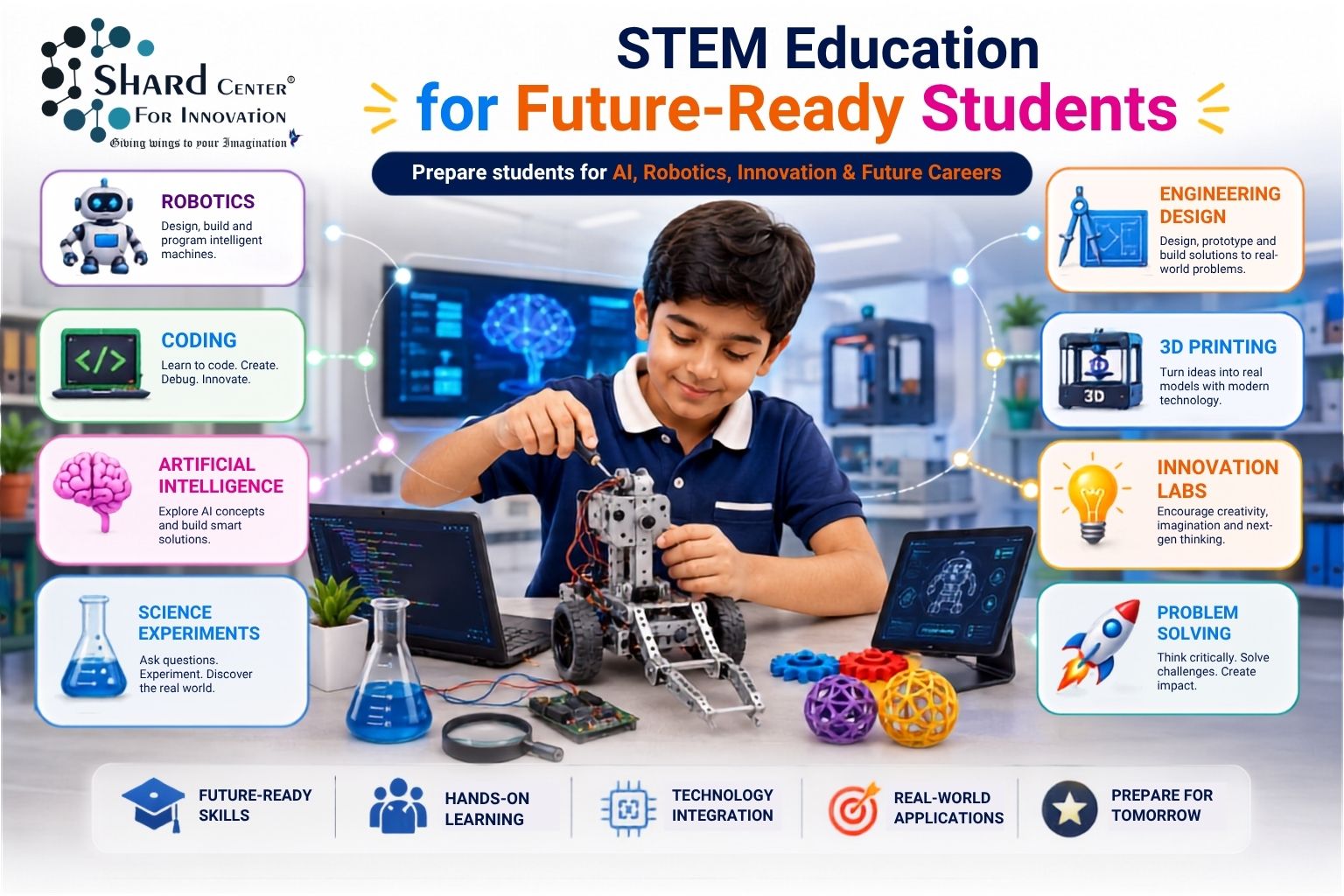
So how do you prepare a child for a future nobody can fully predict? You don't try to teach them every fact they'll ever need. You teach them how to think, build, and solve problems — the skills that stay valuable no matter how the technology changes. That, in a sentence, is what STEM education is for.
This guide is the complete map: what STEM really means, why it matters more now than ever, what it looks like in practice, and how each piece — robotics, AI, coding, hands-on learning, innovation labs — fits together. Where a topic deserves a deeper dive, we'll point you to a full article on it.
What "STEM" Actually Means
STEM stands for Science, Technology, Engineering, and Mathematics. But the four letters are the least interesting part. The real idea is that these subjects shouldn't be taught in isolation — the way most of us learned them, in separate periods that never spoke to each other — but woven together the way they actually work in the real world.
When a student builds a robot, they're using maths (angles, measurement), science (electricity, motion), engineering (design, structure), and technology (coding the behaviour) all at once, on one project. That integration is the whole point. We unpack it properly in What Is STEM Education and Why Is It Important?
Why STEM Matters More Than Ever
It's tempting to treat STEM as just another educational trend. The data says otherwise.
The jobs are moving decisively toward STEM. In the United States, STEM occupations are projected to grow far faster than non-STEM ones, with significantly higher median wages — and the pattern holds across most major economies. Roles like data scientist are among the fastest-growing of any occupation.
AI is reshaping every industry. The World Economic Forum's Future of Jobs Report 2025 found that 86% of employers expect AI and information-processing technologies to transform their business by 2030, and that AI and big data top the list of fastest-growing skills. The same report puts AI and machine learning specialists, along with robotics engineers, among the fastest-growing roles of the decade.
Skills are changing under everyone's feet. That same WEF report estimates that on average, around 39% of a worker's existing skills will be transformed or outdated between 2025 and 2030. The implication is clear: the ability to keep learning and adapting matters more than any single fact.
None of this means every child must become an engineer. It means every child benefits from the thinking STEM builds — because that thinking is what stays valuable when everything else shifts. We cover the future job landscape in depth in Career Opportunities in Robotics, AI, and Emerging Technologies.

The Building Blocks of a Modern STEM Education
STEM isn't one thing — it's a family of connected skills. Here's how the major pieces fit together.
Robotics: Where Everything Comes Together
Robotics is arguably the perfect STEM activity, because building a working robot forces a child to combine mechanics, electronics, coding, and design into one tangible result. A robot either works or it doesn't — and when it doesn't, the child has to diagnose why. That loop of build, test, fail, fix is where deep learning lives.
It also builds teamwork, persistence, and creativity in a way no worksheet can. We explore this fully in Benefits of Robotics Education for School Students.
Artificial Intelligence: The Skill of the Decade
A generation ago, computer literacy meant knowing how to use software. Today it increasingly means understanding how AI works — how machines learn from data, where they're useful, and where they fall short. This isn't about turning ten-year-olds into AI researchers; it's about demystifying the most important technology of their lifetime so they grow up as creators, not just consumers.
If you're new to all this, start with our plain-English explainer: Artificial Intelligence for Students: A Beginner's Guide.
Coding: The New Literacy
A century ago, literacy meant reading and writing. Many educators now argue coding has become a third foundational literacy — a basic way of understanding and shaping the digital world we all live in. Researchers like Marina Bers describe coding as a new literacy for the twenty-first century, and learning to code does far more than produce programmers: it teaches logical sequencing, breaking big problems into small steps, and debugging your own thinking.
We make the case in full in Why Coding Is the New Literacy for Children.
Hands-On Learning: The Method That Makes It Stick
Here's the thread connecting all of the above: STEM works best when it's hands-on. A child who reads about circuits forgets it by next term. A child who builds a circuit that lights a bulb remembers it for years — and understands it far more deeply.
This isn't just intuition; it's how the brain consolidates learning. We dig into the evidence in Benefits of Hands-On STEM Learning.
The Skill That Outlasts Every Technology: Problem-Solving
If we had to name the single most valuable thing STEM education builds, it wouldn't be coding or robotics specifically. It would be problem-solving.
Every STEM project is, at heart, a problem to be cracked: the robot won't turn, the code throws an error, the bridge collapses under weight. Children learn to break a big challenge into smaller pieces, test ideas systematically, learn from failure, and try again. That's a transferable skill — it works on a maths exam, a science fair, a startup, or any obstacle life throws up decades from now.
It's also exactly what the modern workplace prizes. We explore how this is built, step by step, in How STEM Education Builds Problem-Solving Skills.
Where STEM Comes Alive: Innovation Labs
You can't build future-ready skills from a textbook alone. Children need a space — somewhere they can tinker, prototype, fail safely, and create. That's the idea behind innovation labs (sometimes called maker spaces or tinkering labs): dedicated rooms stocked with 3D printers, robotics kits, sensors, and electronics where curiosity becomes a working prototype.
India has bet heavily on exactly this idea, and we explain why it matters in Why Innovation Labs Matter in Schools.
India's STEM Moment
For Indian parents, there has never been a better time to lean into STEM — because the entire system is moving this way at once.
CBSE has embraced AI early. The board introduced Artificial Intelligence as a skill subject in 2019, and adoption has snowballed — 18,839 CBSE schools now offer AI from Class 6 onwards. The board's new 2026–27 curriculum goes further, introducing AI and computational thinking from Class 3.
Innovation labs are spreading nationwide. Under NITI Aayog's Atal Innovation Mission, over 10,000 Atal Tinkering Labs have been set up, with 50,000 more announced — each equipped with 3D printers, robotics, and electronics for students from Class 6 to 12.
National policy backs it. The National Education Policy 2020 explicitly recommended embedding emerging technologies like AI, IoT, and 3D printing into school learning. The intent at the national level is no longer the bottleneck — depth of access is. A short school module introduces the vocabulary; genuine capability is built through sustained, hands-on practice.
Why Starting Early Matters
Parents often ask whether primary school is too soon for robotics or coding. The honest answer: starting early isn't about creating child prodigies. It's about four quieter advantages.
First, early exposure removes fear. A child who builds their first robot at nine treats technology as a tool, not a mystery — and that confidence compounds for a decade.
Second, it builds a creator's mindset. Children who tinker early learn to see technology as something they can shape, not just consume.
Third, the foundational skills transfer. The logic, persistence, and problem-solving built at eight serve a curious sixteen-year-old and a working adult equally well.
Fourth, it widens the door. Early, positive experiences with STEM are one of the strongest predictors of who feels welcome in these fields later — which matters enormously for making sure all children, including girls and first-generation learners, see these careers as open to them.

A Word on Girls and STEM
One pattern worth naming: girls remain underrepresented in many STEM fields, not for any difference in ability but largely because of when and how they're introduced to it. Research consistently shows that early, positive, hands-on experiences are one of the strongest factors in whether a child — especially a girl — grows up seeing these fields as open to them.
This makes early exposure a question of fairness, not just opportunity. A nine-year-old girl who builds a robot and feels the thrill of it working is far less likely to absorb the message that "tech isn't for me." Giving every child — regardless of gender or background — genuine, encouraging access to STEM in the early years is one of the most powerful ways to widen who gets to shape the future. The best programmes are deliberate about this: mixed teams, relatable mentors, and a culture where every child's ideas are taken seriously.
How SHARD Center for Innovation Helps
At the SHARD Center for Innovation, this belief — that every child deserves genuine, hands-on access to the technologies shaping their future — is exactly why we exist.
Across India, we run structured, after-school programmes that go far deeper than a short school module:
- AI programmes that take students from "what is AI?" to building real, working models they can demonstrate, not just describe.
- Robotics training with progressive, age-appropriate kits — from simple builds to sensor-driven, programmable robots students design themselves.
- Coding and 3D printing woven through every level, so children learn to create with technology, not just use it.
- A hands-on, project-based approach in every module — because, as this guide keeps returning to, that's where real learning lives.
Our programmes are designed to complement what schools have started — taking the spark from a CBSE AI class or an Atal Tinkering Lab session and turning it into genuine, demonstrable capability.
Curious to see it in action? Book a free demo class at your nearest SHARD centre and watch your child build their first project.
How to Choose a Good STEM Programme
Not all "STEM classes" are equal. A few things to look for when you're comparing options:
- Building, not just screens. The best programmes are hands-on, with real kits and projects — not children watching videos or filling in digital worksheets.
- A progression, not a one-off. Look for a clear path that grows with your child, from beginner builds to genuinely challenging projects.
- Projects your child can show you. If a child can't demonstrate what they made, they probably didn't make much. Real STEM produces real outputs.
- Trained mentors who guide, not lecture. The instructor's job is to ask the right question at the right moment, not hand over the answer.
- A culture of productive failure. A good lab treats a crashed robot as the start of learning, not a mistake to be embarrassed about.
The Bottom Line
STEM education isn't about predicting exactly which skills your child will need in 2040 — nobody can. It's about building the durable ones: curiosity, logical thinking, the confidence to build, and the resilience to fail and try again. Those are the skills that stay valuable no matter how the technology changes.
The world is moving fast, and the children who learn to create with technology — rather than just consume it — will have a profound head start. The best time to begin was a few years ago. The second-best time is today.
Start with the deeper dives linked throughout this guide, visit a real lab, and watch what happens when a child builds something that actually works. That moment — the grin when the robot finally moves — tells you everything about why this matters.
FAQ (Frequently Asked Question)
Q1: What age should a child start STEM education?
Ans: Children can begin age-appropriate STEM activities as early as 6–8 with block-based coding and simple builds, progressing to programmable robotics and real coding by 10–12.
Q2: Does my child need to be "good at maths" to do STEM?
Ans: No. Hands-on STEM often builds mathematical confidence by making abstract concepts tangible and useful, which helps children who don't see themselves as "maths people."
Q3: Is STEM only useful for children who want tech careers?
Ans: No. STEM builds problem-solving, logical thinking, and resilience that transfer to any field — and AI and technology now touch nearly every career anyway.
Q4: How is STEM aligned with India's education system?
Ans: Closely. CBSE offers AI from Class 6 (and from Class 3 in the new
2026–27 curriculum), NEP 2020 backs emerging technologies, and 10,000+ Atal
Tinkering Labs bring hands-on STEM into schools nationwide.