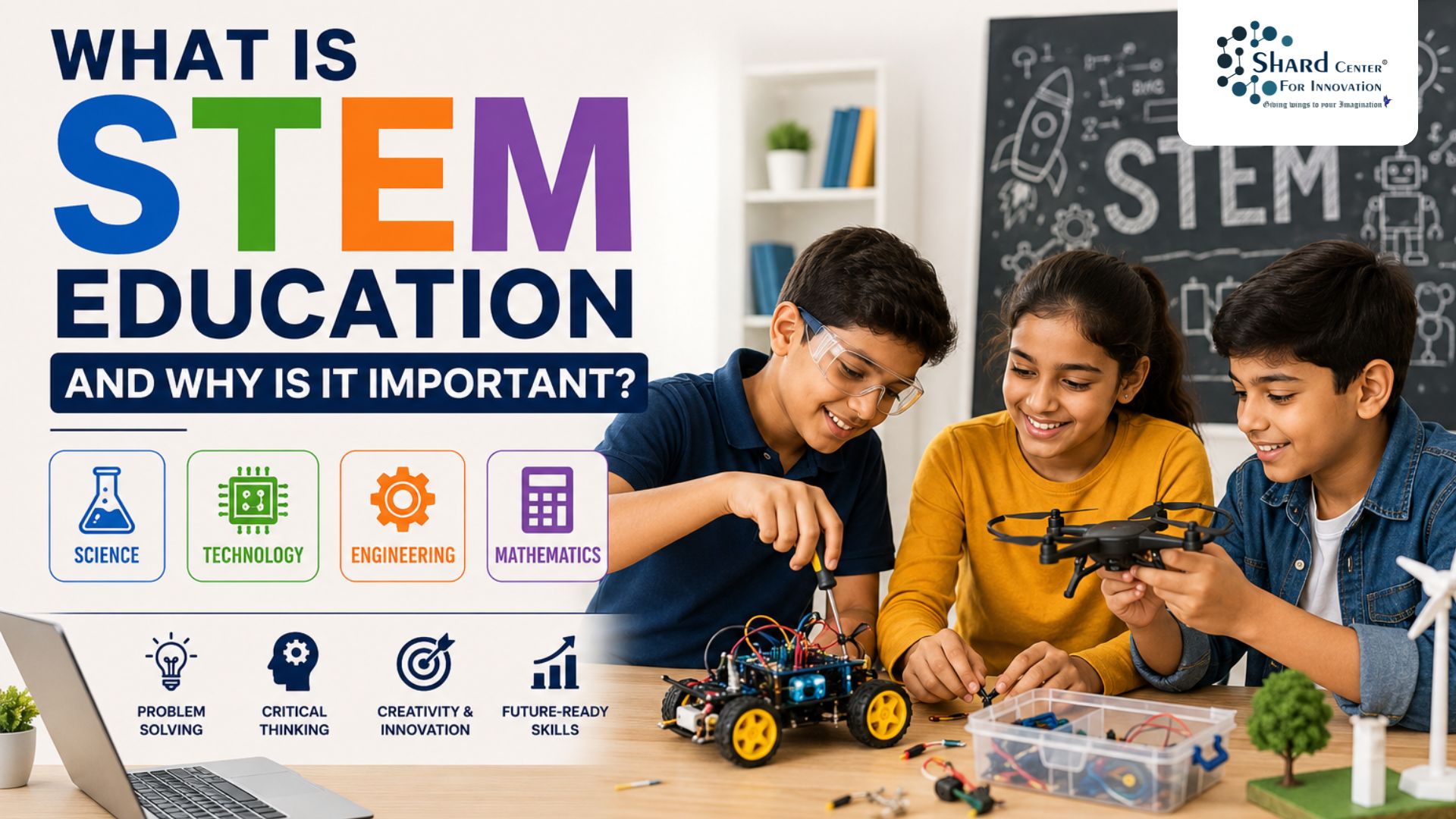
You've probably seen "STEM" everywhere — on school brochures, in news headlines, in conversations about your child's future. But what does it actually mean, and why has it become such a big deal? Let's clear it up simply.
(This article is part of our complete guide: STEM Education for Future-Ready Students.)
The Simple Definition
STEM stands for Science, Technology, Engineering, and Mathematics. But here's the part most definitions miss: STEM education isn't just teaching those four subjects. It's teaching them together, the way they actually work in the real world.
Think about how most of us learned in school — science in one period, maths in another, never the two meeting. STEM flips that. It connects the subjects through real projects, so a child sees how they fit together rather than treating them as unrelated boxes to memorise.
What Makes STEM Different
The clearest way to understand STEM is to watch it in action. Imagine a group of students building a small bridge out of craft materials to hold as much weight as possible. In that one activity they are:
• using science (understanding forces and weight distribution),
• applying maths (measuring, calculating angles and loads),
• doing engineering (designing and improving the structure),
• and often using technology (testing or modelling their design).
No single subject is "the lesson." The bridge is the lesson, and the subjects are the tools. That integration is the heart of STEM — and it's why STEM learning tends to stick far better than memorising facts in isolation. (We explore exactly why in Benefits of Hands-On STEM Learning)
You'll Sometimes See "STEAM" Too
You may come across STEAM — the same idea with an "A" for Arts added. The thinking is that creativity and design are essential to innovation, not separate from it. Whether it's called STEM or STEAM, the core principle is the same: integrated, hands-on, real-world learning.

Why STEM Has Become So Important
This is where it stops being abstract. A few hard realities explain why STEM has moved to the centre of education worldwide.
The jobs are shifting toward STEM. In the United States, STEM occupations are projected to grow much faster than non-STEM ones, and pay substantially more on average — a pattern echoed across most major economies.
AI and automation are reshaping everything. The World Economic Forum's Future of Jobs Report 2025 found 86% of employers expect AI to transform their business by 2030, with AI and big data topping the list of fastest-growing skills.
Skills themselves are changing fast. The same report estimates that around 39% of workers' existing skills will be transformed or outdated between 2025 and 2030. The ability to keep learning has become a core skill in itself — and STEM, at its best, teaches exactly that.
But It's Not Just About Jobs
Here's the thing many people miss: STEM matters even for children who'll never work in technology. Because what STEM really builds is a way of thinking:
• Problem-solving — breaking big challenges into manageable steps. (More in How STEM Education Builds Problem-Solving Skills.)
• Logical reasoning — testing ideas instead of guessing.
• Resilience — learning that failure is information, not defeat.
• Creativity — there's rarely one "right answer" in a real STEM project.
These transfer to any subject and any career. A child who learns to debug a robot is also learning to debug their own reasoning — and that's useful whether they become an engineer, a doctor, an entrepreneur, or an artist.
STEM in India Right Now
Indian parents have a particularly good reason to pay attention. The whole system is pivoting toward STEM at once: CBSE now offers AI as a skill subject from Class 6, with AI and computational thinking entering the curriculum from Class 3 in the 2026–27 framework, and the National Education Policy 2020 explicitly recommends weaving emerging technologies into school learning. The direction is set; the opportunity is to give children depth, not just exposure.
A Common Worry: "Is My Child Too Young?"
Parents often assume STEM is for older, "techy" kids. In reality, age-appropriate STEM starts remarkably early. A four-year-old sorting blocks by shape is doing early pattern recognition. A seven-year-old building a marble run is learning about gravity and cause-and-effect. The activities simply scale with age — from playful building and sorting for little ones to robotics and AI for older students. The thinking habits, though, start forming young, which is exactly why early exposure matters so much.
The Takeaway
STEM education is simply science, technology, engineering, and maths taught together, through hands-on, real-world projects. It matters because it builds both the specific skills a fast-changing economy demands and the durable thinking — problem-solving, logic, resilience, creativity — that stays valuable no matter how technology evolves.
The best way to understand it is to see it. Book a free demo class at a Shard Center for Innovation near you and watch integrated, hands-on STEM learning in action.
FAQ's (Frequently Asked Questions)
Q1 : What does STEM stand for?
Ans : Science, Technology, Engineering, and Mathematics — taught in an integrated, hands-on way rather than as separate subjects.
Q2 : What's the difference between STEM and STEAM?
Ans : STEAM adds "Arts" to STEM, recognising creativity and design as central to innovation. The core hands-on, integrated approach is the same.
Q3 : Is STEM only for children who are good at maths?
Ans : No. Hands-on STEM often builds maths confidence by making concepts tangible, which especially helps children who don't yet see themselves as "maths people."
Q4 : What are the benefits of STEM education for students?
Ans : STEM education helps students develop problem-solving, critical thinking, creativity, teamwork, and communication skills. It also encourages hands-on learning and prepares students for future academic and career opportunities.
Q5 : At what age should children start STEM education?
Ans : Children can begin exploring STEM concepts from an early age through simple activities like building blocks, puzzles, science experiments, and coding games. As they grow, they can progress to robotics, AI, and engineering projects.
Q6 : Why is hands-on STEM learning important?
Ans : Hands-on STEM learning allows students to apply classroom concepts through practical projects and real-world challenges. This approach improves understanding, boosts confidence, and makes learning more engaging.
Q7 : What careers can STEM education lead to?
Ans : STEM education provides a strong foundation for careers in Artificial Intelligence, Robotics, Data Science, Software Development, Engineering, Healthcare, Cybersecurity, Space Technology, and many other technology-driven industries.
Q8 : How can parents encourage STEM learning at home?
Ans : Parents can support STEM learning by encouraging curiosity, providing educational toys and science kits, introducing coding or robotics activities, visiting science museums, and motivating children to solve real-world problems through creative projects.