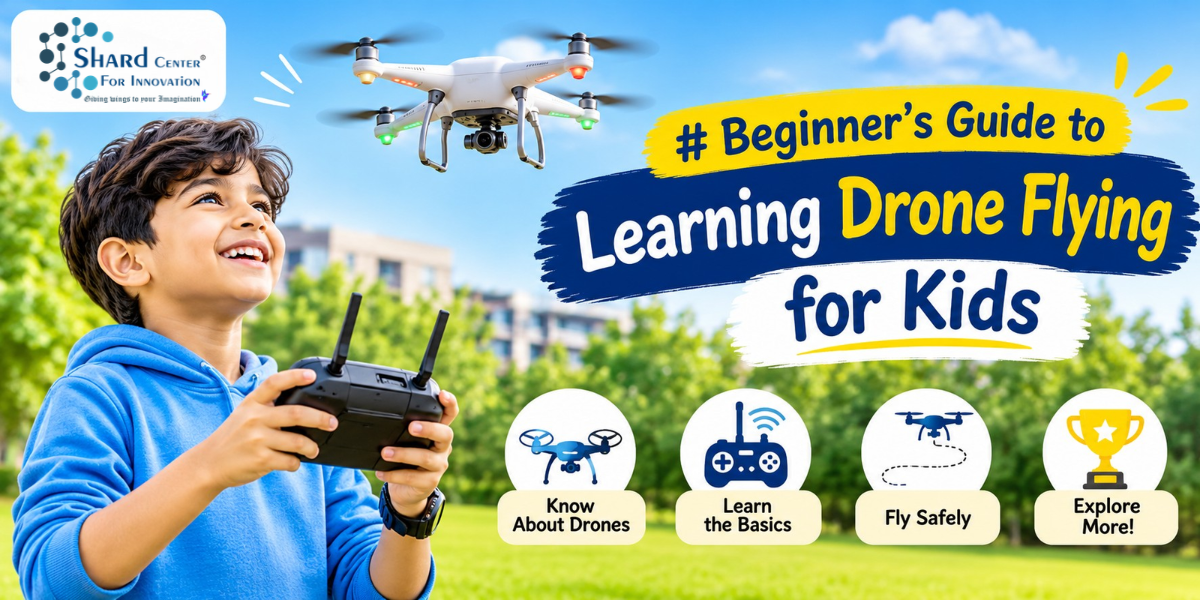
Drone piloting has attracted increased attention from young students. It is a useful skill that teaches many aspects about STEM to students. Beginner’s Guide to Learning Drone Flying for Kids discusses how to make children learn drone flying in a step-by-step manner and the best practices to follow.
Why Should Kids Learn How to Fly a Drone?
Children should be introduced to drone flying since childhood because a drone is not merely a toy, but is an educational tool that develops several skills in children. It encourages coordination, scientific thinking and engineering skills and develops hand-eye coordination. It has many applications for kids such as aerial photography. It is a useful and informative activity that allows children to develop their skills.
Preparation for Flying
Before taking off, it is important to make sure that the environment for flying is suitable. The flying space should be free and clear, without many obstacles. The weather conditions must be suitable and without rain. Parents should be able to supervise the activity to ensure the safety of children.
Basics of Piloting
Before taking off, it is important that the students understand the operation of the remote control and mobile app (if any). Once students understand how to use these, they should next learn the basic such as takeoff and landing, which are the first achievements as the child learns to raise a drone and then land it again. Hovering is more challenging than this and involves maintaining the drone at a stationary height. It is after this that small movements can be made by the drone. The sessions should be limited to a few minutes in order to develop the skill and patience required to operate the drone successfully by the child. Parents can give the child simple challenges to overcome, such as completing four perfect takeoffs and landings, or hovering for 4 seconds. These challenges develop expertise and skill, without feeling like a task to perform.
After understanding the basics, students should progress carefully and, in a step-wise manner. drone flying training programme The first step is to master takeoff and landing, and then let the aircraft hover in the air for a few seconds. This is challenging as it requires patience and precision. Next, the student can perform simple movements such as moving left or right without losing balance. Students can then draw shapes in the air such as a square or a circle, making the experience interesting and game-like. The last step is to learn how to practice tricks such as flipping the drone, headless mode or other features. Children can now also use a drone with a camera and film their flight paths.

Read more: - Benefits of Drone Flying Classes for School Students
Some Learning Tips
Some actions can enhance students' learning process:
- Break the sessions into many shorter flights instead of one long flight.
- Let the drone take off from a flat surface.
- Keep sight of the obstacles, such as trees, walls or objects.
- Have many batteries to maximize flights.
These tips ensure that the child remains motivated and flies the drone in a secure space.
Progressing Further
After becoming familiar with the basics, the child can try more advanced models and methods. The drone can comprise a better battery life (up to 20 minutes), smartphone control through Wi-Fi, an HD or 4K camera for creativity, and a foldable design. These aspects introduce a more advanced piloting by introducing concepts of trajectory and battery management.
Some Mistakes to Avoid
Students should not try to develop the advanced concepts before mastering the basics. They should first seek to fly in moderate wind and with adult supervision while understanding the role of batteries and propellers. These mistakes should be avoided for a smooth drone flying experience.
The Key Takeaway
Drone piloting is a fun activity for students when performed under adult supervision. It helps students develop their creativity, concentration, and problem-solving skills. However, safety considerations must always be kept in mind while undertaking drone-flying, to enjoy its benefits. Shard Center for Innovation offers a well-curated drone flying training program for young students that offers the best practical and hands-on drone flying experience in a safe and engaging space.
Enroll your child in drone-flying classes today!
Frequently Asked Questions (FAQs)
Q.1. Why should students learn drone piloting?
Ans: Students should learn drone piloting to develop hand-eye coordination, problem-solving skills, and technical STEM-related skills. It encourages them to develop their technological expertise.
Q.2. How long does it take to master drone piloting?
Ans: Students can develop their skills in a few sessions and improve through regular flights.
Q.3. Is drone piloting difficult to learn?
Ans: No, as learning the basics of drone piloting, such as take-off, hovering, moving in different directions and landing the drone as not difficult. Mastery can be built upon these basic movements, and students can progress to advanced piloting.
Q.4. Is drone piloting safe for school students?
Ans:Yes, in the presence of adult supervision and age-appropriate equipment, drone piloting is generally safe for students. Students should make sure that there are no obstacles such as power lines in their flying path.
Q.5. Do kids need prior technical knowledge to learn drone flying?
Ans:No, beginners can start with basic controls and gradually learn more advanced concepts.
Q.6. What type of drone is suitable for beginners?
Ans:Small, lightweight, easy-to-control drones with propeller guards are suitable for beginners.
Q.7. How does drone flying support STEM education?
Ans:Drone activities introduce children to technology, engineering, basic physics, coding, and practical problem-solving.
Q.8. Can drone flying improve problem-solving skills?
Ans:Yes, children learn to understand flight challenges, adjust controls, and find solutions through practical activities.
Q.9. What do children learn in drone flying classes?
Ans:They learn drone parts, flight controls, take-off and landing, navigation, safety, and basic drone technology.
Q.10. Why should kids learn drone flying?
Ans:Drone flying helps children explore technology, build confidence, develop practical skills, and understand emerging career fields.