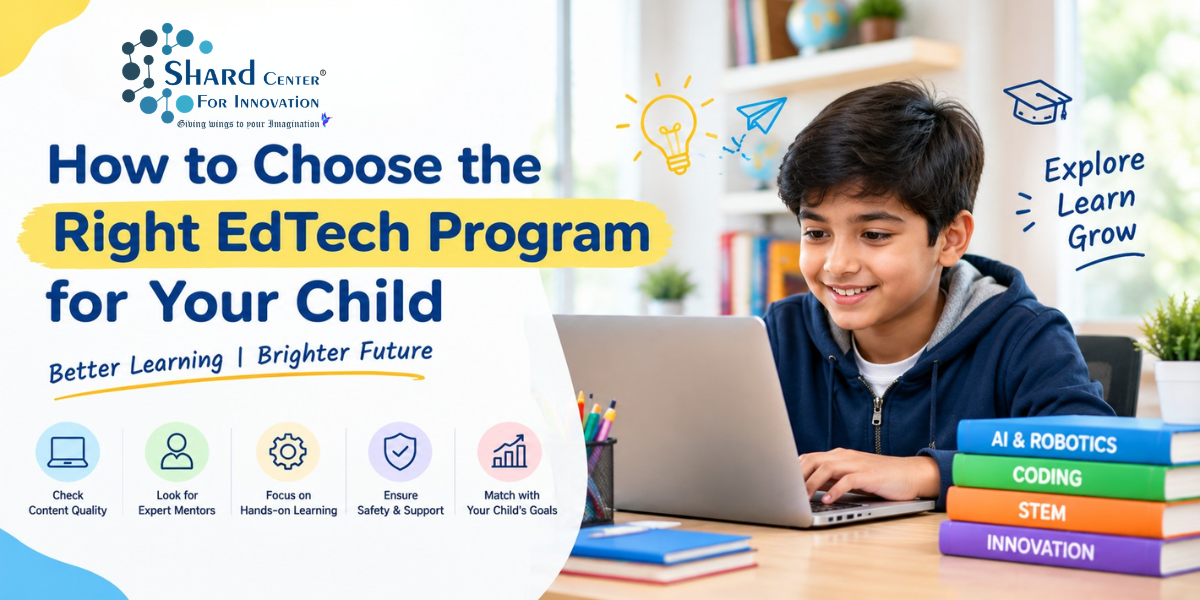
Understanding EdTech can be challenging—there are thousands of apps, platforms, and programs that promise to transform your child’s future. Some offer excellent learning experiences, while others may feel like “babysitting in disguise,” keeping children occupied without providing meaningful educational value. So, how to choose an EdTech program that genuinely supports your child’s learning? Parents can start by comparing different types of EdTech offerings based on the quality of content, expert guidance, hands-on activities, age-appropriate learning, and the skills children are expected to develop.
This practical guide helps you choose EdTech that actually contributes to your child’s learning and growth.
(This article is part of our complete guide: EdTech in India: The Complete Guide to Education Technology
Start With Your Child, Not the Product
The most important step is to know your child’s individual requirements.
Question yourself:
•What is the goal behind investing in the product? Does your child require support with school subjects or require help with building specific skills such as coding? Is support required with exam preparation? Different goals require different programs.
•What does my child enjoy? The product utilized depends upon your child’s individual personality and his or her likes and dislikes.
•What's missing? How could an offering cater to a gap in your child’s understanding that is not being fulfilled elsewhere?
Respond to your child’s individual requirements rather than being influenced by the most marketed offerings.
The Key Questions to Ask
By asking key questions before availing a product, parents can ensure that their child’s learning is maximized:
1. Does It Build Real Skills and Understanding?
This is the most important question. Does your child build genuine skills and understanding through the product or just passively consume the contents? Programs where the child builds skills by actively solving problems are much better than ones where the child just watches videos and types the answers.
2. Is It Active or Passive?
Is your child actively engaged with the content or merely consuming videos without any hands-on learning? Learning skills such as robotics or coding require actively absorbing the content and practicing it. Make sure that your child gets to practice their learning rather than just consume the content.
3. Who Teaches It, and How Good Are They?
Good quality of teaching is required for any successful program. Make sure that a program's instructors are qualified, experienced, and good with teaching children. A brilliant mentor can truly transform a student’s learning, and good quality of teaching is relevant for even tech-enabled learning.
4. Is It Age-Appropriate and the Right Level?
Good programs match children’s age and learning ability. Most good programs are adaptive and adjust to a child’s level of understanding.
5. Does It Balance Screen Time Well?
Choose a program that involves reasonable screentime for young children. Digital learning should be blended with hands-on offline activity. Offerings that involve children building real things offer a better learning experience.
6. Is It Transparent and Trustworthy?
Look past the marketing and aggressive sales tactics to consider programs that are clear about their offerings, costs, and results.
Prioritize Hands-On, Skill-Building Programmes
Hands-on programs are beneficial for building real-world skills in coding, robotics, AI and STEM. Programs that can transform virtual learning into offline building allow real skills to be developed.
This is the philosophy behind SHARD Center for Innovation, whose STEM and skill-development programmes combine technology with genuine hands-on building and expert mentorship. If you're considering a skills program, you can explore SCIL's courses or book through admissions to see the hands-on approach for yourself.
Try Before You Commit
Try to consider products where you can try before committing to it, through free trials, demo classes, and trial periods. This matters more than merely following reviews or brochures. Watch your child’s response and learning during the trial period, and then decide to go ahead or not.
The Key Takeaway
Choosing the right EdTech programs involves being responsive to your child’s real needs and judging the program through a broad criterion, which includes the quality of teaching, age appropriateness, level of engagement, whether it is active or passive, screen time, and program transparency. Programs that are hands-on and can combine virtual learning and offline engagement offer the best learning curve for children.
Frequently Asked Questions (FAQs)
Q1: How do I choose the right EdTech program for my child?
Ans: Respond to your child’s genuine needs and interests and then evaluate the program based upon how engaging it is, the quality of teaching, the suitability of the level of teaching, screen time, and transparency. Try the program for a while before purchasing it.
Q2: Are hands-on EdTech programs better for kids?
Ans: For skill-building like coding, robotics, and STEM, hands-on programs offer many advantages, as children learn much better by creating and building rather than watching videos. Hands-on learning is generally much better for children than less engaging products.
Q3. Is every EdTech program suitable for children?
Ans: No. Different programs are designed for different age groups, skill levels, and learning objectives. Parents should check whether the curriculum is age-appropriate and engaging before enrolling their child.
Q4. How can I tell if an EdTech program offers genuine learning?
Ans: Look for clear learning objectives, structured lessons, practical projects, assessments, mentor interaction, and evidence of what students will be able to create or understand after completing the program.
Q5. Are hands-on projects important in an EdTech program?
Ans:Yes. Hands-on projects can help children apply concepts instead of only watching videos or attending lectures. This can be especially useful for subjects such as AI, coding, robotics, IoT, and STEM.
Q6. Should parents choose live classes or recorded courses?
Ans: It depends on the child’s learning style and needs. Live classes can provide real-time interaction and mentor support, while recorded courses can offer greater flexibility and allow children to learn at their own pace.
Q7. How important is the teacher or mentor in an EdTech program?
Ans: Mentor quality is an important factor. Parents should check whether instructors have relevant subject knowledge and whether students have opportunities to ask questions and receive feedback.
Q8. How can parents avoid “babysitting in disguise” EdTech programs?
Ans: Check whether the program has a clear educational structure rather than simply providing screen-time activities. Look for measurable learning outcomes, meaningful projects, regular feedback, and opportunities for interaction.
Q9. What role does safety play when selecting an EdTech program?
Ans: Safety should be considered alongside educational quality. Parents should review privacy practices, communication channels, online interaction policies, and how the program handles children’s information.
Q10. How can parents know whether an EdTech program is worth the investment?
Ans: Compare the program's curriculum, teaching support, practical activities, duration, outcomes, and overall cost. Reviews and demonstrations can provide additional information, but parents should also evaluate whether the program fits their child’s specific learning goals.