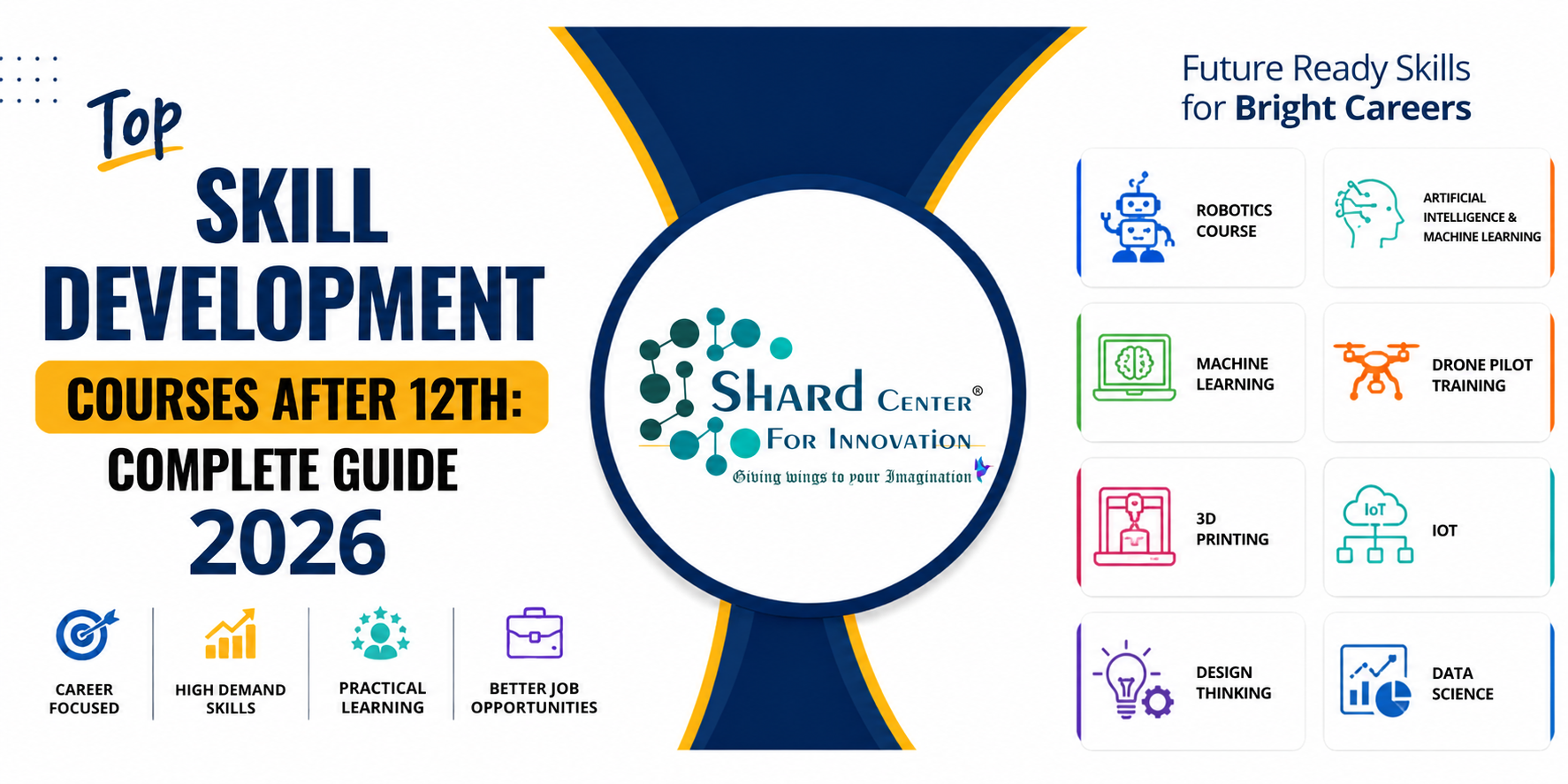
Finishing Class 12 used to come with a simple script: pick a stream, get a degree, get a job. In 2026, that script is broken. A degree alone no longer guarantees employability, and employers everywhere are asking a sharper question, not "what did you study?" but "what can you actually do?"
That shift is why skill development courses have become one of the smartest moves a student can make after 12th. Whether taken alongside a degree or as a direct route into a career, the right skill-based course can set you apart in a crowded market. This guide walks you through why these courses matter, which ones carry the most career potential in 2026, how to choose well, and how to turn training into a real job.
What "Skill Development" Actually Means
Let's clear up the term first. Skill development courses are focused, practical programmes that teach you to do something specific and valuable, rather than only learn about it in theory. Think coding an AI model, piloting a drone, designing in 3D, or analysing data, hands-on abilities you can demonstrate and get paid for.
They differ from traditional degrees in three important ways. They're shorter, often weeks or months rather than years. They're practical, built around projects rather than exams. And they're current, updated to match what industry actually needs right now. In a job market changing this fast, that combination is powerful.

Why This Matters More Than Ever in 2026
The urgency isn't hype, it's in the data. The World Economic Forum's Future of Jobs Report 2025 found that around 39% of workers' existing skills will be transformed or outdated between 2025 and 2030, and that 86% of employers expect AI and related technologies to reshape their business by 2030. Skills, not just degrees, are becoming the currency of the job market. We explore this fully in Why Skill Development Matters After 12th.
If you'd like a straight, honest sense of how a dedicated skills institute approaches this, it's worth understanding why SHARD Center for Innovation built its entire model around experiential, project-based learning aligned to NEP 2020, rather than the lecture-and-exam format most students are leaving behind.
The Big Question: Degree, Skills, or Both?
Many students and parents treat this as either/or. It usually isn't. Here's the honest breakdown of the three realistic paths.
Degree plus skills (the strongest option for most). You pursue your BTech, BSc, BCom or BA, and add focused skill courses alongside. The degree gives you the credential; the skills give you the edge that actually gets you hired. For most students, this combination beats either alone.
Skills-first, then earn. For students who want to enter the workforce quickly, or who learn better by doing than by sitting exams, a strong skill-based route can lead to earning sooner, sometimes while studying further part-time.
Degree alone. Still fine for some regulated professions (medicine, law, core engineering roles). But for the fast-growing technology economy, a degree without demonstrable skills is an increasingly risky bet.
There's no single right answer, but for most students in 2026, ignoring skills entirely is the one clearly wrong choice.
The Courses Worth Your Attention
So which skills actually pay off? Here's an overview of the highest-potential areas, each explored in depth in its own guide.
Artificial Intelligence and Machine Learning
If you learn one thing after 12th, this has the strongest case. AI is reshaping every industry, and people who can build and work with it are among the most sought-after globally. An AI course or a machine learning course takes you from "what is AI?" to building real, working models. We cover this and other high-potential fields in Technology Courses with High Career Potential.
Robotics
Robotics combines mechanics, electronics, and coding into one hands-on discipline, and it's transforming manufacturing, healthcare, and logistics. A robotics course is also one of the best ways to build genuine problem-solving ability, because a robot either works or it doesn't.
Data Science
Data is the raw material of modern business, and people who can turn it into decisions are consistently among the highest paid in tech. A data science course builds skills in Python, statistics, and machine learning that apply across virtually every sector.
Drone Technology
One of the fastest-emerging fields, with applications in mapping, agriculture, surveillance, and logistics. A drone pilot training course opens a niche but rapidly growing career path, and India's drone sector is expanding quickly.
3D Printing and IoT
3D printing is changing how products are designed and made, while IoT connects the physical and digital worlds into smart systems. Both are strong, future-facing additions to any skill portfolio.
For a ranked run-through of the strongest options, see Top 10 Skill Development Courses After 12th
What About Certifications?
A recurring worry: are these courses "recognized"? It's a fair question. The honest answer is that in technology fields, a verifiable certificate backed by a real portfolio of projects often carries more weight with employers than the certificate alone. What convinces a hiring manager is proof you can do the work. We break down what makes a certification genuinely worth having in certification programs for students.
Choosing the Right Course (Without Regretting It)
With so many options, choosing well matters as much as choosing at all. In brief, the strongest choices are hands-on rather than video-only, taught by people with real industry experience, structured as a genuine progression, and matched to your own interests rather than just the current hype. A course you're genuinely curious about is a course you'll finish. We give you a full framework in How to Choose the Right Skill Development Course.
Two Routes: Short Courses or Full-Time
One practical decision worth understanding early is intensity. Broadly, there are two formats.
Short courses for professionals are focused and fast, ideal if you want to add a specific skill alongside a degree or test a field before committing. Full-time courses for professionals go deeper and build career-ready depth, better suited to students ready to commit seriously to a technology path.
And if you're still in school and want to start early, the Young Scientist Programme is designed to build these foundations well before Class 12, so you arrive at this decision already ahead.
Where It All Leads: Careers
None of this matters without the payoff, real career opportunities. The good news is that skill-based training leads directly into some of the fastest-growing, best-paid roles of the decade: AI engineer, data scientist, robotics engineer, drone specialist, and more. Crucially, many of the jobs today's students will hold don't exist yet, which is exactly why building adaptable, foundational skills beats chasing one narrow qualification. We map the full landscape in Career Opportunities After Skill-Based Training .
The Skills Every Employer Now Expects
Beyond any specific technology, there's a set of underlying skills that employers in 2026 value across every field, and good skill development builds them almost as a by-product.
The first is problem-solving. Every real project, a robot that won't turn, a model that keeps guessing wrong, forces you to diagnose, test, and fix. That habit transfers to any job and any challenge. The second is adaptability, the ability to pick up new tools quickly, which matters enormously when the tools themselves keep changing. The third is communication and collaboration, because almost all real work happens in teams, and being able to explain your thinking is as valuable as the thinking itself. And the fourth is initiative, the willingness to build things beyond what's strictly required, which is precisely what makes a young candidate stand out.
These aren't taught in a lecture. They're built by doing, which is exactly why hands-on, project-based skill development is so powerful. You come away not just with a technical skill, but with the deeper professional habits that make that skill employable.
Common Myths About Skill Courses, Cleared Up
A few misconceptions hold students back from making a smart choice, so let's address them honestly.
"Skill courses are only for people who aren't academic." The opposite is often true. Some of the most academically capable students use skill courses to turn theoretical knowledge into practical, employable ability, getting far more out of both.
"I need to finish my degree first, then think about skills." Waiting is usually a mistake. The strongest position is building skills alongside your degree, so you graduate with both the credential and a portfolio, rather than starting from zero afterwards.
"Online means low quality." Not necessarily. The format matters less than whether the course is hands-on, mentored, and project-based. A well-designed hybrid or online course with real projects can beat a mediocre in-person one.
"One course will set me up for life." No single course does that. Skills need updating, and careers are built over years. A good first course is a starting point and a habit-former, not a finish line.
A Word for Parents
If you're a parent reading this, your instinct to value your child's degree is not wrong, education matters. But the ground has shifted since many of us made our own career choices. The safest path today isn't a degree or skills; it's ensuring your child has both. Supporting a focused skill course alongside their studies isn't a distraction from their education, it's an investment in their employability. The students who thrive in the coming decade will be the ones who can demonstrate ability, not just qualifications, and that's something you can actively help them build now.
A Realistic Word of Caution
Skill courses are powerful, but they aren't magic. A certificate you never apply won't help; the value comes from actually building things and creating a portfolio. Cheap, purely video-based courses with no projects and no mentorship rarely deliver. And no single course guarantees a job, what it gives you is a genuine, demonstrable edge. Go in with that realistic mindset and the returns can be significant.
How Long Does It Take to Become Job-Ready?
A fair question every student asks: how quickly can this actually lead somewhere? The honest answer is that it depends on the field and the depth you go to, but the timelines are far shorter than a full degree.
A focused short course can give you a usable, demonstrable skill in a matter of weeks to a few months, enough to start building a portfolio and taking on small projects or freelance work. Reaching genuine job-ready depth in a technical field like AI, data science, or robotics typically takes several months of consistent, hands-on practice, plus the projects that prove it. And becoming genuinely strong, the level that commands the better salaries, usually takes a year or two of continued building and learning on the job.
The encouraging part is that you don't have to wait until the end to benefit. Even a few months in, a solid portfolio project can open doors to internships, freelance gigs, or entry roles that themselves accelerate your growth. The key is to start, build consistently, and keep going, rather than waiting for a mythical moment of being "fully ready."
Skill Development Is a Habit, Not a One-Time Event
Perhaps the most important mindset shift is this: in a world where roughly two-fifths of skills are changing within five years, learning can't be something you finish. The professionals who thrive treat skill-building as ongoing, a course this year, a new tool next year, a fresh project always on the go.
Viewed this way, your first course after 12th isn't just about the specific skill it teaches. It's about building the habit of learning practical skills and the confidence that you can. That habit, more than any single certificate, is what will carry you through a career spanning technologies that haven't even been invented yet.
How SHARD Center for Innovation Fits In
SHARD Center for Innovation , part of the Jalsa Ventures Group, was built specifically for this new reality. Its courses in AI, machine learning, robotics, drones, 3D printing, IoT, and data science are hands-on, project-based, taught by industry professionals, and aligned with NEP 2020, so students learn by building, not just watching.
Whether you're a student wanting to add skills alongside a degree, a school student ready to start early, or a young professional looking to upskill fast, there's a genuine pathway here. If you're ready to explore, the simplest next step is to look at SCIL's admissions and find the programme that fits where you are right now.
The Bottom Line
After 12th, the smartest move in 2026 isn't choosing between a degree and skills, it's making sure you build real, demonstrable skills either way. The technology economy rewards people who can do, not just people who can recite. Pick a field you're genuinely curious about, choose a hands-on course that builds a real portfolio, and start early.
Your future won't be decided by your marksheet alone. It'll be shaped by what you can build. Start building.
FAQ (Frequently Asked Questions)
Q1: Which skill development course is best after 12th?
Ans. It depends on your interests, but AI, machine learning, data science, and robotics currently have the strongest career potential. The best course is one that's hands-on, project-based, and in a field you're genuinely curious about.
Q2: Can I do a skill development course along with my degree?
Ans. Yes, and for most students this is the strongest option. A degree provides the credential while skill courses provide the practical edge that actually gets you hired.
Q3: Do skill development courses guarantee a job?
Ans. No course guarantees a job, but skill-based training with a real project portfolio gives you a genuine, demonstrable advantage in a competitive market.
Q4: Are short courses or full-time courses better after 12th?
Ans. Short courses suit adding a specific skill alongside a degree or testing a field. Full-time courses build deeper, career-ready expertise for students ready to commit to a technology path.
Q5. Which course has the best career graph?
Ans.AI, data science, machine learning, robotics, drone technology, IoT, etc., have the best career graphs among all.
Q6. Does it have practical implementation?
Ans. Yes, most of the courses include live projects and assignments, workshops, coding sessions, etc.
Q7. How to choose the best course after 12th?
Ans. The choice of the course depends on students’ interest, scope, demand in the market, curriculum, practical training, etc.
Q8. Are these courses available for science, commerce, and Arts students?
Ans. We have courses for all streams like Science, Commerce, Arts, etc.
Q9. Does the course provide any certification?
Ans. Yes, most of the reputed institutes provide certificates after course completion, which add up to your resume and show your potential employers that you know the stuff.
Q10. What is the importance of skill development courses after 12th in 2026?
Ans. In 2026, technology will govern each and every field and so students need these skill development courses to get an edge over the other students and be job-ready in this competitive world.